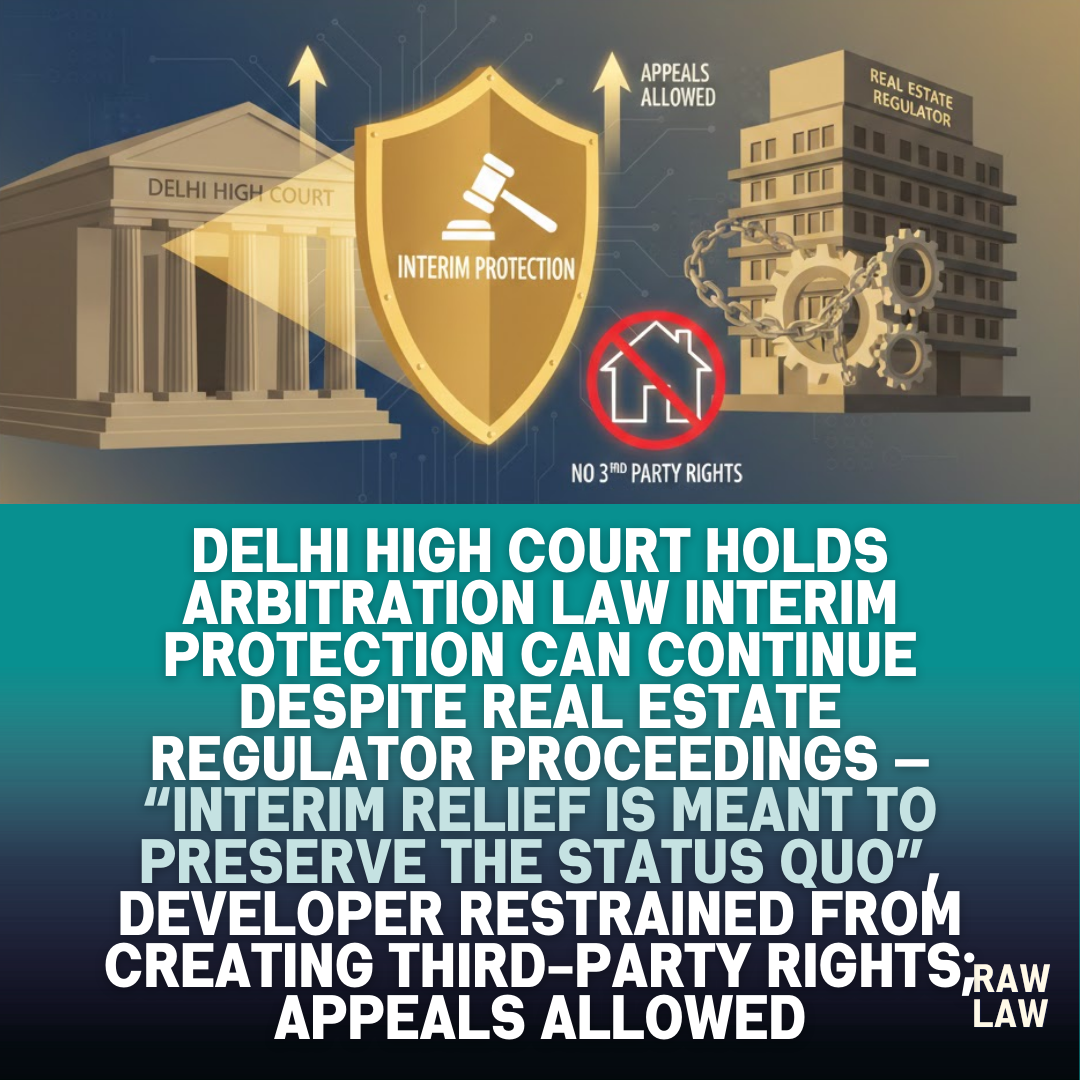
Delhi High Court holds arbitration law interim protection can continue despite real estate regulator proceedings — “Interim relief is meant to preserve the status quo”, developer restrained from creating third-party rights; appeals allowed

1. Court’s decision
A Division Bench of the Delhi High Court set aside the dismissal of multiple applications seeking interim measures under the arbitration law, holding that buyers of commercial units were not barred from seeking Section 9 interim protection merely because they had already pursued remedies before the real estate regulator under the Real Estate (Regulation and Development) Act. The Court found that the lower commercial courts had wrongly invoked the doctrine of election without comparing the reliefs sought in the two forums, and granted protective injunctions to preserve the subject matter until arbitration commences, restraining the developer from creating third-party rights (including leasing) and directing status quo over the units.
2. Facts
The dispute arose from commercial unit allotments in a project located on the Dwarka Expressway, Gurugram, where buyers had entered into a builder-buyer arrangement and a memorandum of understanding promising assured monthly returns and eventual possession. From 2019 onwards, the developer allegedly stopped assured returns, issued notices raising vague dues coupled with cancellation threats, and delayed construction and possession. The buyers approached the economic offences wing leading to a criminal case, and also filed complaints before the Haryana real estate regulator, which passed orders granting directions including setting aside cancellation/demand notices, payment of assured returns with interest, and possession-related directions. Subsequent communications from the developer allegedly raised fresh “fit-out” and other demands and warned of cancellation, triggering the buyers’ request for interim restraint pending arbitration.
3. Issues
The High Court framed the core maintainability question around whether Section 9 interim measures were (i) distinct from the reliefs sought and granted by the real estate regulator, and (ii) whether the commercial courts failed to appreciate the limited, protective nature of Section 9 jurisdiction meant to preserve the arbitral process. A connected issue arose in one matter where a commercial court dismissed the application on a hyper-technical reading of territorial jurisdiction by differentiating between “Delhi” and “New Delhi” as the seat of arbitration, rather than returning the petition for presentation before the proper court.
4. Petitioner’s arguments
The buyers argued that the cause of action for Section 9 relief was not the same as the regulatory adjudication before the real estate authority. They maintained that the interim threat—leasing out units, creating third-party interests, and cancelling allotments unless unexplained charges were paid—required immediate protective orders so arbitration would not be rendered meaningless. They relied on the statutory structure indicating the real estate law operates in addition to other remedies, and stressed that the commercial courts had dismissed their requests without assessing basic Section 9 parameters such as preservation of the subject matter and irreparable harm. In essence, they contended that invoking the real estate regulator did not amount to abandoning arbitration-based interim protection.
5. Respondent’s arguments
The developer resisted the interim measures by asserting that the buyers had already obtained adjudication before the real estate regulator and were, therefore, barred from seeking parallel relief under Section 9 based on the doctrine of election. It was argued that the Section 9 applications were essentially injunction suits in another form and that the grievances had been heard and decided by the regulator’s orders. The developer also advanced contractual submissions that the memorandum of understanding controlled over the builder-buyer arrangement, and claimed that possession in such projects could be symbolic or proportionate rather than tied to a specifically identified space. In support of its position, it relied on asserted leasing arrangements and demanded “fit-out” and other charges as preconditions for possession-related steps.
6. Analysis of the law
The judgment treats Section 9 interim measures as a court’s supportive tool to preserve the arbitral process, not a mechanism to decide merits. The Court contrasted the regulatory forum’s determinative role (granting directions on assured returns, possession, and contractual compliance within the regulator’s mandate) with the interim court’s narrowly tailored role of preserving property and preventing irreversible prejudice pending arbitration. It also examined the doctrine of election as explained in Supreme Court precedent: the doctrine applies only when truly concurrent and inconsistent remedies for the same relief exist, and not when the ambit and scope of two remedies are materially different. The Court criticized lower courts for applying the doctrine mechanically without analysing the character and scope of the two proceedings.
7. Precedent analysis
To explain when election applies, the Court relied on authorities clarifying that election requires multiple remedies, inconsistency between them, and an actual choice; if any element is missing, the doctrine fails. It also relied on jurisprudence on interim injunctions and the limited nature of interlocutory protection, emphasising that interim relief is ancillary—meant to preserve the status quo until final adjudication. The Court cited precedent recognising that, without interim protection, arbitral outcomes can become illusory if property is alienated or encumbered. It invoked classic injunction principles of prima facie case, balance of convenience, and irreparable harm, adapted to the arbitration context, to justify why courts must intervene in real estate disputes where third-party interests can permanently alter the subject matter.
8. Court’s reasoning
The Court held that the commercial courts erred by dismissing Section 9 petitions without comparing the reliefs sought before the real estate regulator and those sought under arbitration law; without such analysis, it was legally impermissible to conclude that Section 9 relief was barred. It found the Section 9 reliefs to be preservative and ancillary—focused on restraining leasing, cancellation, and creation of third-party rights pending arbitration—rather than a challenge to the regulator’s orders. The Court also recorded that a local commissioner’s inspection showed ongoing construction/renovation and that the premises were not fit for commercial use, casting doubt on the developer’s narrative of leasing and strengthening the need for interim restraint.
9. Conclusion
Allowing the appeals, the Delhi High Court granted interim protection in substance: it restrained the developer and its representatives from creating third-party interests, “including… leasing out the property” until commencement of arbitration; directed status quo regarding the units under the contractual documents; and clarified that once an arbitral tribunal is constituted, either party may seek modification of the interim protection before the tribunal. The ruling reaffirms that the presence of real estate regulator proceedings does not automatically extinguish the court’s power to secure the subject matter under Section 9, especially where the interim threat arises after regulatory orders and risks defeating arbitration.
10. Implications
This decision is significant for real estate arbitration, especially in commercial unit disputes involving assured returns, possession delays, and coercive cancellation threats. It signals that courts will not permit developers to use the doctrine of election as a blunt instrument to defeat interim protection, particularly where regulatory relief and Section 9 relief serve different purposes. For buyers, the judgment strengthens the strategy of seeking Section 9 interim injunctions to prevent leasing, alienation, or cancellation while arbitration is initiated, even if real estate regulator orders already exist. For developers, it underscores that post-order conduct—fresh demands, threatened cancellations, and creation of third-party interests—can invite immediate court restraint, and that interim compliance directions (like deposit of lease amounts) will matter in equitable assessment.
Case-law references (as discussed and applied)
- Adhunik Steels Ltd. v. Orissa Manganese and Minerals (P) Ltd. (2007)
- Holding: Interim relief cannot be granted in vacuum; it is ancillary to a substantive cause of action and must follow settled principles.
- Application: Used to reinforce that Section 9 is protective and discretionary, guided by injunction standards.
- Wander Ltd. v. Antox India (P) Ltd. (1990)
- Holding: Interlocutory injunctions are discretionary; courts weigh balance of convenience and irreparable harm when rights are uncertain.
- Application: Supported the Court’s approach that interim restraint preserves the status quo until rights are finally adjudicated.
- Transcore v. Union of India (2008) and Mathew Varghese v. M. Amritha Kumar (2014)
- Holding: Doctrine of election requires multiple remedies, inconsistency, and a choice; statutes may provide remedies “in addition to” others.
- Application: Helped the Court reject mechanical election arguments where remedies are not identical or truly concurrent.
- A.P. State Financial Corpn. v. Gar Re-Rolling Mills (1994)
- Holding: Election does not apply where remedies differ materially in scope and ambit.
- Application: Used to stress that regulatory adjudication and Section 9 protective relief are not the same remedy.
- Sir Ganga Ram and Sons v. Punjab State Electricity Board (1973)
- Holding: Courts can issue interim injunctions to preserve property so that arbitration does not become meaningless.
- Application: Directly supported interim protection to prevent disposal/alienation pending arbitration.
FAQs
1. Can a buyer seek Section 9 interim injunction after approaching the real estate regulator?
Yes. The Delhi High Court held that interim relief under Section 9 can still be maintainable if it is distinct and protective, aimed at preserving the property and preventing third-party rights, rather than duplicating the regulator’s determinative relief.
2. When does the doctrine of election bar parallel remedies in real estate disputes?
Only when two remedies are truly concurrent, inconsistent, and sought for the same relief. If the scope and purpose differ—such as regulatory adjudication versus interim protection pending arbitration—the doctrine of election should not be applied mechanically.
3. What interim protections can courts grant under Section 9 in real estate arbitration matters?
Courts can restrain creation of third-party interests (including leasing), prevent cancellation or coercive actions, and order status quo to preserve the subject matter until arbitration begins, with liberty to seek modification before the arbitral tribunal once constituted.