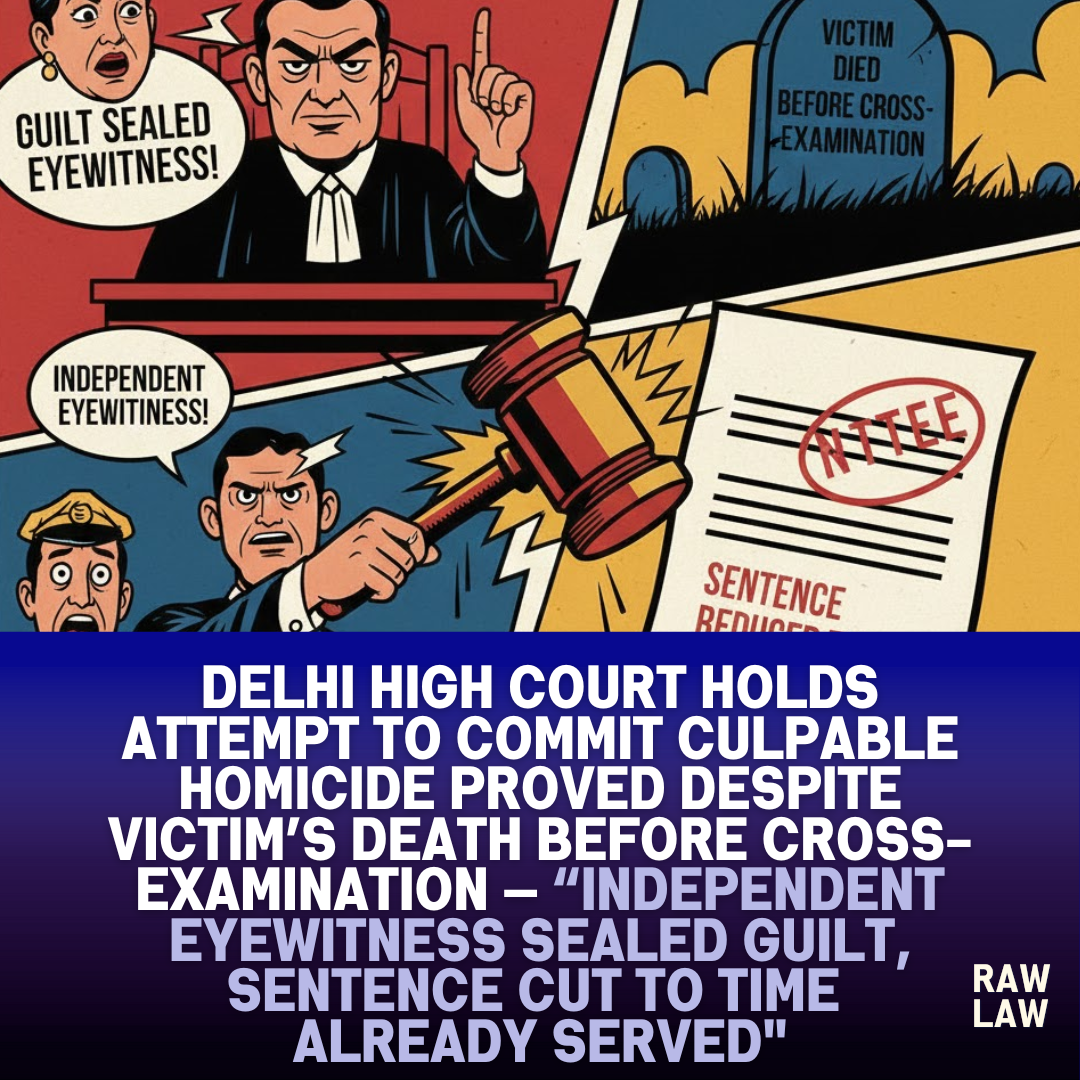
Delhi High Court holds attempt to commit culpable homicide proved despite victim’s death before cross-examination — “Independent eyewitness sealed guilt, sentence cut to time already served”

1. Court’s decision
The Delhi High Court upheld the conviction for attempt to commit culpable homicide, rejecting the argument that the prosecution case collapses because the injured victim could not be cross-examined after his examination-in-chief. The Court found the core incident reliably proved through an independent eyewitness who saw the assault, helped apprehend the accused at the spot, and whose testimony remained unshaken in cross-examination. While sustaining guilt, the Court substantially modified sentencing, reducing the imprisonment to the period already undergone, citing the passage of time since the 2013 incident, the accused’s youth at the time, and satisfactory jail conduct.
2. Facts
The case arose from a 2013 incident at a fish market area in Kishan Garh, Delhi, where a quarrel broke out between the accused and the victim around noon. The prosecution alleged that after an initial altercation, the accused returned about half an hour later and struck the victim with a wooden stick, causing head injuries. The accused was allegedly caught at the spot by an independent witness and others, after which police arrived, arrested him, and recovered the weapon. Medical evidence from hospital doctors recorded blunt injuries, later opined to be grievous in nature.
3. Issues
The High Court essentially dealt with two linked issues: first, whether a conviction can safely stand when the injured complainant’s cross-examination never happened because he died during trial; and second, whether the sentence imposed for attempt to commit culpable homicide warranted interference considering the time elapsed, the accused’s personal circumstances, and the extent of incarceration already undergone. These questions mattered because criminal adjudication demands both reliability of proof and proportionality in punishment—especially where a serious assault is alleged but the procedural chance to test the victim’s testimony is lost due to death.
4. Petitioner’s arguments
The appellant argued that since the complainant/victim was not offered for cross-examination, his deposition could not be read against the accused, and therefore the prosecution failed to prove guilt beyond reasonable doubt. In the alternative, the appellant sought reduction of sentence to the period already undergone, urging that the case justified a pragmatic approach on sentencing because of the passage of years and the appellant’s circumstances. The appellant relied on a Supreme Court decision to support the plea that, even if conviction is maintained, sentencing should account for custody served and the broader “ends of justice.”
5. Respondent’s arguments
The State supported the conviction by pointing to the overall evidentiary chain: an independent eyewitness account identifying the assault with a wooden stick, apprehension of the accused immediately after the incident, recovery of the weapon, and medical corroboration showing grievous blunt injuries. The prosecution position, as reflected in the record, was that even if the injured victim’s cross-examination could not take place due to his death, the case did not rest solely on that testimony. Instead, the State emphasized that the independent witness’s narrative and contemporaneous investigation details were sufficient to sustain guilt for attempt to commit culpable homicide.
6. Analysis of the law
In criminal trials, the right to cross-examine is a vital safeguard; ordinarily, a witness’s testimony is tested through cross-examination to assess reliability. However, the law also recognizes that if a witness becomes unavailable due to death, the court must evaluate the remaining evidence and determine whether the prosecution still proves guilt beyond reasonable doubt. In offences like attempt to commit culpable homicide, courts look for intent/knowledge inferred from the weapon used, the body part targeted, and severity of injuries, along with credible direct evidence. Sentencing, separately, is guided by proportionality and individualized assessment—age, background, custody undergone, and delay can weigh at appellate stage.
7. Precedent analysis
The High Court referred to the Supreme Court’s decision in Sonadhar v. State of Chhattisgarh to inform its approach on sentence reduction. The relevance of that precedent lay not in diluting the evidentiary threshold for conviction, but in shaping the sentencing outcome where a long passage of time, personal circumstances, and time already served make continued incarceration potentially excessive. The Court treated Sonadhar as supporting a “ends of justice” approach, allowing modification of sentence even while maintaining conviction, particularly when the accused has already undergone a significant portion of the awarded imprisonment and has satisfactory jail conduct.
8. Court’s reasoning
On the conviction, the Court placed decisive weight on the independent eyewitness who not only saw the quarrel unfold and the assault on the head, but also helped catch the accused when he tried to flee. The Court noted that the defence failed to disprove the witness’s presence at the spot and could not extract anything in cross-examination to discredit him. Coupled with medical documentation and opinion that the injuries were grievous and blunt, the Court held the prosecution case remained intact even if the victim’s testimony could not be fully tested due to his death. Thus, the conviction for attempt to commit culpable homicide was upheld.
9. Conclusion
The High Court struck a balanced outcome: it refused to overturn a conviction supported by an unimpeached independent eyewitness and medical corroboration, but it also recognized that sentencing is not mechanical. The judgment underscores that criminal liability can be sustained on reliable non-victim testimony when the victim becomes unavailable, provided the remaining evidence clears the standard of proof. At the same time, it reflects appellate sensitivity to delay and rehabilitative considerations by reducing the sentence to the period already undergone, thereby bringing finality to a prosecution stemming from a 2013 incident.
10. Implications
This ruling is significant for attempt to commit culpable homicide trials where the injured witness dies before cross-examination. It signals that courts will not automatically treat the prosecution as defeated if there is strong independent eyewitness evidence, prompt apprehension, recovery of weapon, and medical corroboration. For practitioners, the decision highlights the strategic importance of testing independent witnesses rigorously, because an unshaken neutral account can carry the case even without the victim’s cross-examination. On sentencing, it reinforces that prolonged litigation, youth at the time of offence, custody served, remission, and satisfactory conduct can justify reducing imprisonment to time already undergone.
Case law references
1) Supreme Court: Sonadhar v. State of Chhattisgarh (2021 SCC OnLine SC 3683)
- Core holding (as relied upon): The decision is used to support a sentencing approach where the “ends of justice” may be met by reducing sentence, especially when significant custody has been served and other mitigating factors exist.
- How applied here: The High Court used Sonadhar to justify reducing the sentence to the period already undergone after considering the offence being from 2013, the long duration of proceedings, the appellant’s youth at the time, family responsibilities, remission, and satisfactory jail conduct—while leaving the conviction untouched.
FAQs
1) Can a conviction stand if the injured complainant dies before cross-examination?
Yes. If the complainant’s cross-examination becomes impossible due to death, a court can still uphold conviction if the remaining evidence—such as independent eyewitness testimony, medical records, and recovery/arrest circumstances—proves guilt beyond reasonable doubt.
2) What evidence is crucial for proving attempt to commit culpable homicide in an assault case?
Courts typically examine credible eyewitness proof, weapon used, the body part targeted (like the head), severity and nature of injuries, and medical corroboration. These factors help infer the required intent or knowledge for attempt to commit culpable homicide.
3) When will an appellate court reduce sentence to “period already undergone”?
Reduction may be granted when the offence is old, the accused has served a substantial part of the sentence, conduct in custody is satisfactory, and mitigating circumstances such as youth at the time and family responsibilities exist—provided the conviction is otherwise sustainable.