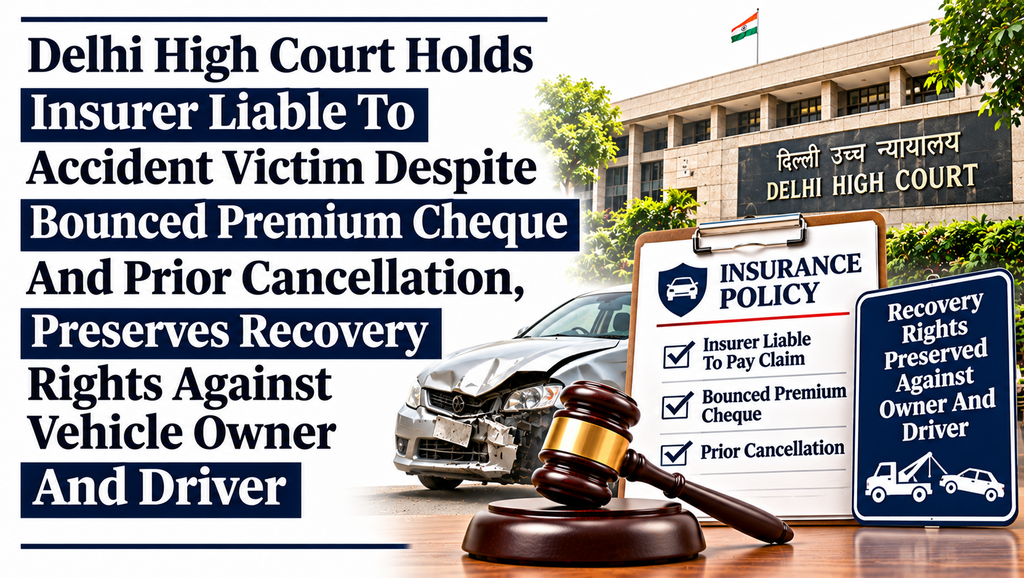
Delhi High Court Holds Insurer Liable To Accident Victim Despite Bounced Premium Cheque And Prior Cancellation, Preserves Recovery Rights Against Vehicle Owner And Driver

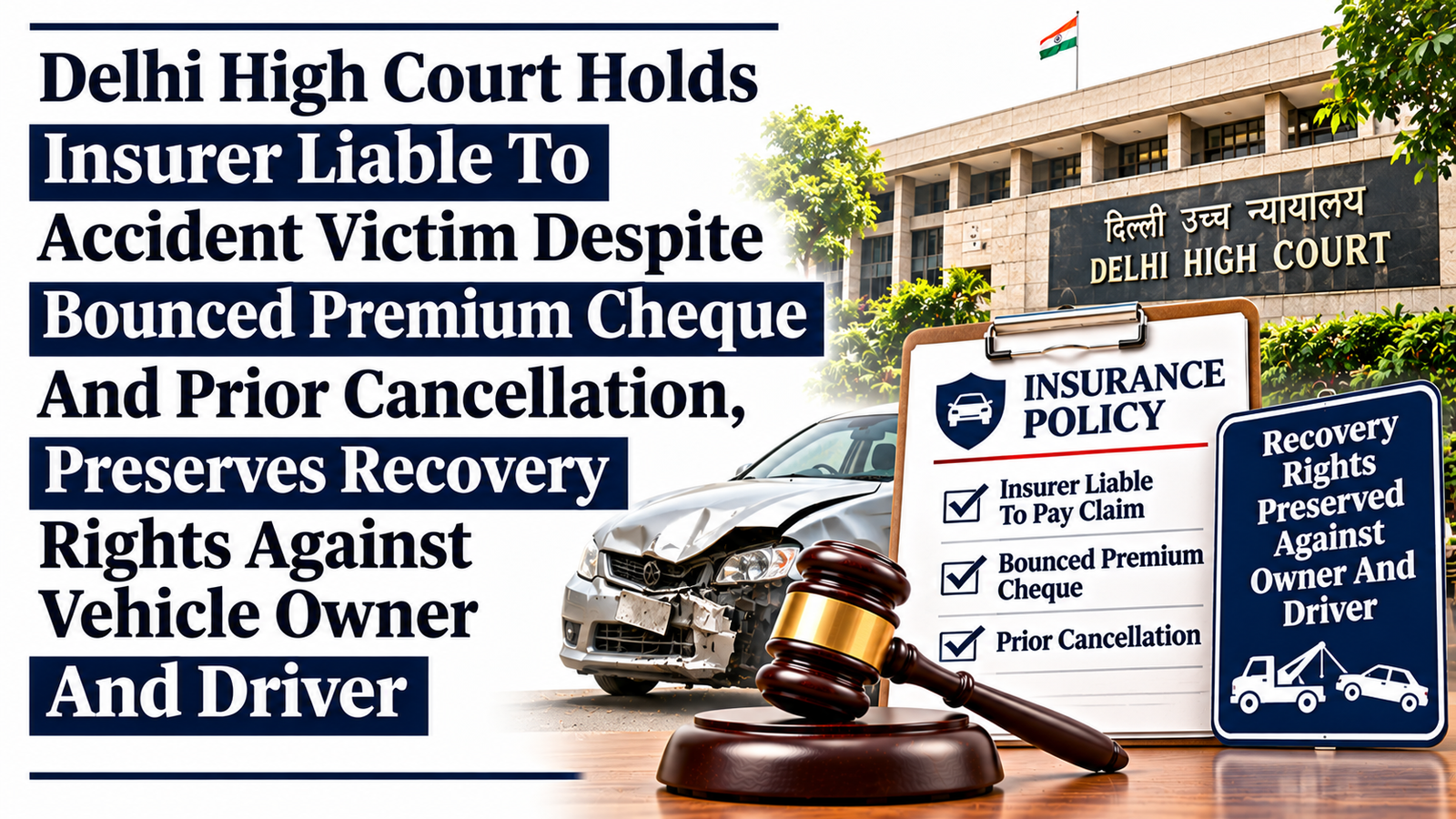
Delhi High Court Enhances Injured Cyclist’s Compensation To ₹10.28 Lakh, Rules Issued Insurance Certificate Triggers Third Party Protection Despite Unpaid Premium And Cancellation Before Accident
Facts
Sanjay, a municipal sanitation worker, was cycling to work on 10 October 2014 when a minibus struck him, causing serious injuries and permanent impairment of his left lower limb. The Motor Accident Claims Tribunal awarded ₹9.25 lakh with 9% annual interest and directed Oriental Insurance to pay, with recovery rights against the driver and owner. The insurer contested liability because the vehicle owner’s premium cheque had been dishonoured in January 2014, its policy cancelled, and notices dispatched to both the owner and transport authority about nine months before the accident. Sanjay filed a cross-appeal seeking higher compensation, particularly for functional disability and loss of amenities. Both appeals came before Justice Anish Dayal.
Issues
Whether an insurer that issued an insurance policy must satisfy a third-party motor accident award despite dishonour of the premium cheque and cancellation communicated before the accident; whether it can recover payment from the vehicle owner; how a cover note differs from a certificate of insurance; and whether the claimant’s disability and non-pecuniary losses justified enhancement.
Petitioner’s Arguments
Oriental Insurance argued that dishonour for insufficient funds meant no premium was received and the policy had been validly cancelled before the collision. The company proved its cancellation endorsement and January 2014 notifications to the insured and Regional Transport Office, relying on Section 64VB of the Insurance Act and Supreme Court decisions including Deddappa, Seema Malhotra and Laxmamma. It sought complete exoneration rather than an obligation to satisfy the award first and pursue recovery. The insurer maintained that a contract unsupported by premium should not impose continuing indemnity liability.
Respondent’s Arguments
Sanjay contended that issuance of a policy triggered statutory protection for third-party victims, regardless of subsequent non-payment of premium or cancellation. He supported the Tribunal’s pay-and-recover direction and relied on Inderjit Kaur and other motor accident authorities. On quantum, he sought recognition of 16% functional disability, corresponding to the medical certificate for his left leg, rather than the Tribunal’s 8% assessment. He stressed his inability to continue municipal work and sought higher compensation reflecting diminished earning capacity and daily living difficulties.
Analysis of the Law
The Court read Sections 145, 147 and 149 of the Motor Vehicles Act, 1988, as applicable to the 2014 accident, alongside Section 64VB of the Insurance Act and the Motor Vehicles Rules. An issued certificate or policy in prescribed Form 51 activates the insurer’s mandatory duty to satisfy third-party awards, notwithstanding contractual avoidance or cancellation. A Form 52 cover note ordinarily lasts sixty days; if a policy is not issued, the insurer must notify the registering authority within seven further days and, according to the Court, inform the insured. Following the 2019 amendment, the corresponding payment obligation appears in Section 150(1).
Precedent Analysis
Oriental Insurance v. Inderjit Kaur and New India Assurance v. Rula supported the protection of third parties despite unpaid premiums. Deddappa and United India Insurance v. Laxmamma illustrated cancellation and recovery issues; National Insurance v. Sunita Devi underscored the competing consequences of pre-accident cancellation. New India Assurance v. Kamla supported recovery from an insured after payment to victims. The Court also considered Section 65 of the Contract Act and restitution principles. For compensation, Raj Kumar v. Ajay Kumar required functional disability to be assessed by its actual impact on earning capacity, not mechanically equated with a limb-disability certificate.
Court’s Reasoning
Justice Anish Dayal found the insurer had issued a policy effective from 19 January 2014, so its statutory obligation to the injured cyclist survived the earlier dishonour and cancellation. Documentary proof of notices to the owner and RTO did not eliminate the protection arising from an issued policy. Nevertheless, because the owner never actually paid the premium, the insurer retained recovery rights, as the Tribunal had ordered. The Court formulated practical guideposts distinguishing temporary cover notes from final policies and identifying the insurer’s notification duties. On quantum, medical evidence supported a modest increase in functional disability from 8% to 10%, not the requested 16%; loss-of-amenities damages rose from ₹40,000 to ₹1 lakh.
Conclusion
The insurer’s challenge to liability failed and its right to recover payment from the owner and driver remained intact. Sanjay’s compensation increased by ₹1.03 lakh, from ₹9.25 lakh to ₹10.28 lakh, with interest retained at 9% per annum. Oriental Insurance must deposit the enhanced amount with interest from the claim petition’s filing date before the Tribunal within four weeks; it is to be released as a lump sum within two further weeks. The balance of the original award remains subject to existing disbursement directions. The decision reconciles third-party protection with insurers’ restitutionary remedies and gives operational guidance on motor insurance documentation.
Case: Oriental Insurance Co. Ltd. v. Sanjay & Ors. (connected cross-appeal)
Court: High Court of Delhi at New Delhi
Case Number: MAC.APP. 610/2018 and MAC.APP. 45/2019; 2026:DHC:9953
Judge: Justice Anish Dayal
Date: 6 November 2026 (reserved 29 September 2026)
Result: Insurer to pay and recover; compensation enhanced to ₹10.28 lakh with 9% interest.