

1. Court’s decision
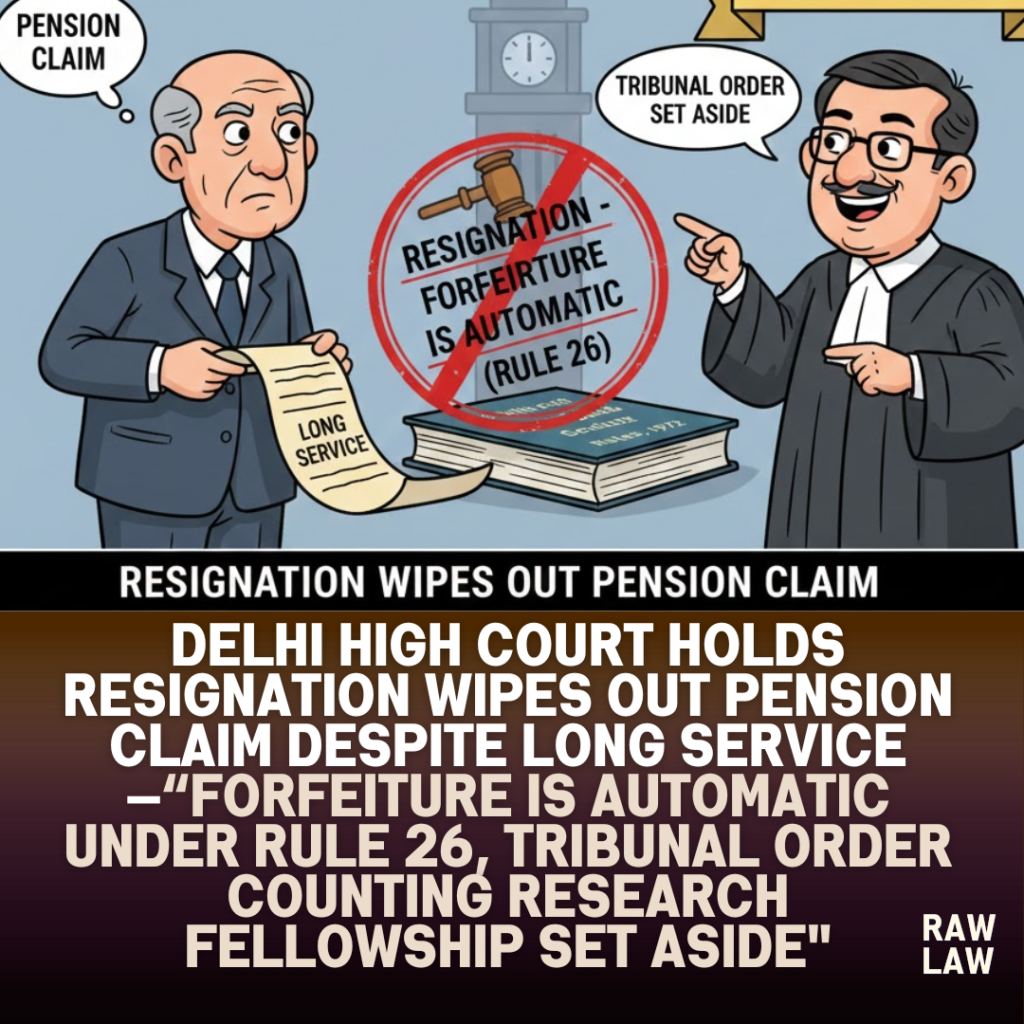
The Delhi High Court allowed the writ petition filed by a premier public medical institute and set aside two Central Administrative Tribunal orders that had directed pensionary benefits to a former employee. The High Court held that once the employee’s resignation was accepted, Rule 26(1) of the Central Civil Services (Pension) Rules, 1972 mandated forfeiture of past service, making any pension claim legally untenable unless the resignation is withdrawn in public interest. The Court also held that the employee’s earlier research fellowship under an external funding body could not be treated as qualifying service under the institute for pension computation.
2. Facts
The respondent first worked as a Senior Research Fellow from February 1979 to April 1983 on a research project sponsored by the Indian Council of Medical Research but implemented at the institute. She was then appointed as a Clinical Psychologist in April 1983. She availed various leaves between 1997 and 2002, which were regularised, but her last attendance was on 30 October 2002 after which she remained absent. The institute issued a memorandum directing her to report back and warning of disciplinary action. She then wrote seeking voluntary retirement and later sent a letter termed as resignation, asking acceptance retrospectively.
3. Issues
The High Court framed two principal issues: (i) whether the institute was justified in treating the employee’s communication dated 27 April 2003 as a resignation attracting forfeiture of past service under Rule 26(1), thereby disentitling her from pension; and (ii) whether the period from February 1979 to April 1983 spent as Senior Research Fellow could be counted as qualifying service for pension under Rule 13. A further practical issue ran through the case: whether the Tribunal could grant pension relief and bar recovery of notice pay when the employee’s exit was ultimately treated as resignation effective from the date last attended duty.
4. Petitioner’s arguments
The institute argued that the employee’s pension claim was barred at the threshold because she did not retire; she resigned, and resignation entails forfeiture of past service under Rule 26(1). It emphasized that after remaining absent from 30 October 2002 and being directed to rejoin, the employee chose not to return and instead sent a resignation letter seeking retrospective acceptance. Once accepted, the legal consequence of forfeiture followed automatically, making the debate on whether she completed twenty years of qualifying service irrelevant. The institute also contended that research fellowship service under the Indian Council of Medical Research was service under a distinct organisation and could not be counted for pension under the institute.
5. Respondent’s arguments
The employee maintained that her research fellowship period should be counted as qualifying service because the institute was the host institution and the fellowship paperwork indicated that host service rules applied. She relied on a Governing Body resolution and an Office Memorandum that, according to her, permitted counting research project service for pension. On the exit issue, she argued that she had applied for voluntary retirement first, and that her later “resignation” letter should be treated as a continuation of her voluntary retirement request triggered by the institute’s inaction. She also invoked the concept of deemed acceptance of voluntary retirement after the notice period and argued against recovery of notice pay due to delay attributable to the employer.
6. Analysis of the law
The Court treated the case as primarily governed by the CCS (Pension) Rules, 1972. Rule 26(1) states that resignation from service entails forfeiture of past service unless withdrawal is allowed in public interest by the appointing authority. Rule 48-A deals with voluntary retirement after completion of twenty years’ qualifying service upon giving not less than three months’ notice, and includes a proviso on deemed effectiveness if permission is not refused before the notice period expires. Rule 13 defines commencement of qualifying service from the date one takes charge of a post to which one is first appointed substantively or in an officiating/temporary capacity. The Court’s approach was text-first: determine the legal character of exit (resignation vs voluntary retirement) before assessing service counting.
7. Precedent analysis
On the distinction between resignation and voluntary retirement, the High Court relied heavily on the Supreme Court’s decision in BSES Yamuna Power Ltd. v. Ghanshyam Chand Sharma, which explains that resignation attracts Rule 26 forfeiture and cannot be retrospectively reclassified as voluntary retirement merely because qualifying years may have been completed. The Court also examined the respondent’s reliance on Tek Chand v. Dile Ram on deemed voluntary retirement, and found it inapplicable because the respondent resigned before expiry of the three-month notice period contemplated by Rule 48-A. It further held decisions like Balram Gupta and Amita Singh could not help once an unequivocal resignation was tendered and accepted.
8. Court’s reasoning
The Court first answered the resignation question. It held the 27 April 2003 communication was a categorical resignation, requesting retrospective acceptance from the last working date. Resignation, the Court said, is voluntary, unambiguous and unequivocal; once accepted, Rule 26(1) mandates forfeiture, and there was no subsequent withdrawal in public interest. Therefore, the respondent’s attempt to repackage resignation as an extension of voluntary retirement could not be accepted.
Even on the second issue, the Court held research fellowship under the Indian Council of Medical Research was funded and sanctioned externally; mere execution within the institute’s premises did not convert it into institute service under Rule 13. The Governing Body resolution and Office Memorandum, the Court held, contemplated counting research project service rendered as an employee of the institute, not as an appointee of an external body.
9. Conclusion
The Delhi High Court held that the Tribunal erred in three core ways: it overlooked the statutory effect of resignation under Rule 26(1); it wrongly directed inclusion of the research fellowship period as qualifying service; and it entertained relief despite serious delay, because the respondent had to necessarily challenge the acceptance of resignation from 2003, which she did not do within limitation. Consequently, the High Court allowed the writ petition, set aside both Tribunal orders, and declined pensionary relief. There was no order as to costs.
10. Implications
This ruling underscores a strict and recurring principle in service pension litigation: resignation and voluntary retirement are legally distinct, and courts will not dilute Rule 26 forfeiture by sympathetic re-characterisation. Employees who intend to secure pension must be careful about how they exit service, because a resignation—even if preceded by a voluntary retirement request—can extinguish past service benefits once accepted. The judgment also narrows attempts to count externally sponsored research fellowships as qualifying service, signalling that such service will not qualify unless the individual was serving as an employee under the appointing authority’s framework. Finally, the decision strengthens limitation discipline in pension disputes where foundational orders (like acceptance of resignation) are not challenged for nearly a decade.
Case law references
1) BSES Yamuna Power Ltd. v. Ghanshyam Chand Sharma (Supreme Court)
- Held: Resignation triggers Rule 26 forfeiture; courts cannot blur resignation and voluntary retirement; completion of qualifying years is irrelevant once resignation is accepted.
- Applied: Used as the central authority to reject reclassification of resignation as voluntary retirement and deny pension.
2) Tek Chand v. Dile Ram (Supreme Court)
- Held: Where an authority does not refuse voluntary retirement before expiry of notice, retirement may become effective.
- Distinguished: Inapplicable because the employee resigned before completion of the notice period under Rule 48-A.
3) Balram Gupta v. Union of India (Supreme Court) and Amita Singh v. Air India (Delhi High Court)
- Held (broadly, as cited): Address nuances around voluntary retirement/withdrawal and related service law consequences.
- Distinguished: Not helpful once an unequivocal resignation was tendered and accepted, attracting Rule 26 forfeiture.
4) Jagpal Singh v. Delhi Transport Corporation; Sanjeev Verma v. District & Sessions Judge (Delhi High Court); Yashwant Hari Katakkar v. Union of India (Supreme Court)
- Held (as cited): Proportionate pension principles in specific contexts like premature retirement or computation disputes.
- Distinguished: Not applicable because those cases did not involve forfeiture flowing from accepted resignation.
FAQs
1) Does resignation cancel pension eligibility under CCS (Pension) Rules, 1972?
Yes. Rule 26(1) provides that resignation entails forfeiture of past service unless withdrawal is permitted in public interest, and the Delhi High Court held this forfeiture is automatic once resignation is accepted.
2) Can a resignation be treated as voluntary retirement if the employee had earlier applied for voluntary retirement?
Not in this case. The Court held that an unequivocal resignation cannot be reinterpreted as voluntary retirement to bypass Rule 26 forfeiture, and relied on Supreme Court authority emphasising the distinction.
3) Can research fellowship service under an externally funded project be counted as qualifying service for pension?
Not automatically. The Court held that an externally sanctioned and funded fellowship does not become qualifying service under the institute merely because the project was implemented on the institute’s premises; qualifying service begins from appointment to a post under the appointing authority.


