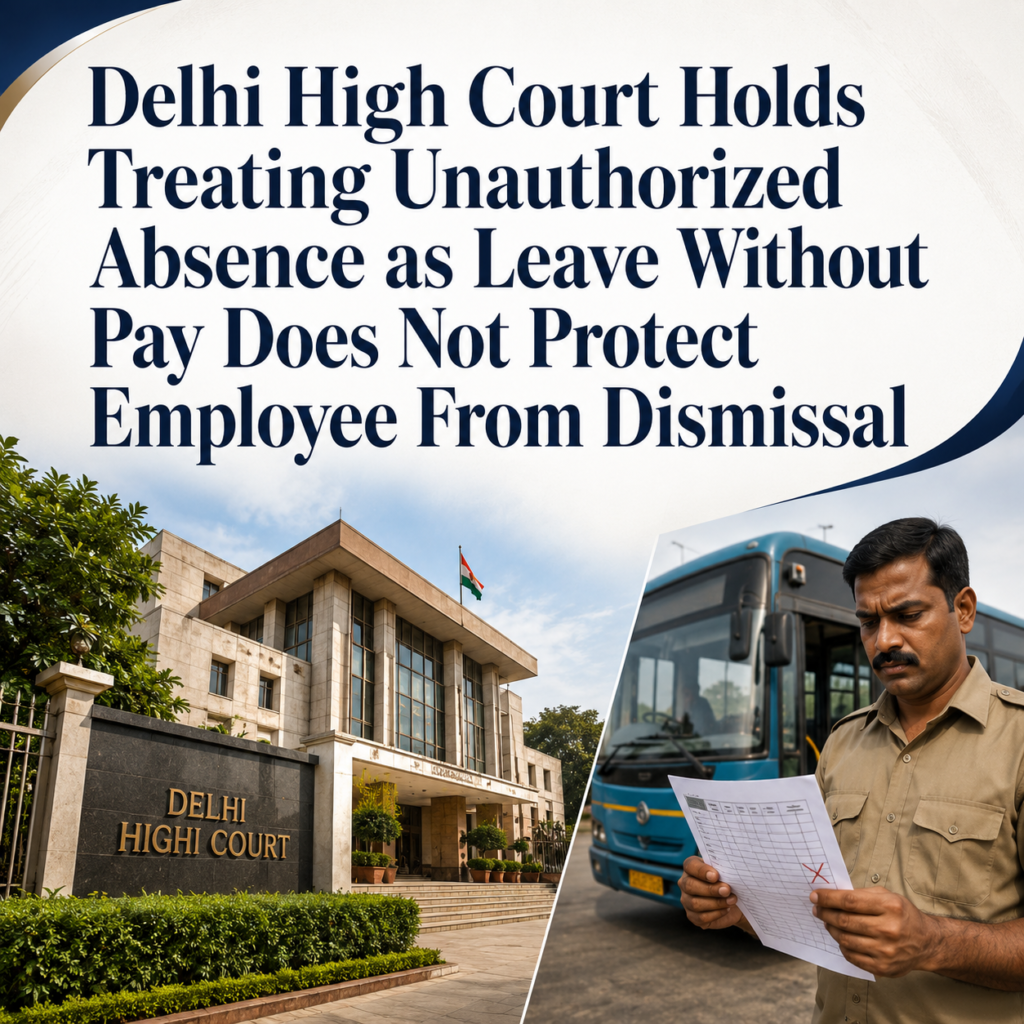
Delhi High Court Holds Treating Unauthorized Absence as Leave Without Pay Does Not Protect Employee From Dismissal

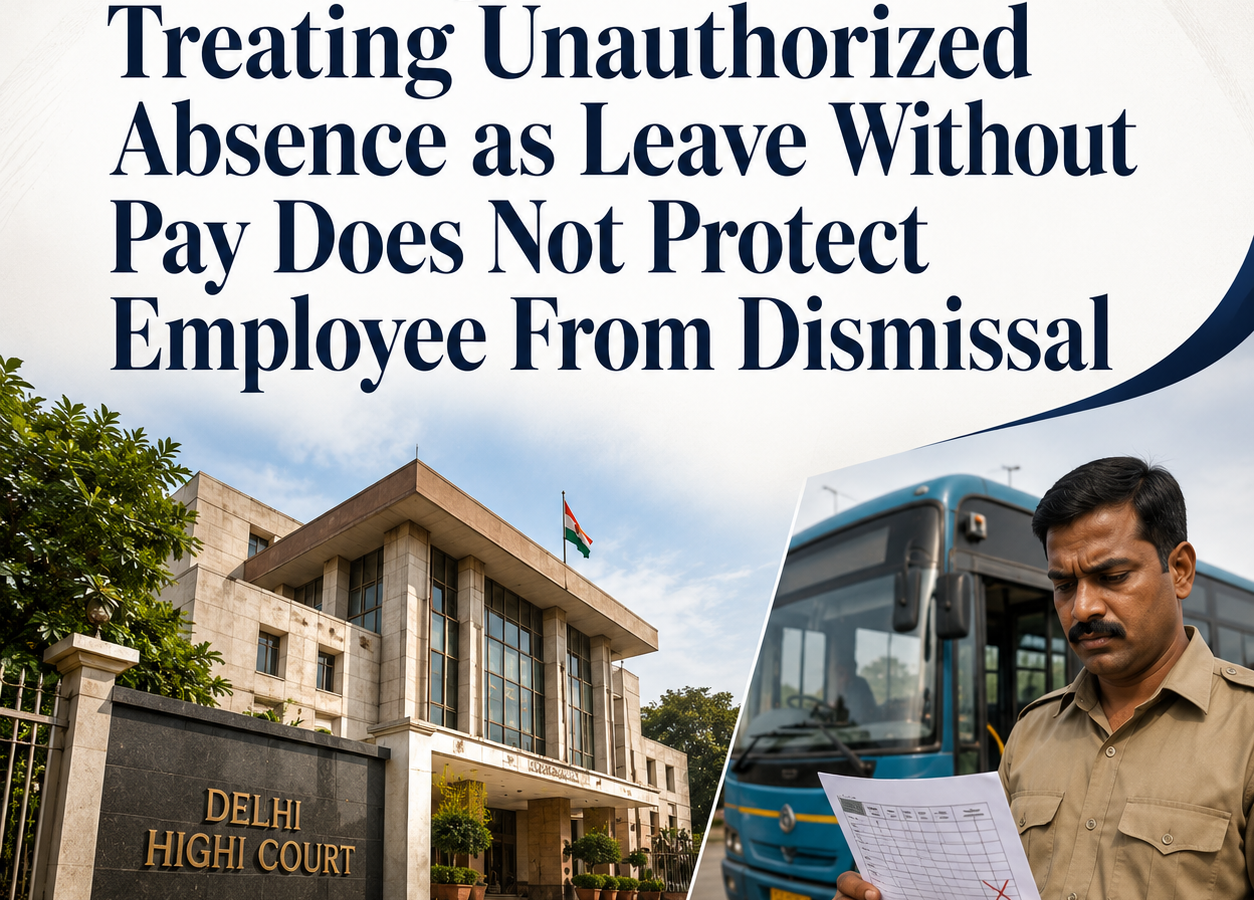
Delhi High Court Upholds DTC Driver’s Removal, Holds Treating Unauthorized Absence as Leave Without Pay Does Not Wipe Out Misconduct
Facts
The appeal was filed by the legal representatives of Pyare Lal, a deceased DTC driver, challenging the Single Judge’s order dated 5 October 2012. The Single Judge had allowed DTC’s writ petition and set aside the Industrial Tribunal’s orders dated 7 May 1997 and 11 February 1999, by which the Tribunal had refused approval under Section 33(2)(b) of the Industrial Disputes Act, 1947 for removal of the employee from service.
Pyare Lal was appointed as a driver with Delhi Transport Corporation in 1977. The record showed repeated instances of absence from duty, including absence in 1979, 1984, 1989, 1990 and 1991. In 1991, he had availed 107 days’ leave without pay, for which penalty of stoppage of increment with cumulative effect was imposed. In February 1993, he was charge-sheeted for remaining absent without permission for 22 days.
He did not reply to the charge-sheet and did not participate in the enquiry despite repeated notices. The Enquiry Officer found the charge proved, and after show-cause notice, DTC removed him from service on 27 April 1993. DTC remitted one month’s wages and filed an approval application under Section 33(2)(b) of the Industrial Disputes Act.
Issues
Whether unauthorized absence ceases to be misconduct merely because the absence period is treated as “leave without pay”.
Whether the Tribunal was justified in refusing approval under Section 33(2)(b) of the Industrial Disputes Act.
Whether the charge against the employee was vague.
Whether the Single Judge rightly set aside the Tribunal’s order and approved the removal from service.
Appellant’s Arguments
The legal representatives of the deceased employee argued that the Tribunal had rightly refused approval because the absence period had been treated as leave without pay by DTC.
It was contended that once the employer regularized the absence as leave without pay, the employee could not still be treated as guilty of misconduct for unauthorized absence.
It was also argued that the charges were vague and that the employee did not have sufficient notice of the case he had to meet.
Respondent’s Arguments
DTC argued that the employee had a repeated history of unauthorized absence and had failed to participate in the domestic enquiry despite several opportunities.
DTC submitted that treatment of the absence period as leave without pay was only for maintaining service records and did not amount to sanction or approval of leave.
It was further argued that the Tribunal’s reasoning was contrary to binding Supreme Court precedent, which had already held that unauthorized absence remains misconduct even if the period is later treated as leave without pay.
Analysis of the Law
The Court held that treating unauthorized absence as leave without pay does not erase the misconduct of remaining absent without prior permission. Such treatment is generally for administrative purposes, including maintaining correct service records, and cannot be treated as approval or sanction of leave.
The Court also held that the charge was not vague. The employee was informed of the period and number of days of unauthorized absence, and the leave statement was placed on record. Therefore, he had sufficient notice of the allegation against him.
Precedent Analysis
The Court relied on State of Madhya Pradesh v. Harihar Gopal, where the Supreme Court held that regularizing absence after termination is only for maintaining correct records and does not invalidate disciplinary action for unauthorized absence.
The Court also relied on Delhi Transport Corporation v. Sardar Singh, where the Supreme Court held that treating absence as leave without pay is not the same as sanctioned or approved leave, and unauthorized absence may still amount to misconduct.
The Single Judge had also considered Devendra Swami while dealing with delay in filing the writ petition, holding that where sufficient cause such as counsel’s negligence is shown, delay can be condoned.
Court’s Reasoning
The Division Bench agreed with the Single Judge that the Tribunal’s refusal to grant approval was legally unsustainable. The Tribunal had proceeded on the basis that since the absence was treated as leave without pay, there was no misconduct. The High Court held that this conclusion was directly contrary to Supreme Court law.
The Court further held that the deceased employee had been given proper opportunity to defend himself. He did not reply to the charge-sheet and did not appear in the enquiry despite repeated notices.
On the plea of vagueness, the Court held that the charges contained sufficient particulars, including the period and number of days of absence. Therefore, the employee was aware of the case against him and could not complain of lack of notice.
Conclusion
The Delhi High Court dismissed the appeal filed by the legal representatives of Pyare Lal. It upheld the Single Judge’s order setting aside the Industrial Tribunal’s refusal of approval and held that DTC’s removal order did not suffer from illegality.
Case: Pyare Lal (Since Deceased) Through LRs v. Delhi Transport Corporation
Court: Delhi High Court
Case Number: LPA 550/2013
Judge: Justice V. Kameswar Rao and Justice Manmeet Pritam Singh Arora
Date: 3 July 2026
Result: Appeal dismissed; Single Judge’s order upheld; DTC’s approval application under Section 33(2)(b) treated as allowed.