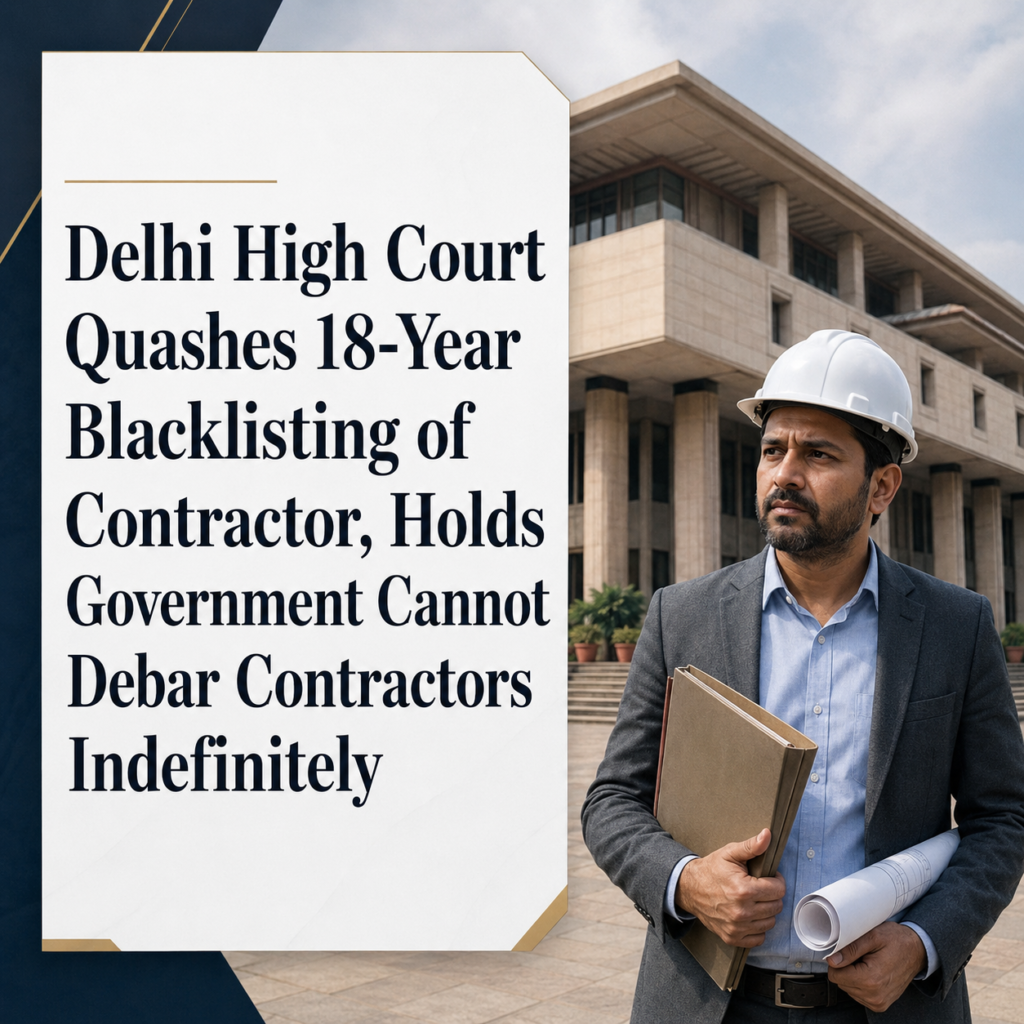
Delhi High Court Quashes 18-Year Blacklisting of Contractor, Holds Government Cannot Debar Contractors Indefinitely

Delhi High Court Quashes Delhi Jal Board’s 18-Year Blacklisting of Contractor, Holds Debarment Cannot Continue Indefinitely Without Fixed Period
Facts
The petitioner, Kaveri Infrastructure Pvt. Ltd., is engaged in water supply, sewerage rehabilitation, tube well installation and related infrastructure works. In 2004, the Delhi Jal Board awarded the petitioner a contract for renovation of old pipelines. In 2007, the CBI registered an FIR alleging that the petitioner had secured a ₹35.84 crore contract through corrupt and extraneous considerations involving its then Managing Director and the CEO of the Delhi Jal Board.
Following the FIR, the Delhi Jal Board debarred the petitioner from participating in future tenders. Earlier proceedings were filed before the Delhi High Court, and after multiple rounds of litigation, the Delhi Jal Board passed an order dated 28 March 2008 stating that the petitioner would not be permitted to participate in tenders until the outcome of the CBI investigation was made known. The petitioner and its Managing Director were later convicted by the CBI Court in 2013, and appeals against the conviction remained pending.
In 2022, after the petitioner again sought participation in fresh tenders, the Delhi Jal Board passed the impugned speaking order dated 22 July 2022, continuing the debarment till the final outcome of investigation, court proceedings or appeals. The petitioner challenged this order before the Delhi High Court.
Issues
Whether the Delhi Jal Board could continue the petitioner’s blacklisting for an indefinite period.
Whether a debarment order linked to the final outcome of criminal proceedings and appeals is legally sustainable.
Whether the impugned order was arbitrary for failing to prescribe a specific period of debarment.
Whether the petitioner was barred from challenging the blacklisting again due to earlier litigation and delay.
Petitioner’s Arguments
The petitioner argued that the impugned order was arbitrary because it did not prescribe any fixed period of debarment. It was submitted that both the Delhi Jal Board’s own rules and the CPWD guidelines prescribe a maximum period for blacklisting, and therefore debarment cannot be open-ended or indefinite.
The petitioner contended that the order merely repeated the earlier 2008 blacklisting order without considering subsequent developments, including the conviction in 2013 and the pendency of appeals. It was argued that the order was passed mechanically and with a predetermined mindset.
Reliance was placed on Kulja Industries Ltd. v. Chief General Manager and Sabharwal Medicos Pvt. Ltd. v. Union of India to submit that blacklisting can never be permanent and must always be for a definite and proportionate period.
Respondent’s Arguments
The Delhi Jal Board argued that the issue of blacklisting had already been considered in earlier proceedings, particularly in the judgment dated 12 August 2009 in W.P.(C) 5704/2008, and therefore the petitioner could not reopen the same issue through a fresh writ petition.
It was submitted that the petitioner had been convicted in the CBI case for misconduct involving forged documents to obtain the tender, and the State has the right to decide with whom it will enter into contracts.
The respondent also argued that the writ petition was barred by delay and limitation because the petitioner had effectively challenged a blacklisting order that had been in place since 2008.
Analysis of the Law
The Court held that blacklisting is a serious civil consequence and cannot be imposed for an unlimited or indefinite period. While the State or its instrumentalities may debar a contractor for misconduct, such action must be proportionate, reasoned and confined to a definite period.
The Court noted that the impugned order dated 22 July 2022 did not prescribe any time limit. It stated that the petitioner would remain debarred till the outcome of CBI investigation, finalisation of court proceedings and appeals. These contingencies were open-ended and incapable of being confined to a definite timeframe.
The Court also examined the Delhi Jal Board Rules for Enlistment of Contractors, 2023, which prescribe debarment for a minimum of six months and a maximum of two years. Similarly, the CPWD Rules for Enlistment of Contractors, 2022 prescribe a maximum debarment period of two years. The impugned order was therefore contrary to the applicable rule framework.
Precedent Analysis
The Court relied on Kulja Industries Ltd. v. Chief General Manager, where the Supreme Court held that debarment is an accepted disciplinary measure against erring contractors, but it can never be permanent. The period of debarment must depend on the seriousness of the misconduct.
The Court also relied on Coastal Marine Construction and Engineering Ltd. v. Indian Oil Corporation Ltd., where the Delhi High Court held that blacklisting must remain within the framework of applicable rules and must be proportionate to the nature of the alleged misconduct.
The Court further relied on Sabharwal Medicos Pvt. Ltd. v. Union of India, where the Delhi High Court held that blacklisting during the pendency of criminal proceedings amounts to indefinite blacklisting unless a fixed period is prescribed. Even in a case involving allegations of forged tender documents, the Court had restricted blacklisting to a definite period.
Court’s Reasoning
The Court found that the impugned order was almost a repetition of the 2008 blacklisting order and had been passed mechanically. It failed to consider important subsequent events, especially the petitioner’s conviction in 2013 and the pendency of appeals.
The Court held that although the petitioner and its Managing Director would face consequences flowing from the criminal proceedings, the conviction could not justify continuous or permanent blacklisting. The petitioner had already remained blacklisted since 2008, i.e. for nearly 18 years.
The Court rejected the respondent’s objection that the challenge was barred due to earlier litigation. It held that continued blacklisting gives rise to a recurring cause of action. Further, the legal position had evolved after the earlier 2009 judgment, particularly due to the Supreme Court’s ruling in Kulja Industries, which categorically held that permanent blacklisting is impermissible.
Conclusion
The Delhi High Court quashed the Delhi Jal Board’s speaking order dated 22 July 2022, holding it to be arbitrary and unlawful. The Court held that blacklisting cannot continue indefinitely and that the petitioner had already suffered debarment for an excessive period of 18 years. The Court directed that the petitioner shall be entitled to participate in all future Delhi Jal Board tenders, subject to fulfilment of eligibility norms.
Case: Kaveri Infrastructure Pvt. Ltd. v. Delhi Jal Board, Through Its Chief Executive Officer
Court: Delhi High Court
Case Number: W.P.(C) 16962/2022 & CM APPL. 53749/2022
Judge: Justice Amit Bansal
Date: 2 July 2026
Result: Writ petition allowed; blacklisting order quashed; petitioner permitted to participate in future Delhi Jal Board tenders subject to eligibility norms.