Delhi High Court Holds Unproved MoU and FSL Report Cannot Defeat Original Tenant’s Rights; Upholds Restoration of Shop Possession After Partnership Dissolution

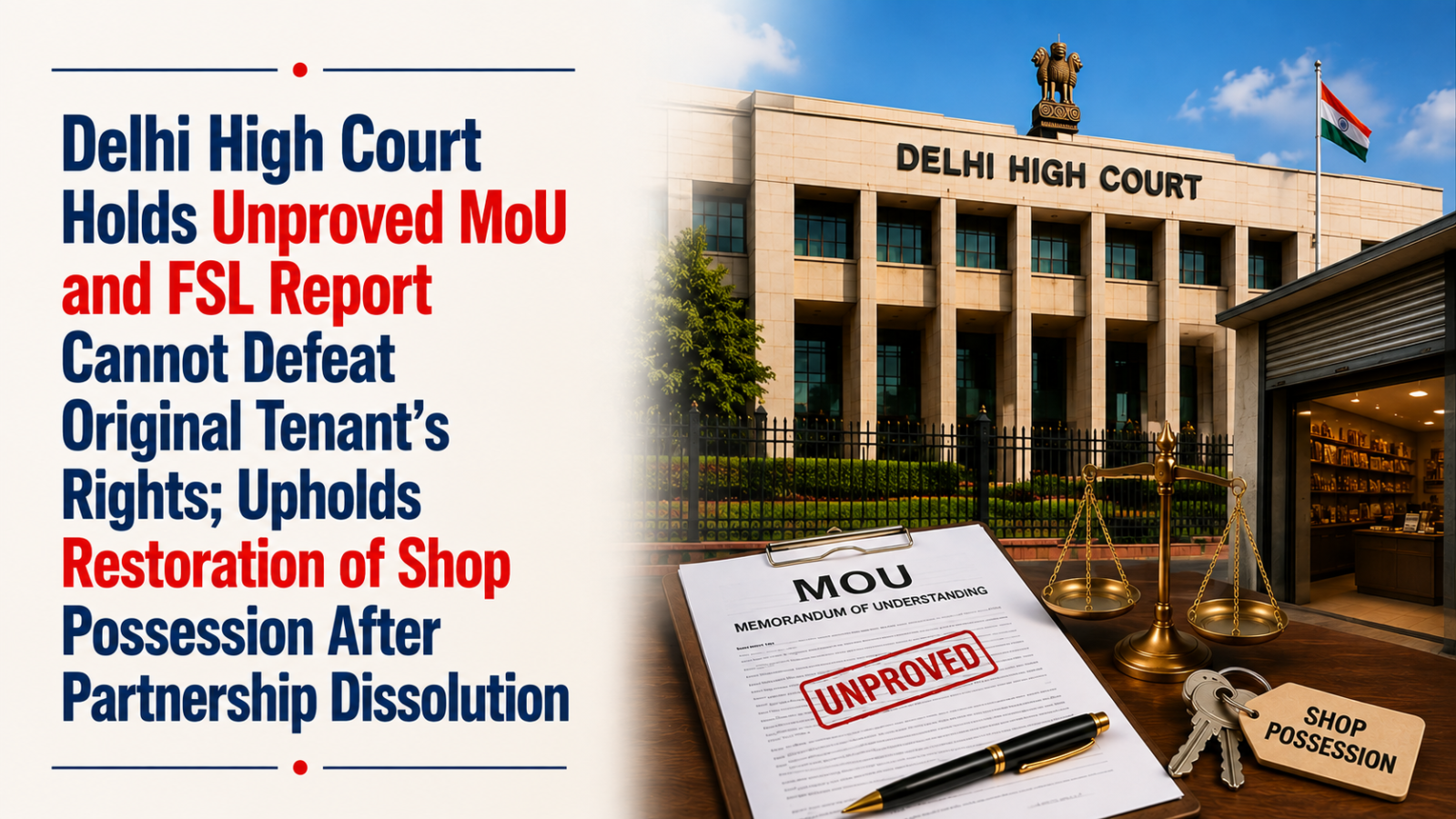
Delhi High Court Upholds Restoration of Tenanted Shop to Original Tenant; Holds Unproved MoU Cannot Defeat Partnership Rights
Facts
The dispute concerned Shop Nos. 7 and 8, Esplanade Road, Chandni Chowk, Delhi, originally tenanted by the plaintiff’s father. After his father’s death, the plaintiff became the tenant. In 1989, the plaintiff and the defendants entered into a ten-year partnership to run Mona Studio, with the plaintiff as a sleeping partner and the defendants managing the business. Upon expiry of the partnership and issuance of a notice terminating it, the plaintiff sought rendition of accounts and restoration of possession. The defendants relied upon an alleged Ikrarnama/MoU dated 29 April 1995, claiming the plaintiff had agreed to surrender his partnership and tenancy rights after defaulting on repayment of loans. The Trial Court rejected the defence, ordered rendition of accounts, and directed restoration of possession. Defendant No.1 challenged that decree before the Delhi High Court.
Issues
- Whether the defendants had successfully proved the alleged Ikrarnama/MoU under which the plaintiff surrendered his tenancy and partnership rights.
- Whether the alleged loan transactions and forensic reports established a valid transfer of tenancy.
- Whether the Trial Court was justified in directing rendition of partnership accounts and restoration of possession of the suit property.
Petitioner’s (Appellant’s) Arguments
The appellant contended that the Trial Court ignored crucial documentary evidence, including the Ikrarnama/MoU, promissory notes, statements of accounts, rent receipts, title documents and forensic reports. According to the appellant, the plaintiff had borrowed over ₹10 lakh and agreed that failure to repay by 1 January 1999 would automatically terminate his partnership and transfer tenancy rights to Defendant No.1. Since repayment was never made, the partnership allegedly ended in 1998, the landlord transferred the tenancy to Defendant No.1, rent was accepted from him thereafter, and no eviction proceedings were ever initiated.
Respondents’ Arguments
The respondents argued that the defendants failed to prove execution of the alleged MoU in accordance with the Indian Evidence Act. None of the attesting witnesses were examined, the alleged loan transactions were unsupported by documentary evidence, and the forensic reports were never proved through expert testimony. They further submitted that the partnership deed clearly provided for a ten-year term, after which the plaintiff was entitled to dissolution, accounts and restoration of possession. The alleged transfer of tenancy was also never legally established.
Analysis of the Law
The High Court examined the partnership deed and found that it unequivocally recognised the plaintiff as the tenant, fixed the partnership period at ten years, and specifically provided that possession of the premises would revert to the plaintiff after dissolution.
The Court held that merely exhibiting a document does not dispense with the requirement of proving its execution. Since the defendants failed to examine the attesting witnesses to the MoU and produced no reliable evidence regarding the alleged loan transactions, the defence collapsed.
The Court also held that expert opinions contained in FSL reports do not become substantive evidence automatically. Such reports must be proved by examining the expert, who must be available for cross-examination. Similarly, rent receipts allegedly evidencing transfer of tenancy could not be relied upon because the landlord was never examined.
Precedent Analysis
The Court relied upon:
- Sait Tarajee Khimchand v. Yelamarti Satyam—holding that mere marking of a document as an exhibit does not prove its execution.
- State of Himachal Pradesh v. Jai Lal—holding that an expert report becomes evidence only after the expert is examined.
- S. Gopal Reddy v. State of Andhra Pradesh and Chennadi Jalapathi Reddy v. Baddam Pratapa Reddy—holding that expert opinion is advisory and requires corroboration.
- Novartis AG v. Natco Pharma Ltd. and Gautam Saluja v. Jitender Kumar Sethi—reiterating that FSL reports are not substantive evidence unless properly proved.
Court’s Reasoning
The Court found several serious deficiencies in the defendants’ case. The alleged loans were unsupported by receipts, loan documents, income tax records or demand notices. Defendant No.1 admitted these shortcomings during cross-examination.
The alleged MoU itself remained unproved because neither attesting witness was examined, and Defendant No.1 could not even identify the witnesses or explain the execution of the document. The FSL reports also carried no evidentiary value since the concerned experts were never produced before the Court.
The Court further observed that Defendant No.1 failed to establish any lawful transfer of tenancy. In contrast, the plaintiff’s evidence regarding continuation of tenancy remained unrebutted. Consequently, the Trial Court had rightly concluded that the partnership ended by efflux of time and that possession had to revert to the plaintiff after settlement of accounts.
Conclusion
The Delhi High Court dismissed the appeal and affirmed the Trial Court’s decree. It held that the defendants failed to prove the alleged MoU, the loan transactions, the forensic reports or any valid transfer of tenancy. The decree directing rendition of partnership accounts and restoration of possession of the suit property in favour of the plaintiff’s legal representatives was therefore upheld.
Case Details
Case: Rajinder Kumar v. Sewa Ram (Since Deceased) through Legal Representatives & Anr.
Court: High Court of Delhi
Case Number: RFA 908/2017
Judge: Hon’ble Mr. Justice Amit Bansal
Date: 31 July 2026
Result: Appeal Dismissed; Trial Court decree directing rendition of partnership accounts and restoration of possession to the plaintiff’s legal representatives upheld.