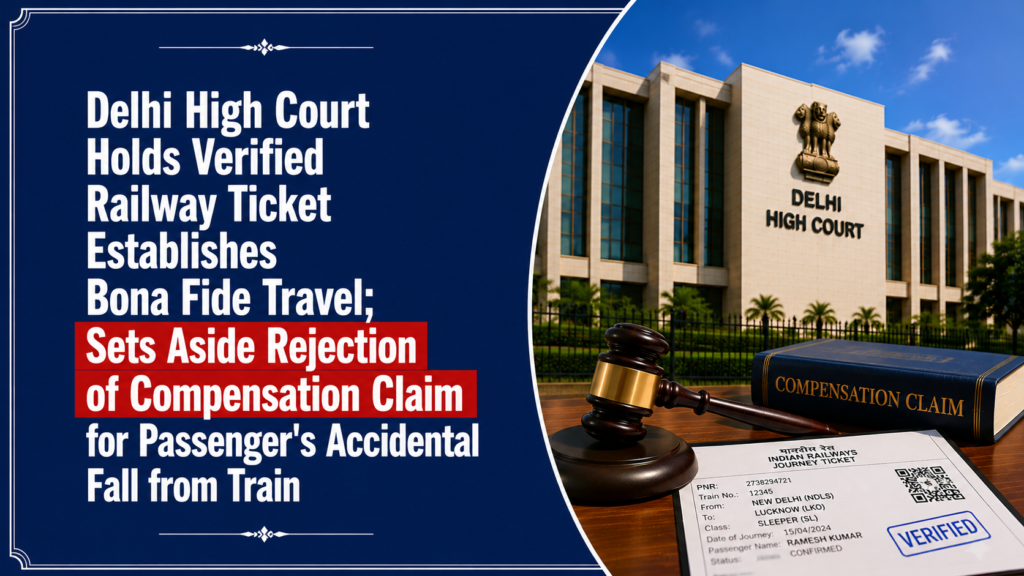
Delhi High Court Holds Verified Railway Ticket Establishes Bona Fide Travel; Sets Aside Rejection of Compensation Claim for Passenger’s Accidental Fall from Train

Verified Journey Ticket Cannot Be Ignored on Mere Suspicion, Rules Delhi High Court While Restoring Railway Claim
Facts
The appellants challenged the order of the Railway Claims Tribunal dismissing their claim for compensation arising from the death of Sunder Singh.
According to the claimants, on 26 July 2015, the deceased had purchased a valid journey ticket for travel from Agra Cantt. to Mathura Junction. During the journey, he accidentally fell from the running train near Mathura Junction, sustained grievous injuries and later succumbed to them while being taken to the hospital.
The Railway Claims Tribunal dismissed the claim, holding that the deceased was not a bona fide passenger and that the incident did not amount to an “untoward incident” under the Railways Act, 1989.
Aggrieved, the legal heirs preferred the present appeal before the Delhi High Court.
Issues
- Whether the deceased was a bona fide passenger travelling with a valid railway ticket.
- Whether non-recovery of the railway ticket during inquest proceedings justified rejection of the compensation claim.
- Whether the deceased’s fall from the train constituted an “untoward incident” under the Railways Act, 1989.
- Whether the Railway Claims Tribunal was justified in dismissing the claim petition.
Petitioner’s Arguments
The appellants contended that:
- The Tribunal ignored contemporaneous official records prepared immediately after the incident.
- The Station Memo, HDTC Diary, and DRM report consistently showed that the deceased had fallen from the train and nowhere suggested that he had intentionally jumped.
- The original journey ticket was produced before the Tribunal, and its issuance had been verified by the Railway Administration itself.
- The Tribunal’s conclusions that the ticket had been subsequently procured and that the deceased deliberately jumped from the train were unsupported by any evidence.
Respondent’s Arguments
The Union of India argued that:
- The deceased attempted to alight from a moving train despite being warned.
- He consciously exposed himself to an obvious risk.
- Since no railway ticket was recovered during the inquest proceedings, the Tribunal rightly concluded that the deceased was not a bona fide passenger.
- The Tribunal had correctly relied upon the testimony of witness Bhagwati Prasad Sharma (CW-1) in dismissing the claim.
Analysis of the Law
The Court examined the provisions governing compensation for untoward incidents under the Railways Act, 1989.
The Court reiterated that the initial burden upon claimants to establish that the deceased was a bona fide passenger is not onerous. Once the claimant produces sufficient attendant circumstances indicating lawful travel, the burden shifts to the Railways to rebut that evidence by producing cogent material.
The Court further held that mere non-recovery of a ticket during inquest proceedings cannot, by itself, justify a finding that the deceased was travelling without a valid ticket, particularly where the Railway Administration itself verifies the ticket’s issuance.
Precedent Analysis
The Court relied upon:
- Lata v. Union of India (2026 SCC OnLine SC 1350) — reiterating that the claimant’s initial burden to prove bona fide travel is not onerous and once discharged, the burden shifts to the Railways.
- Union of India v. Rina Devi (2019) 3 SCC 572 — reaffirming the principles governing proof of bona fide travel and railway accident compensation.
- Sh. Prempal Singh v. Union of India (2018 SCC OnLine Del 9571) — holding that a passenger travelling alone cannot reasonably be expected to preserve evidence explaining every aspect of the journey and that production of a valid ticket sufficiently establishes bona fide travel unless rebutted.
Court’s Reasoning
The Court found that the original railway ticket had been produced before the Tribunal and, more importantly, its issuance had been independently verified by the Railway Administration through the Booking Supervisor at Agra Cantt.
Accordingly, the Tribunal could not reject the ticket merely because it was not mentioned in the panchnama. The absence of reference in the inquest proceedings amounted only to non-recovery, not proof that the ticket was fabricated or subsequently procured.
On the nature of the incident, the Court observed that the earliest contemporaneous records—including the Station Master’s Memo, HDTC Diary, and RPF Inquiry Report—consistently recorded that the deceased had fallen from the train. None of these documents suggested that he had deliberately jumped or intended to injure himself.
The Court also found the Tribunal’s reliance upon the testimony of CW-1 misplaced. His statement regarding the deceased allegedly admitting that he had no ticket and had attempted to get down from the moving train surfaced only during his examination before the Tribunal more than six years after the occurrence and found no support in any contemporaneous record.
The Court held that such delayed oral testimony could not override the earliest official documents prepared immediately after the incident. Consequently, the Tribunal’s findings regarding both bona fide passenger status and the nature of the occurrence were unsustainable.
Conclusion
The Delhi High Court held that the deceased was a bona fide passenger travelling on a valid railway ticket and that his accidental fall from the train constituted an untoward incident under the Railways Act.
Accordingly, the Court set aside the Tribunal’s judgment, remanded the matter for determination of compensation, and directed the Railway Claims Tribunal to assess and disburse the compensation in accordance with law within two months after receipt of the order.
Case Details
Case: Ravikant & Ors. v. Union of India
Court: Delhi High Court
Case Number: FAO 61/2023
Judge: Hon’ble Mr. Justice Manoj Kumar Ohri
Date: 03 August 2026
Result: Appeal allowed. Tribunal’s order set aside; deceased held to be a bona fide passenger and victim of an untoward incident; matter remanded to the Railway Claims Tribunal for determination and disbursement of compensation.