Delhi High Court Limits Booth Agents’ Liability in Electoral Roll Revision; Holds BLAs Cannot Verify Voters’ Personal Details and ECI Cannot Demand Blanket Undertakings

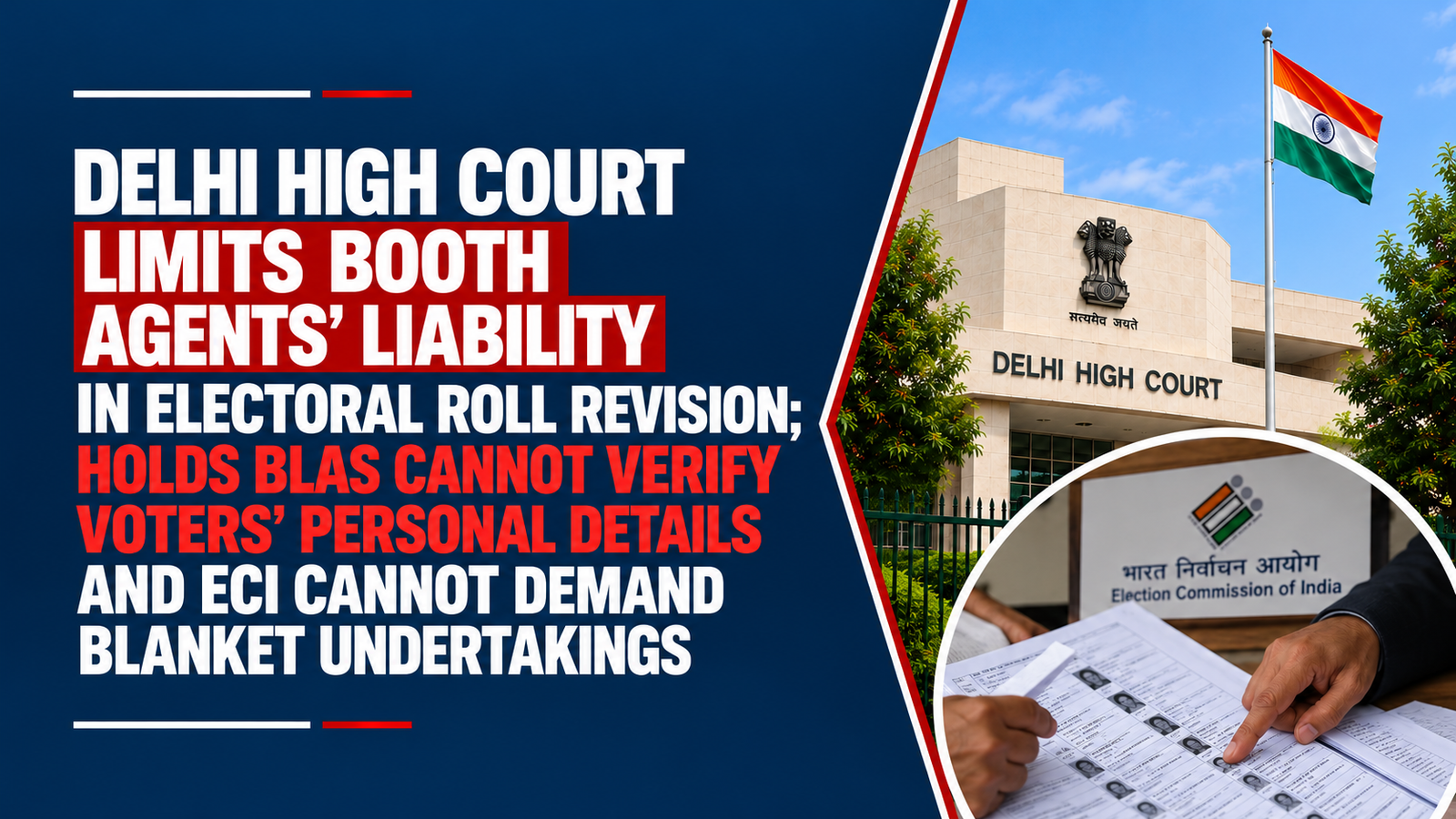
Delhi High Court Says Booth Level Agents Cannot Be Made Liable for Voters’ Personal Information; Verification Responsibility Under SIR Lies With Booth Level Officers
Facts
The petition was filed by Devender Yadav, a former Delhi MLA and President of the Delhi Pradesh Congress Committee, along with the Chairman of its Booth Management Committee, against the Election Commission of India (ECI) and the Chief Electoral Officer, Delhi.
The controversy concerned the Special Intensive Revision (SIR) of electoral rolls in the NCT of Delhi. ECI had issued SIR guidelines on 24 June 2025 and subsequently decided on 14 May 2026 to undertake SIR in various States and Union Territories, including Delhi.
The petitioners principally challenged the requirement under Clause 9(d)(iv) that a Booth Level Agent (BLA) appointed by a recognised political party must submit an undertaking stating that the BLA had personally verified the particulars contained in Enumeration Forms and was satisfied that they were correct.
They also sought printed and soft copies of the 2002 electoral rolls and the frozen/photo electoral rolls to enable BLAs to participate effectively in the SIR exercise.
The prescribed undertaking required the BLA to state:
“I undertake that I have personally verified the particulars mentioned in the Enumeration forms…”
The form permitted a BLA to submit up to 50 Enumeration Forms per day before draft publication.
Issues
The principal issue identified by the Delhi High Court was:
Whether requiring a BLA to personally undertake that all particulars contained in voters’ Enumeration Forms had been verified and were correct was arbitrary and unreasonable.
The Court also considered:
- the distinction between the functions of a Booth Level Agent and Booth Level Officer;
- the scope of liability under Section 31 of the Representation of the People Act, 1950;
- whether BLAs could reasonably verify information exclusively within an elector’s personal knowledge;
- whether ECI could require BLAs to certify the entire Enumeration Form; and
- whether the petitioners were entitled to copies of the relevant electoral rolls.
Petitioners’ Arguments
The petitioners submitted that the revised Enumeration Form itself assigned the verification function to the Booth Level Officer (BLO), who is a government official.
The guidelines dated 27 May 2026 similarly emphasised that the BLO must conduct house-to-house verification and verify documents furnished by electors.
The petitioners argued that much of the Enumeration Form contained information exclusively within the voter’s personal knowledge.
A political party’s BLA merely assists the voter in filling and/or submitting the form. Therefore, the BLA could not realistically authenticate every personal particular contained in it.
They accepted responsibility for information independently gathered by BLAs—for example, lists of dead or shifted electors—but objected to being made responsible for personal information supplied by individual voters.
Their alternative submission was that a BLA could reasonably verify only:
- the identity of the person submitting the Enumeration Form; and
- whether the photograph appearing on the form corresponded with that person.
ECI’s Arguments
The ECI defended its power to conduct the SIR under Section 21 of the Representation of the People Act, 1950, the Registration of Electors Rules, 1960 and Article 324 of the Constitution.
It relied upon the Supreme Court’s decision in Association for Democratic Reforms v. Election Commission of India, which had upheld ECI’s authority to conduct SIR.
ECI explained that BLAs are voluntarily appointed by recognised political parties to complement BLOs and facilitate political-party participation in revision of electoral rolls.
The undertaking was said to be an accountability mechanism intended to ensure reasonable due diligence before political parties submitted applications in bulk.
ECI also relied upon Section 31 of the RP Act, which makes knowingly or recklessly false written statements or declarations relating to preparation, revision, inclusion or exclusion in electoral rolls punishable with imprisonment up to one year, fine, or both.
Analysis of the Law
1. ECI Has Wide Power to Conduct SIR
The High Court accepted that the Election Commission possesses wide procedural latitude under Section 21(3) of the RP Act read with Article 324 of the Constitution to conduct SIR for ensuring free and fair elections.
That general authority had already been upheld by the Supreme Court in Association for Democratic Reforms.
Accordingly, the Court did not question ECI’s power to conduct the SIR itself.
The controversy was confined to whether the particular undertaking imposed upon BLAs was legally sustainable.
2. BLAs Have a Legitimate Role in Electoral Roll Revision
The Court examined Chapter 25 of ECI’s Manual of Electoral Rolls, 2023.
BLAs were introduced to enhance grassroots participation by recognised political parties during preparation and revision of electoral rolls and are appointed to complement Booth Level Officers.
The Manual legitimately requires BLAs to undertake responsibility for information they themselves collect—for example, through house surveys.
3. BLAs Can Be Responsible for Information They Personally Gather
The Court accepted that where a BLA furnishes a list of:
- dead voters; or
- shifted electors,
the BLA can legitimately be required to verify the information and assume responsibility under Section 31.
This is because such information is actually collected and supplied by the BLA.
Thus, the Court did not invalidate BLA undertakings altogether.
4. Enumeration Forms Are Fundamentally Different
The crucial distinction concerned the individual voter’s Enumeration Form.
The form contains personal particulars relating to the elector and family members, much of which is within the exclusive knowledge of the elector.
The Court held that there was simply no practical means by which a BLA could independently verify all such information.
Therefore, requiring the BLA to certify the correctness of every entry was unreasonable.
5. Statutory Verification Is BLO’s Responsibility
ECI’s own counter-affidavit acknowledged that the BLA does not participate in statutory verification concerning inclusion or exclusion from electoral rolls.
That verification is carried out by the BLO through house-to-house verification.
The Enumeration Form itself contained a separate BLO undertaking confirming verification against the previous SIR electoral roll.
Consequently, once statutory verification had expressly been assigned to BLOs, the Court found “no justification” for simultaneously requiring BLAs to certify the correctness of information they could not independently verify.
6. BLA Liability Limited to Personally Verifiable Information
The Court drew a clear boundary.
A BLA may be responsible for ensuring that:
the photograph on the Enumeration Form matches the identity of the elector whose form is being submitted.
Beyond that, the BLA could not be made liable under Section 31 for personal information that could not reasonably be verified by the BLA.
This is the central ratio of the judgment.
Precedent Analysis
Association for Democratic Reforms v. Election Commission of India, 2026 INSC 564
This was the principal precedent considered by the Delhi High Court.
The Supreme Court had upheld ECI’s authority to conduct SIR under Section 21(3) of the RP Act read with Article 324 and recognised ECI’s wide procedural latitude in conducting such revision exercises.
The Delhi High Court did not depart from that ruling.
Instead, it distinguished between:
- ECI’s general power to conduct SIR, which was unquestioned; and
- the legality and reasonableness of a specific procedural requirement imposed upon BLAs, which remained subject to judicial review.
Accordingly, the judgment limits a particular BLA obligation without interfering with ECI’s underlying SIR powers.
Court’s Reasoning
The Court’s reasoning rested upon a practical allocation of responsibility.
A political party’s BLA may be expected to stand behind information that the BLA personally collects and furnishes. But the same principle cannot apply to personal information supplied by individual voters.
The Court found it inconsistent for ECI to expressly acknowledge that statutory verification belongs to the BLO while simultaneously requiring a BLA to certify the correctness of the entire Enumeration Form.
Accordingly:
BLA responsibility follows the BLA’s capacity to verify.
Where the information is independently verifiable by the BLA, responsibility may attach. Where it lies exclusively within the elector’s knowledge, liability cannot be shifted to the BLA.
Electoral Rolls Relief
The petitioners also sought copies of electoral rolls to facilitate the SIR exercise.
ECI informed the Court that:
- the 2002 Electoral Roll and Final Roll of 2025 as on 6 January 2025 were available online;
- physical copies could be supplied on written request and payment of the prescribed fee; and
- physical copies containing elector photographs could also be provided where the photographs formed part of the electoral roll.
In view of this assurance, the Court held that the second prayer stood satisfied.
Conclusion
The Delhi High Court disposed of the writ petition by restricting the scope of the undertaking that may be demanded from Booth Level Agents.
The Court held that a BLA:
- may be held responsible for information personally gathered and furnished by the BLA;
- may verify whether the photograph on an Enumeration Form matches the identity of the concerned elector;
- cannot be made liable for all personal information contained in an elector’s Enumeration Form; and
- cannot be required to undertake correctness of matters that are exclusively within the elector’s knowledge and statutorily subject to BLO verification.
The request for electoral rolls was treated as satisfied in view of ECI’s undertaking regarding online availability and supply of physical/photo electoral rolls.
Case Details
Case: Devender Yadav & Anr. v. Election Commission of India & Anr.
Court: High Court of Delhi at New Delhi
Case Number: W.P.(C) 11278/2026 with CM APPL. 52187/2026
Judge: Justice Amit Bansal
Reserved on: 13 August 2026
Date: 3 September 2026
Subject: Special Intensive Revision of Electoral Rolls; BLA undertaking; Section 31, Representation of the People Act, 1950
Result: Writ petition disposed of; BLA liability restricted to information capable of personal verification, particularly elector identity/photograph; ECI’s assurance regarding supply of electoral rolls recorded and second prayer treated as satisfied.