


Court’s decision
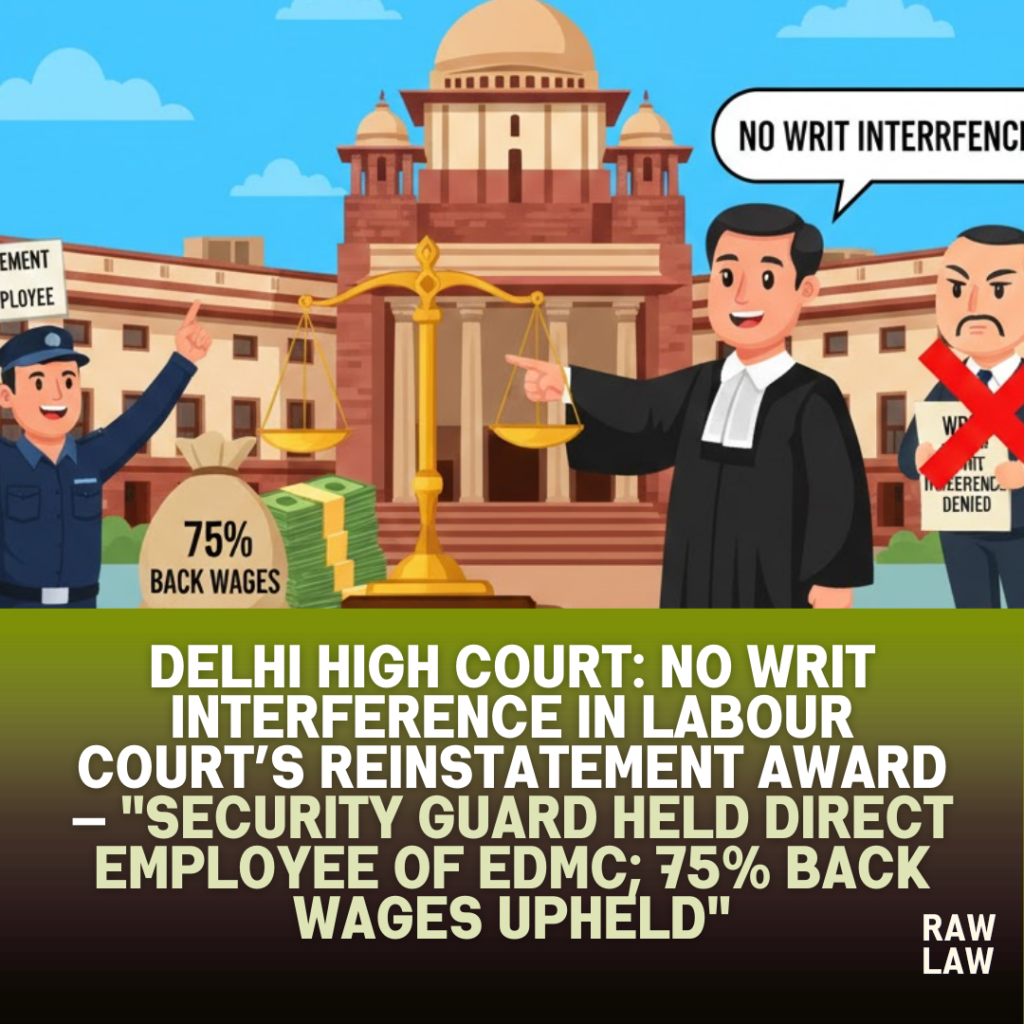
The Delhi High Court dismissed the writ petition filed by the Commissioner, East Delhi Municipal Corporation, challenging a Labour Court award directing reinstatement of a security guard with 75% back wages and consequential benefits. Justice Manoj Kumar Ohri held that the Labour Court’s finding of employer-employee relationship between the workwoman and the Municipal Corporation was based on evidence and disclosed no perversity or jurisdictional error. Reiterating the limited scope of judicial review under Articles 226 and 227, the Court declined to reappreciate factual findings and upheld the award dated 09.10.2017.
Court’s decision
The High Court affirmed the Labour Court’s direction to reinstate the claimant on the same post with effect from 01.12.2014—the date of termination—along with 75% back wages and consequential benefits, including promotion if applicable.
The Court clarified that writ jurisdiction does not permit reassessment of factual conclusions unless findings are perverse, unsupported by evidence, or suffer from jurisdictional infirmity. Finding none, the petition was dismissed.
Facts
The claimant asserted that she had been working as a Security Guard since May 2012 at a Community Centre and Recreation Centre maintained by the East Delhi Municipal Corporation. Her services were terminated on 01.12.2014 without notice or statutory compliance.
She claimed that although engaged through M/s Gaurav Enterprises, the Municipal Corporation was the principal employer and the contractor was a sham arrangement.
The Corporation contended that it had entered into a contract in 2007 with M/s Gaurav Enterprises for providing private security services and that the claimant was a contractual employee of the contractor, not the Corporation.
The contractor stated that its contract had ended in May 2014.
The Labour Court held that the contractor functioned merely as an agent, and directed reinstatement with 75% back wages.
Issues
The High Court examined:
- Whether the Labour Court erred in holding that an employer-employee relationship existed between the claimant and the Municipal Corporation.
- Whether the contractor arrangement was genuine or a sham.
- Scope of interference under Articles 226 and 227 in labour adjudication.
Petitioner’s arguments
The Municipal Corporation argued that the Labour Court wrongly concluded that the contractor was an agent and that no employer-employee relationship existed. It contended that payments were released to the contractor, who paid wages to the workmen.
Reliance was placed on the existence of a valid contract awarded pursuant to tender no. 10306 in 2007. The Corporation maintained that the claimant was engaged on temporary and contractual basis by the contractor.
Respondent’s arguments
The claimant argued that no appointment letter was issued and statutory benefits such as ESI, PF, leave, overtime, and increments were not provided. It was contended that the contractor lacked proper licensing and functioned merely as a conduit.
The claimant also relied on earlier proceedings under the Minimum Wages Act, 1948, where the Corporation undertook to pay wage arrears, demonstrating control and supervision indicative of employment relationship.
Analysis of the law
The Court reiterated that the burden to establish employer-employee relationship initially lies on the workman. Once prima facie evidence is led, the onus shifts to management.
Relying on settled jurisprudence including International Airport Authority of India v. International Air Cargo Workers’ Union, the Court emphasized that findings of fact recorded by Labour Courts should not be interfered with unless perverse or based on no evidence.
It further cited the principles laid down in Indraprastha Gas Ltd. v. Ambrish Kumar (2025 SCC OnLine Del 8896), reiterating that determination of employer-employee relationship is a factual inquiry based on totality of circumstances.
Precedent analysis
The Court relied on International Airport Authority of India v. International Air Cargo Workers’ Union, wherein the Supreme Court held that High Courts cannot sit in appeal over factual findings of Industrial Tribunals unless findings are unsupported by evidence.
Reference was also made to Ritz Theatre Private Limited v. Ramesh Chandra, where a Coordinate Bench summarized the narrow scope of writ interference—limited to jurisdictional errors, perversity, or gross violation of natural justice.
Applying these precedents, the Court found no error warranting interference.
Court’s reasoning
The Court observed that the claimant had continuously worked with the Municipal Corporation until termination. The contractor arrangement lacked transparency, and statutory benefits were not extended.
The Labour Court had evaluated documentary and oral evidence and concluded that Management 2 merely acted as an agent for supplying guards.
Since the finding was supported by evidence and did not disclose perversity, the High Court refused to substitute its own view.
It reiterated that writ jurisdiction is supervisory, not appellate. Mere possibility of another view does not justify interference.
Conclusion
The writ petition along with pending applications was dismissed. The Labour Court award directing reinstatement with 75% back wages and consequential benefits was upheld.
Implications
This ruling reinforces the limited scope of writ jurisdiction in labour matters and affirms that employer-employee relationship is a question of fact.
Public authorities engaging workers through contractors must ensure genuine compliance with labour laws; sham contractual arrangements may expose them to direct liability.
The decision also underscores that High Courts will not reappreciate evidence merely because another interpretation is possible.
Case Law References
- International Airport Authority of India v. International Air Cargo Workers’ Union
- Indraprastha Gas Ltd. v. Ambrish Kumar (2025 SCC OnLine Del 8896)
- Ritz Theatre Private Limited v. Ramesh Chandra (W.P.(C) 6173/2024)
FAQs
1. Can High Courts re-examine evidence in labour awards?
No. Under Articles 226 and 227, High Courts exercise supervisory jurisdiction and do not act as appellate courts.
2. How is employer-employee relationship determined?
It is determined based on totality of circumstances including control, supervision, payment of wages, and nature of engagement.
3. Can a contractor arrangement be treated as sham?
Yes. If evidence shows the contractor merely acted as an agent without genuine independence, courts may hold the principal employer directly liable.