Delhi High Court Orders Forensic Audit in Daiichi’s ₹5,300-Crore Award Enforcement; Probes Fortis Share Dissipation and Banks’ Role in Allegedly Defeating Court Assurances

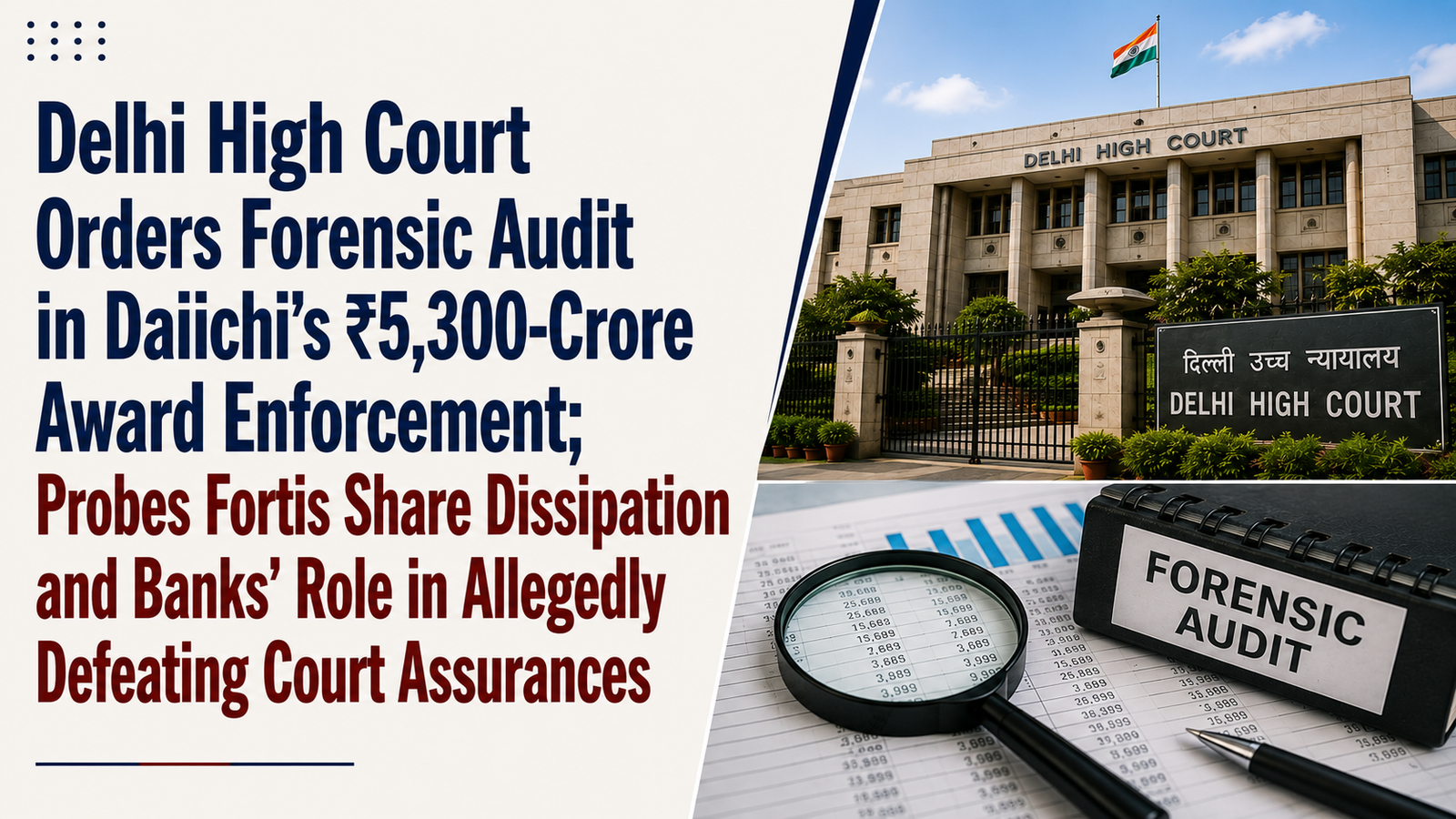
Delhi High Court Allows Daiichi’s Applications in Decade-Long Award Enforcement; Appoints Forensic Auditor to Trace Fortis Shares and Identify Persons Behind Dissipation
Facts
The dispute arises from a Singapore-seated arbitral award dated 29 April 2016 in favour of Daiichi Sankyo Company Limited against Malvinder Mohan Singh and other judgment debtors. The award directed payment of approximately ₹2,562 crore, with pre-award interest at 4.44% and post-award interest at 5.33%. According to Daiichi, approximately ₹5,300 crore had become due and payable by the time of the present proceedings.
The challenge to the award was rejected by the Delhi High Court on 31 January 2018 and that decision was affirmed by the Supreme Court on 16 February 2018. The present proceedings concerned enforcement of that foreign award.
Central to the controversy was the shareholding of the judgment debtors, particularly JD Nos. 1 and 6, through their controlled entities in Fortis Healthcare Limited (FHL) and Fortis Healthcare Holding Private Limited (FHHPL). The Court recorded that FHHPL was ultimately controlled by JD Nos. 1 and 6 through affiliated entities.
Following the award, repeated assurances and undertakings were given before the Court that sufficient unencumbered assets would remain available to satisfy the award. At one stage, affidavits projected unencumbered assets running into several thousand crores, leading the Court to believe that the decretal amount was adequately secured.
Despite those assurances, the shareholding of FHHPL in FHL progressively declined. The Court noted that FHHPL held approximately 71.7% of FHL when the decree was passed, which had fallen to 52% by September 2016 and ultimately to less than 1%. The Court described this complete dissipation of what had once been a controlling stake as raising serious concerns.
The Supreme Court had already dealt extensively with the alleged violation of undertakings and dissipation of assets in Vinay Prakash Singh v. Sameer Gehlaut and Daiichi Sankyo Company Limited v. Oscar Investments Limited.
Against that background, Daiichi filed three applications before the Delhi High Court. Two sought appointment of a forensic auditor, including an audit relating to 17 banks and financial institutions, while another sought to place additional documents on record allegedly demonstrating how assets had been frittered away with assistance from others to defeat execution of the decree.
Issues
The principal issues before the Court were:
- Whether a forensic audit was necessary to reconstruct how the judgment debtors’ substantial shareholding in FHL was dissipated after the arbitral award and repeated assurances to the courts.
- Whether the forensic investigation could extend beyond the judgment debtors to Fortis Healthcare Limited, banks, financial institutions and other third parties allegedly involved in pledging, encumbering, invoking or transferring FHL shares.
- Whether an execution court has jurisdiction to investigate transactions involving entities that were not parties to the original arbitration or decree where those transactions may have frustrated enforcement.
- Whether the corporate structure surrounding FHL, FHHPL and the downstream companies could prevent the Court from examining the persons actually controlling the transactions.
- Whether the audit should continue even though Daiichi ultimately stated that it no longer sought a forensic audit of the banks.
- Whether the factual disputes concerning pledges, top-ups, encumbrances, loans and transfer of shares required independent expert examination before legal liability could be determined.
Petitioner/Decree Holder’s Arguments
Daiichi contended that the judgment debtors had systematically dissipated assets after the award despite repeated undertakings and assurances to the Delhi High Court and orders of the Supreme Court.
Its principal allegation was that the shareholding in FHL, which constituted a major part of the judgment debtors’ asset base, had been progressively encumbered, pledged, transferred or otherwise depleted through a complex network of downstream companies and financing transactions.
Daiichi relied upon earlier Supreme Court findings concerning wilful and contumacious violation of undertakings by JD Nos. 1 and 6 and argued that the transactions had effectively frustrated enforcement of an award that had already attained finality.
It initially sought forensic examination of 17 banks and financial institutions. During oral arguments, that request was restricted to three banks. After conclusion of the hearing, however, Daiichi filed a written note stating that it no longer wanted any bank audited and sought an audit only of FHL and the judgment debtors.
The Court ultimately held that this change in Daiichi’s position did not control the scope of the judicial inquiry.
Respondents’ Arguments
The judgment debtors, FHL, banks and other affected entities disputed allegations that the relevant transactions were designed to defeat the decree.
There were conflicting positions regarding whether particular FHL shares were encumbered or unencumbered, whether transfers resulted from legitimate invocation of existing pledges and top-up obligations, and whether banks had merely exercised contractual security rights arising from bona fide lending transactions.
FHL also resisted being subjected to a forensic audit on the basis that it was not itself a party to the arbitration or original execution proceedings and that its present management was distinct from the management in control during the relevant transactions.
The Court, however, found that these sharply conflicting factual versions themselves demonstrated why an independent forensic exercise was required. In particular, it considered it necessary to determine how more than three crore unencumbered shares apparently disappeared during a crucial period.
Analysis of the Law
The judgment strongly emphasises the powers and responsibilities of an executing court.
The Court began by observing that obtaining a decree should not become merely the beginning of another prolonged litigation. Procedure exists to advance justice, and courts must ensure that judgment debtors do not exploit procedural complexity to prevent decree holders from receiving the fruits of successful litigation.
Where assets that could satisfy a decree have allegedly been dissipated in violation of assurances or binding judicial orders, an executing court is not confined to passively examining the formal ownership structure.
It may investigate the actual movement of assets and transactions and identify the persons or entities that participated in frustrating execution.
Third Parties and Forensic Audit
A significant legal question concerned entities that were not judgment debtors.
The Court held that the fact that FHL or the banks were not parties to the arbitration did not prevent an investigation into their role. It relied heavily upon the Supreme Court’s approach in the earlier Daiichi proceedings, where forensic examination of banks had been contemplated notwithstanding their third-party status.
Importantly, the forensic audit does not itself determine liability. Its purpose is to establish the factual position. Questions of liability and consequential relief would arise only after the audit report is received and affected parties are heard.
Piercing the Corporate Veil
The Court also invoked the doctrine of piercing the corporate veil.
It held that a corporate façade cannot be permitted to defeat legitimate rights or facilitate fraudulent conduct. Courts can examine the individuals and entities actually exercising control where corporate structures are allegedly being used to frustrate enforcement.
The Court noted that JD Nos. 1 and 6 ultimately controlled FHHPL and, during the relevant period, exercised substantial control over FHL. It therefore rejected an artificial distinction between FHL’s “old avatar” and its present management for purposes of conducting a factual investigation.
Precedent Analysis
General Manager of the Raj Durbhanga v. Maharajah Coomar Ramaput Sing
The Court began with the historic observation that the difficulties of a successful litigant in India often begin after obtaining a decree.
The precedent was used to frame the central concern of the judgment: execution cannot be permitted to become an endless process through which successful parties are deprived of the fruits of their decree.
Marshall Sons & Co. (I) Ltd. v. Sahi Oretrans (P) Ltd., (1999) 2 SCC 325
The Supreme Court had cautioned against procedural complications and prolonged execution proceedings being exploited by unscrupulous litigants.
The Delhi High Court relied on this principle to stress that procedural law must facilitate, rather than frustrate, actual enforcement.
Vinay Prakash Singh v. Sameer Gehlaut, (2021) 16 SCC 319
This was one of the most significant precedents in the case.
The Supreme Court had examined the progressive reduction of FHHPL’s shareholding in FHL and the conduct surrounding the undertakings given during the Daiichi enforcement litigation.
The Delhi High Court relied upon those findings while examining the dramatic depletion of the FHL shareholding and determining that an independent reconstruction of the transactions was necessary.
Daiichi Sankyo Company Limited v. Oscar Investments Limited, (2023) 7 SCC 641
This decision provided direct support for ordering forensic examination of the banks and financial institutions.
The Supreme Court had contemplated forensic investigation into the role of banks even though they were neither judgment debtors nor original parties to the execution proceedings, while postponing determination of their legal liability until the relevant facts were established.
The Delhi High Court adopted the same approach for FHL and other entities: first reconstruct the transactions; determine legal consequences thereafter.
Court’s Reasoning
The Court considered the decline in FHHPL’s holding in FHL particularly significant.
At the time of the award, FHHPL had approximately 71.7% shareholding in FHL. Yet, despite successive assurances intended to preserve sufficient assets to satisfy Daiichi’s award, the holding ultimately fell below 1%.
The Court highlighted one especially significant period: approximately 3,83,15,217 unencumbered shares fell to 26,31,777 shares between June and September 2017, around the period when the Supreme Court had passed its status quo order.
Because the banks, Daiichi and the judgment debtors offered conflicting explanations regarding those transactions, the Court held that judicial determination on the existing record would be unsafe. A forensic auditor was required to establish precisely what happened.
The audit was also necessary to examine loans taken by downstream entities, the business purposes of those loans, the use of FHL shares as security, and whether the transactions were genuine commercial financing arrangements or devices for dissipating assets and defeating the decree.
Crucially, the Court refused to be bound by Daiichi’s subsequent decision not to press for an audit of the banks. It held that the Court itself possessed power to order such an investigation where material suggested that banks or financial institutions might have knowingly assisted in conduct contrary to judicial orders.
Accordingly, the Court ordered the forensic investigation even beyond the narrowed relief ultimately sought by Daiichi.
The Court made clear that the audit was not a finding that any particular bank, FHL or third party was liable. Rather, it was intended to provide a complete and independent factual foundation upon which liability and consequential directions could subsequently be determined.
Conclusion
The Delhi High Court allowed all three applications — EX.APPL.(OS) 3764/2022, EX.APPL.(OS) 3763/2022 and EX.APPL.(OS) 1615/2025 — and directed a comprehensive forensic audit.
S. Ramanand Aiyar & Co., Chartered Accountants, was appointed as the forensic auditor.
The audit was directed to reconstruct the complete evolution of FHHPL’s shareholding in FHL after the first assurance dated 24 May 2016, including fresh pledges, invocation of securities, top-up mechanisms, transfers, sale of pledged shares and consequential transactions. It must also prepare a transaction-wise chronology and examine the roles of FHL, its officers, banks, intermediaries and other participants.
The auditor was further tasked with tracing consideration received from transfers or sales of FHL shares and determining where those funds ultimately went.
The forensic exercise must be completed within six months, with the auditor’s fees to be borne by Daiichi. The Court expressly warned that failure to comply with requisitions made by the forensic auditor would be viewed as contempt of court. Public authorities, depositories and other relevant bodies were directed to provide information required by the auditor.
Thus, the Court did not finally determine the liability of FHL, the banks or other third parties. The immediate relief was an extensive forensic investigation designed to establish who participated in the dissipation of assets and provide a factual foundation for subsequent recovery and enforcement orders.
Case Details
Case: Daiichi Sankyo Company Limited v. Malvinder Mohan Singh & Ors.
Court: High Court of Delhi at New Delhi
Case Number: O.M.P.(EFA)(COMM.) 6/2016 with EX.APPL.(OS) 3763/2022, 3764/2022 & 1615/2025 and connected applications
Judge: Justice Subramonium Prasad
Date: 31 August 2026
Result: Three applications allowed; comprehensive forensic audit ordered into FHL/FHHPL share dissipation, judgment debtors, banks and financial institutions; S. Ramanand Aiyar & Co. appointed auditor; report to be completed within six months.