Delhi High Court Upholds Bus Driver’s Conviction for Fatal Crash; Reduces Two-Year Sentence to 10 Months Already Served Considering Age, Family and Clean Record

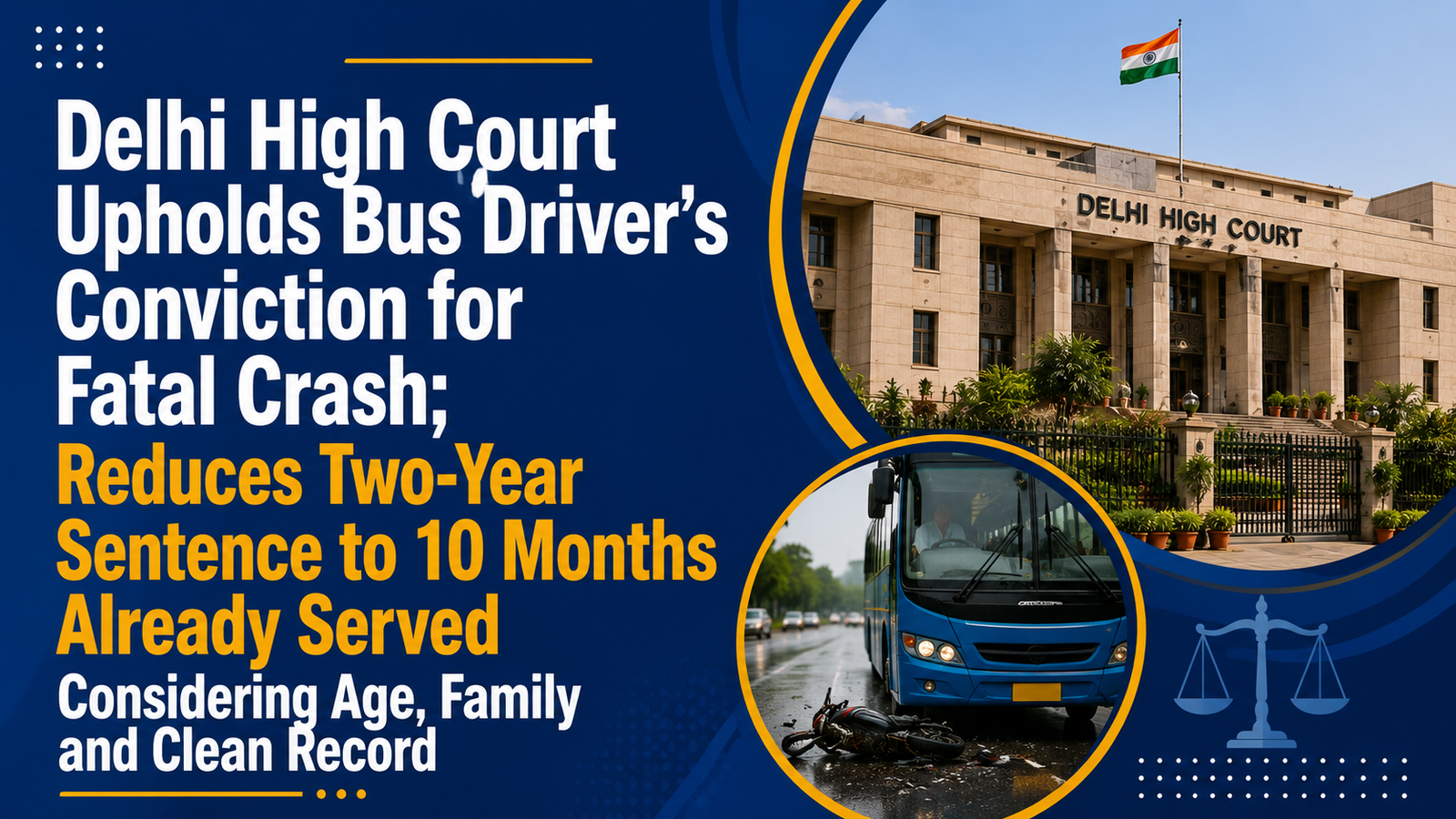
Delhi High Court Upholds Conviction of Blue Line Bus Driver in 2008 Fatal Crash; Cuts Jail Term to Period Already Undergone
Facts
The petitioner, Mohd Khalid Ahmed, challenged concurrent findings of conviction arising from FIR No. 50/2008 registered at Police Station Parliament Street. The Trial Court had convicted him under Sections 279, 337, 338 and 304A IPC, and the Sessions Court had upheld that conviction. He had been sentenced to a cumulative period of two years’ simple imprisonment, apart from fine, compensation and prosecution costs.
The accident occurred on 23 March 2008 at about 3:00 PM. The petitioner was driving a Blue Line bus bearing registration No. DL1PB3866. While turning towards Ashoka Road from Parliament Street near Nirvachan Bhavan, the bus collided with a Jamun tree on the footpath. One passenger died and several others sustained injuries.
After investigation, charges were framed under Sections 279, 337, 338 and 304A IPC. The prosecution examined 17 witnesses, while the petitioner examined himself as DW1. Both the Trial Court and Appellate Court found him guilty.
The petitioner thereafter approached the Delhi High Court in revision under Sections 397 and 401 CrPC.
Issues
The principal issues before the High Court were:
- Whether the concurrent findings that the petitioner drove the bus rashly and negligently suffered from any patent illegality or perversity warranting interference in revisional jurisdiction.
- Whether the petitioner’s defence that a scooter suddenly appeared from the left side, forcing him to take evasive action and hit the tree, created reasonable doubt.
- Whether the allegation of overloading, allegedly attributable to the conductor, affected the petitioner’s criminal liability.
- Whether the sentence of two years’ simple imprisonment required reduction considering the petitioner’s age, family responsibilities, antecedents and period already undergone.
Petitioner’s Arguments
The petitioner argued that there was no rashness or negligence on his part.
He claimed that he was driving at a speed below 20 kmph while navigating the Gol Chakkar and that a scooterist suddenly emerged from the side. According to him, he was forced to turn the bus to avoid the scooter, lost balance and consequently collided with the tree.
He challenged the prosecution testimony that the bus was travelling at about 60 kmph, contending that such speed was improbable at a roundabout.
He also argued that although the bus was overloaded, that was attributable to the conductor rather than the driver and could not be used against him.
Respondent’s Arguments
The State argued that it was undisputed that the petitioner was driving the bus when it struck the Jamun tree, causing death and injuries.
It contended that consistent eyewitness evidence established that the accident occurred due to the petitioner’s rash and negligent driving.
According to the prosecution, there was no material on record capable of displacing the concurrent findings of the Trial Court and Appellate Court.
Analysis of the Law
The High Court first examined the limited scope of revisional jurisdiction under Section 397 CrPC.
A revisional court does not ordinarily conduct a fresh appreciation of evidence as if exercising appellate jurisdiction. Intervention is justified where the challenged decision suffers from a patent defect, jurisdictional error, illegality, perversity, disregard of material evidence or similarly serious infirmity.
The Court relied upon the Supreme Court’s decision in Amit Kapoor v. Ramesh Chander, which explains that revisional jurisdiction is intended to correct well-founded jurisdictional or legal errors and not to substitute the revisional court’s own view merely because another interpretation of evidence is possible.
For conviction under Sections 279, 337, 338 and 304A IPC, the prosecution was required to prove that the petitioner was driving on a public road in a rash or negligent manner and that such conduct caused hurt, grievous hurt or death.
The High Court found that these ingredients had been established through the combined eyewitness and medical evidence.
Precedent Analysis
Amit Kapoor v. Ramesh Chander, (2012) 9 SCC 460
This was the principal precedent relied upon by the High Court.
The Supreme Court held that revisional jurisdiction is supervisory and is intended to correct patent illegality, jurisdictional error, perversity or findings unsupported by evidence.
The High Court applied this principle and found that the Trial Court and Appellate Court had both carefully considered the evidence. There was therefore no basis for reopening concurrent factual findings merely because the petitioner sought a different appreciation of the testimony.
Court’s Reasoning
The Court found that several prosecution witnesses, including PW4, PW5, PW7, PW10, PW11 and PW12, gave consistent evidence regarding the petitioner’s driving.
PW11 specifically stated that the bus had been driven at around 60–70 kmph during the journey and that the petitioner had rashly overtaken other vehicles. PW5 stated that the bus accelerated considerably while turning at the Gol Chakkar, lost balance and collided with the tree.
The injuries and death were corroborated by medical records, X-ray reports and the post-mortem report.
The High Court also rejected the scooterist defence.
The Appellate Court had reasoned that if a scooter suddenly emerged from the left side, the natural evasive manoeuvre would have been to steer towards the right, away from the scooter. Instead, the bus struck a tree situated on the left side. This made the petitioner’s version inconsistent with the physical circumstances and the site plan.
The argument that overloading was the conductor’s responsibility was also rejected because the conviction was not founded on overloading. It rested independently on evidence of speeding and rash driving.
Accordingly, the Court found no patent defect, illegality or perversity in the concurrent findings and upheld the conviction.
However, the Court separately considered the question of sentence.
The petitioner was 52 years old, was of humble means, had two minor children, was the sole breadwinner of his family and had clean antecedents. He had already undergone approximately 10 months of incarceration, during which his conduct was reported as satisfactory.
Taking these mitigating factors into account, the Court held that the ends of justice would be met by reducing the sentence to the period already undergone.
Conclusion
The Delhi High Court upheld the petitioner’s conviction under Sections 279, 337, 338 and 304A IPC and declined to interfere with the concurrent findings of the Trial Court and Appellate Court.
However, it modified the sentence.
Instead of requiring the petitioner to serve the full two-year simple imprisonment imposed by the Trial Court, the High Court reduced the imprisonment to the period already undergone, approximately 10 months.
The criminal revision petition and pending application were accordingly disposed of.
Case Details
Case: Mohd Khalid Ahmed v. State Govt. of NCT of Delhi
Court: High Court of Delhi at New Delhi
Case Number: CRL.REV.P. 27/2024 with CRL.M.A. 398/2024 and CRL.M.(BAIL) 952/2024
Judge: Justice Saurabh Banerjee
Date: 31 August 2026
Result: Conviction under Sections 279/337/338/304A IPC upheld; two-year simple imprisonment reduced to the period already undergone; petition disposed of accordingly