Delhi High Court Orders Railways to Regularise Commission Vendors and Bearers; Rejects Fresh Screening After Decades of Service and Repeated Supreme Court Directions

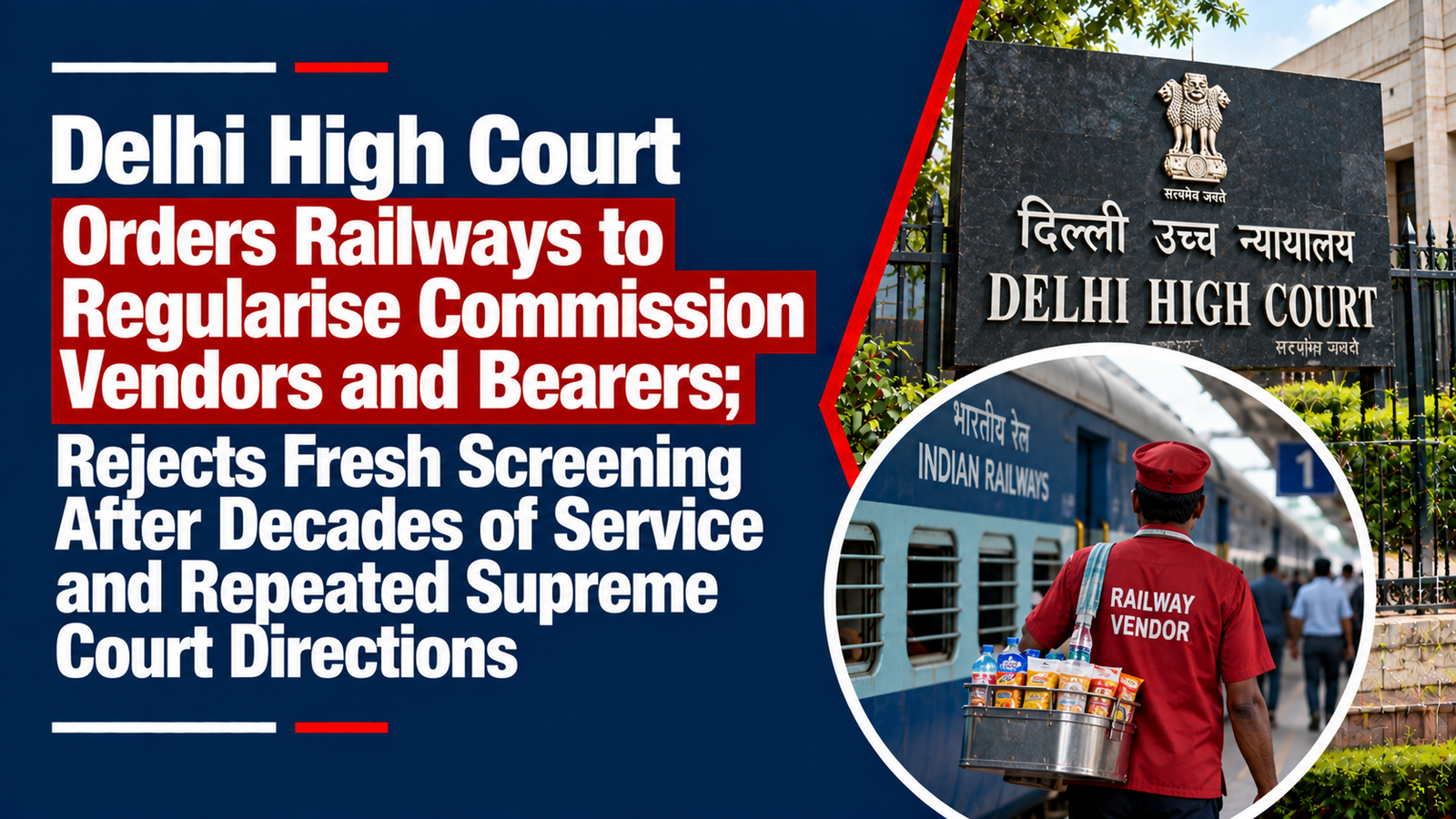
Railway Commission Vendors Entitled to Regularisation After Decades of Service: Delhi High Court Dismisses Centre’s Challenge to CAT Order
Facts
The Delhi High Court dealt with two writ petitions filed by the Union of India through the Ministry of Railways challenging a common order dated 7 November 2016 passed by the Central Administrative Tribunal in OA Nos. 4140/2013 and 173/2014. The respondents were long-serving commission bearers/vendors in the North Eastern Railway seeking regularisation of their services.
The controversy had an unusually long history.
As far back as 13 December 1976, the Railway Board had issued a circular directing that commission bearers and vendors be registered in order of length of service and progressively absorbed against regular vacancies.
The issue subsequently reached the Supreme Court. In Mahesh v. Union of India, the Supreme Court directed that the process of regularisation be completed and that the commission vendors be absorbed in accordance with the applicable rules. It later specifically directed implementation of the Railway Board’s 1976 memorandum.
The subject again came before the Supreme Court in South Eastern Railway Congress v. Chairman, Railway Board, where the Court directed that commission vendors and bearers awaiting absorption be paid the minimum of the revised pay scale along with allowances until their regular absorption.
Despite those directions, the dispute remained unresolved.
In 2005, the Railway Board issued another circular directing that all commission vendors/bearers should be regularised, even providing complete relaxation of educational qualifications, subject to prescribed opportunities for regularisation.
The respondents eventually approached the CAT, which directed the Railways to regularise them within 90 days, pay them the minimum pay scale and allowances from 14 November 2000, and pay ₹1 lakh in costs.
The Union of India challenged that order before the Delhi High Court.
Issues
The principal issues before the High Court were:
- Whether the respondents had an enforceable right to regularisation as commission bearers/vendors in light of the Railway Board’s 1976 policy and repeated Supreme Court directions.
- Whether the Railways could subject the respondents to a subsequent screening process and deny regularisation to those found unsuitable or not screened.
- Whether later Supreme Court jurisprudence concerning long-serving contractual, temporary and ad hoc employees further supported the respondents’ claim.
- Whether the Tribunal was justified in directing regularisation, consequential pay benefits and costs.
- Whether the Railways had satisfactorily established its assertion that several respondents had already been absorbed in Group-D posts.
Petitioners – Union of India / Railways’ Arguments
The Railways argued that those commission bearers/vendors who were eligible under the Railway Board circular dated 1 December 2005 had already been regularised.
According to the Union, certain respondents had been screened and found unsuitable, while others were allegedly not eligible for absorption. Therefore, they could not claim an automatic right to regularisation.
The Railways also relied on records purporting to show that several respondents had already been absorbed in Group-D posts.
Respondents’ Arguments
The commission vendors contended that their right to regularisation had already been settled by the Supreme Court.
They argued that the Railway Board’s 1976 policy, subsequent Railway circulars and binding Supreme Court directions required their absorption and that the Railways could not frustrate those rights by subsequently introducing or relying upon screening exercises.
Their case was that despite decades of litigation and repeated judicial directions, they continued to be denied the regular status and attendant service benefits granted to similarly situated railway employees.
Analysis of the Law
1. Supreme Court directions had already crystallised the respondents’ rights
The High Court held that the sequence of Railway Board circulars and Supreme Court orders left “no manner of doubt” that all commission bearers and vendors who were in service when the Supreme Court passed its orders in Mahesh and South Eastern Railway Congress were entitled to regularisation under the 1976 Railway Board circular.
It was undisputed that the respondents fell within this category.
Once that position was accepted, the Railways could not thereafter conduct a fresh screening exercise so as to eliminate some or all of the respondents from regularisation.
This was a decisive finding.
2. Decades-long temporary status cannot defeat substantive regularisation rights
The Court also relied upon the more recent line of Supreme Court authorities concerning employees who have served for long periods under contractual, casual, ad hoc or temporary labels.
It referred to Jaggo v. Union of India, Shripal v. Nagar Nigam, Vinod Kumar v. Union of India, Dharam Singh v. State of U.P. and Bhola Nath v. State of Jharkhand, as well as Delhi High Court decisions in Pawan Sharma, Kalpana Sharma and Om Prakash Gaur.
The principles emerging from those cases included that where employees are engaged through a legitimate selection process, work continuously for years and discharge essential or perennial duties, their initial label as contractual, casual, temporary or ad hoc does not by itself defeat the right to regularisation.
The Court emphasised that such a right, once earned, is substantive in nature.
Precedent Analysis
Mahesh v. Union of India
This was one of the foundational authorities concerning railway commission vendors.
The Supreme Court directed the Railways to complete the process of regularisation and absorb the commission vendors in accordance with the applicable rules. It subsequently directed implementation of the Railway Board’s 13 December 1976 memorandum.
The Delhi High Court treated these directions as directly binding upon the respondents’ category.
South Eastern Railway Congress v. Chairman, Railway Board
The Supreme Court again recognised the continuing entitlement of commission vendors and bearers awaiting absorption.
Pending regular absorption, they were ordered to receive the minimum revised pay scale and allowances that would be available upon permanent absorption.
This reinforced the proposition that regularisation was not a matter of mere administrative discretion.
Jaggo, Shripal, Vinod Kumar, Dharam Singh and Bhola Nath
The High Court relied upon these newer decisions as further strengthening the respondents’ case.
The emerging jurisprudence rejects the indefinite continuation of workers under temporary labels where they have rendered long, continuous and essential service, particularly where their appointments were not illegal or back-door appointments.
The Court treated these authorities as consistent with, and additional support for, the much earlier Railway-specific directions.
Pawan Sharma v. GNCTD
The Delhi High Court had held that where workers were selected through a process resembling regular recruitment, worked continuously for years and discharged essential duties, they were entitled to regularisation.
Importantly, the Supreme Court upheld Pawan Sharma on 14 May 2026, modifying only the seniority position so that employees regularised pursuant to the judgment would rank below those regularly appointed in the interregnum.
Rohan Vijay Nahar v. State of Maharashtra
The judgment also reproduced the Supreme Court’s strong observations concerning judicial discipline and obedience to binding precedent.
The High Court emphasised that Articles 141 and 144 of the Constitution require courts and authorities to follow and give effect to Supreme Court decisions rather than attempt to distinguish or avoid them artificially.
Court’s Reasoning
The High Court began by expressing “deep regret” that low-paid Group-D employees working as bearers and vendors had been forced to litigate for decades merely to obtain entitlements already recognised by the Supreme Court.
The Court held that the respondents’ right to regularisation arose directly from:
- the Railway Board’s 1976 circular;
- the Supreme Court’s orders;
- the Railways’ own subsequent 2005 circular; and
- later jurisprudence concerning long-serving temporary employees.
The Court therefore rejected the Railways’ attempt to rely upon a later screening process.
It held that there was “no question” of the Railways screening the respondents after their entitlement had already crystallised and eliminating any of them from regularisation.
Railways’ Absorption Records and Lack of Candour
A particularly significant part of the judgment concerned the Railways’ assertion that several respondents had already been absorbed.
The Railways had produced a table claiming that many respondents had been absorbed as Group-D employees.
The respondents disputed this.
The High Court accordingly directed the Railways to file an affidavit specifying the benefits received by regular employees and those being paid to each respondent, including retiral benefits.
Despite that direction, the Railways failed to file material substantiating its assertion that the relevant respondents had actually been regularised. Instead, it filed an affidavit stating that commission vendors who had not been regularised were not entitled to retirement benefits.
The High Court described this position as “very disturbing”.
It observed that one would expect the Railways to display candour before both the Tribunal and the High Court and ultimately accepted the respondents’ contention that none of them had actually been regularised, despite repeated judicial orders extending up to the Supreme Court.
Costs and Protection of Low-Paid Workers
The Tribunal had imposed ₹1 lakh costs on the Railways.
The High Court not only upheld those costs but stated that, if anything, the Tribunal had erred “on the side of leniency.”
The Bench observed that courts must protect weaker sections of society and persons earning paltry wages in order to preserve the socialist structure of Indian democracy, which is recognised in the Preamble.
The Court stated that it was inclined to enhance the costs but ultimately refrained from doing so.
Conclusion
The Delhi High Court found the CAT’s decision “unexceptionable” and held that there was no ground for interference.
It dismissed both writ petitions filed by the Union of India and upheld the Tribunal’s directions requiring:
- regularisation of the respondents;
- payment of the minimum applicable pay scale and allowances;
- implementation of consequential benefits; and
- payment of the ₹1 lakh costs awarded by the Tribunal.
The High Court directed that the Tribunal’s order, including payment of costs, be complied with within four weeks.
Significantly, the Court also noted that contempt proceedings had previously been initiated before the Tribunal but had been kept in abeyance during pendency of the writ petitions.
It expressly directed that if the Railways failed to comply within four weeks, the Tribunal should revive the contempt proceedings and take them to their logical conclusion.
Case Details
Case: Union of India & Ors. v. Mithai Lal & Ors.; Union of India & Ors. v. Ram Baran & Ors.
Court: Delhi High Court
Case Numbers: W.P.(C) 7973/2018 and W.P.(C) 8018/2018
CNR Nos.: DLHC011805892018 and DLHC011805842018
Bench: Justice C. Hari Shankar and Justice Om Prakash Shukla
Reserved On: 26 May 2026
Pronounced On: 8 September 2026
Result: Union of India’s writ petitions dismissed; CAT’s regularisation, pay and ₹1 lakh costs directions upheld; compliance ordered within four weeks, failing which contempt proceedings are to be revived.