

Court’s decision
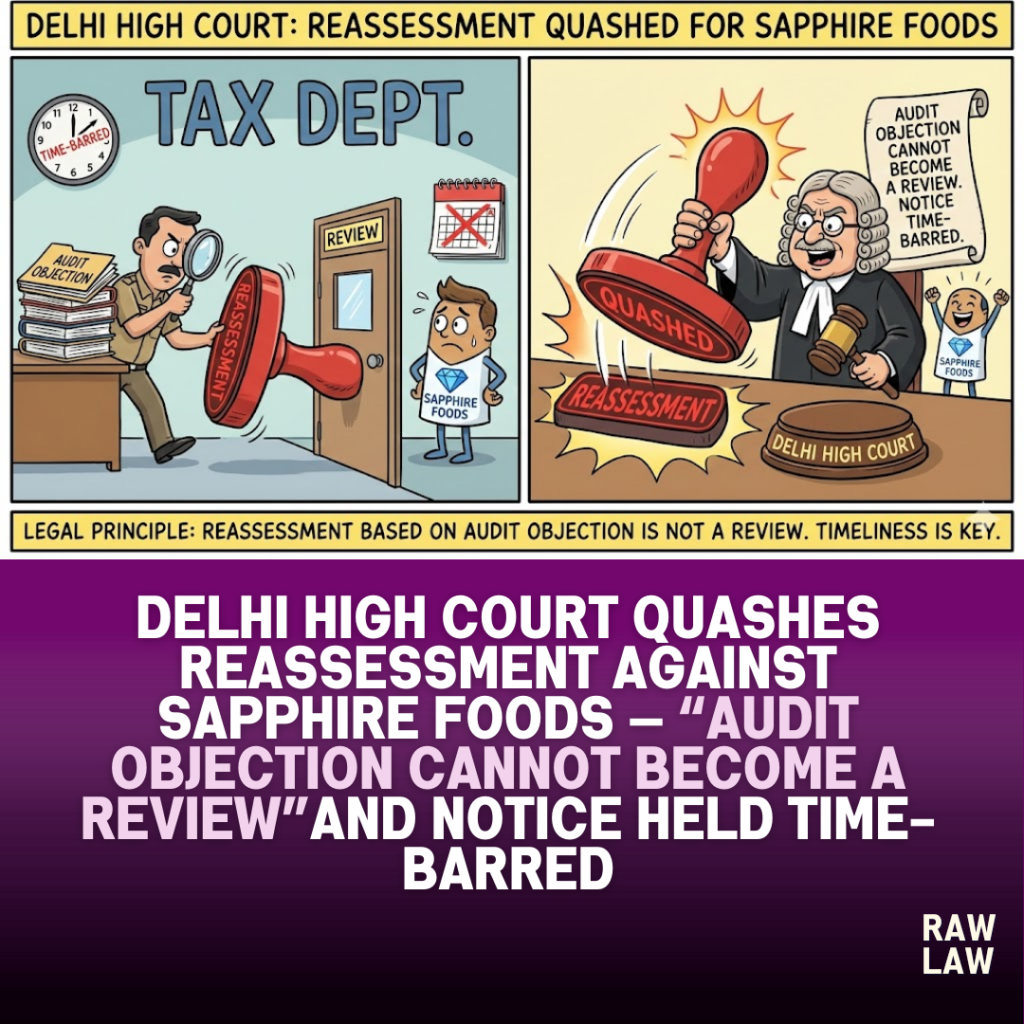
The Delhi High Court allowed the writ petition filed by Sapphire Foods India Ltd. and quashed the order passed under Section 148A(d) and the notice issued under Section 148 of the Income Tax Act, 1961 for Assessment Year 2016–17. The Court held that reopening based solely on an audit objection, when the issue had already been examined during scrutiny assessment, amounted to an impermissible review and change of opinion. It further ruled that the notice dated 31.03.2023 was barred by limitation under the first proviso to Section 149, as the extended period was unavailable in absence of failure to disclose material facts.
Facts
The petitioner company filed its return for AY 2016–17 declaring a loss. The case was selected for scrutiny, and assessment was completed under Section 143(3) on 09.12.2018. During scrutiny, the Assessing Officer had raised specific queries regarding director remuneration and legal and professional expenses, including payments of ₹8.90 crore to the Managing Director and ₹90.81 lakh to a shareholder-consultant.
The petitioner furnished employment and consulting agreements, TDS details, financial statements, and related disclosures. The assessment was finalized after considering these materials.
Subsequently, on 22.03.2023, a notice under Section 148A(b) was issued relying on audit objections alleging incorrect allowance of expenditure under Section 37. The Assessing Officer dropped one audit objection relating to share premium but sustained the objection concerning alleged excessive expenditure, leading to issuance of notice under Section 148.
Issues
The High Court examined whether reassessment proceedings could be initiated solely on the basis of audit objections when the relevant issue had already been examined in scrutiny assessment.
It further considered whether such reopening constituted a “change of opinion” prohibited by law.
Additionally, the Court examined whether the impugned notice was barred by limitation under Section 149, read with the unamended Section 147 applicable to the relevant assessment year.
Petitioner’s arguments
The petitioner contended that all primary facts relating to payments to the Managing Director and consultant were fully disclosed during scrutiny assessment. Specific queries were raised under Section 142(1), and complete replies were furnished along with supporting documents.
It was argued that reopening on identical material amounted to review of the earlier assessment, which is impermissible under settled law. Reliance was placed on precedents including CIT v. Kelvinator of India Ltd. and Financial Software & Systems (P) Ltd.
The petitioner also argued that since the original assessment was completed under Section 143(3), reopening beyond four years required failure to disclose material facts, which was absent in the present case.
Respondent’s arguments
The Revenue contended that audit objections constituted “information” within the meaning of Explanation 1(ii) to Section 148 and justified initiation of proceedings.
It was argued that payments amounting to ₹9.80 crore constituted 93% of total expenses against negligible turnover and were not wholly and exclusively for business purposes.
The Revenue further contended that the escaped income exceeded ₹50 lakh and therefore fell within extended limitation under Section 149(1)(b). It also argued that reassessment proceedings were conducted in accordance with the faceless scheme.
Analysis of the law
The Court examined Explanation 1(ii) to Section 148, which treats audit objections as “information.” However, it clarified that such information cannot enlarge the power of reassessment into a power of review.
Relying on the Supreme Court’s decision in Kelvinator of India Ltd., the Court reiterated that reassessment cannot be based on mere change of opinion. Where the Assessing Officer had examined the issue and accepted the claim after inquiry, reopening would amount to impermissible review.
The Court also referred to the earlier decision in Springer Healthcare Ltd., which held that audit objections cannot compel issuance of notice if the issue was already examined and concluded in assessment proceedings.
Precedent analysis
The Court distinguished CIT v. PVS Beedies (P) Ltd., where audit objections pointed out factual omissions not previously considered. In contrast, in the present case, the Assessing Officer had raised specific queries and received detailed replies regarding the impugned payments.
The Court applied the principle laid down in Financial Software & Systems (P) Ltd., where reopening was held invalid when the issue had been specifically examined in scrutiny assessment.
Thus, the Court concluded that the present case squarely fell within the doctrine prohibiting change of opinion.
Court’s reasoning
The Court observed that the Assessing Officer had consciously examined the expenditure in question during scrutiny proceedings. Although the final assessment order did not elaborate on the issue, the existence of detailed queries and replies demonstrated due application of mind.
The audit objection merely questioned the commercial wisdom and justification of the payments, which had already been disclosed and examined. Such objection could not convert reassessment into a review mechanism.
On limitation, the Court held that since the original assessment was completed under Section 143(3), reopening beyond four years was permissible only if there was failure to disclose fully and truly all material facts. As no such failure was established, the extended period under Section 149 was unavailable.
Accordingly, the notice dated 31.03.2023 was held to be time-barred.
Conclusion
The Delhi High Court quashed the order under Section 148A(d) and the notice under Section 148 for AY 2016–17. It held that reassessment based on audit objection, in absence of fresh tangible material and failure to disclose, amounted to impermissible review and was barred by limitation.
Implications
This ruling strengthens taxpayer protections against mechanical reopening of completed assessments. It clarifies that audit objections cannot override the doctrine of change of opinion.
The judgment reinforces the limitation safeguards under Section 149 and underscores that reassessment powers cannot be used as tools for revisiting concluded scrutiny findings.
For corporates, the decision reiterates the importance of comprehensive disclosure during scrutiny proceedings, which can shield against future reopening attempts.
Case law references
- CIT v. Kelvinator of India Ltd. (2010) 2 SCC 723 — Reassessment cannot be based on change of opinion.
- Financial Software & Systems (P) Ltd. v. CIT (2022 SCC OnLine SC 1411) — Reopening invalid where issue was examined in scrutiny.
- CIT v. PVS Beedies (P) Ltd. (1999) 237 ITR 13 (SC) — Audit objection permissible where factual error not previously considered.
- Springer Healthcare Ltd. v. ACIT (Delhi High Court) — Audit objection cannot convert reassessment into review.
FAQs
1. Can reassessment be initiated solely on the basis of an audit objection?
Yes, audit objections can constitute “information,” but reassessment is invalid if the issue was already examined in scrutiny and no new material exists.
2. What is ‘change of opinion’ in income tax reassessment?
It refers to reopening an assessment based on the same material previously examined by the Assessing Officer, which is legally impermissible.
3. When is reopening beyond four years barred?
If an assessment under Section 143(3) was completed and there was no failure by the assessee to disclose material facts, reopening beyond four years is barred under Section 149.


