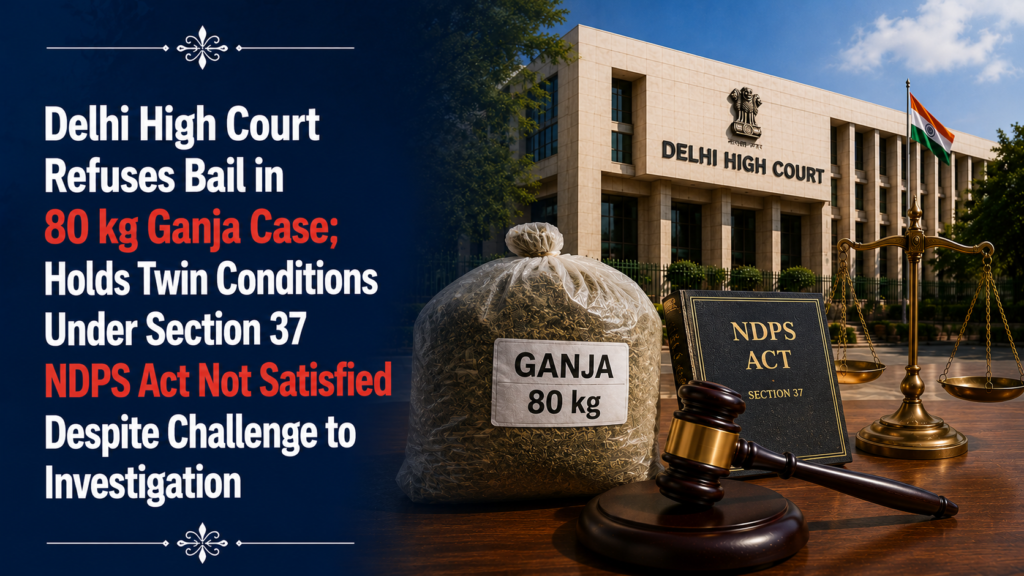
Delhi High Court Refuses Bail in 80 kg Ganja Case; Holds Twin Conditions Under Section 37 NDPS Act Not Satisfied Despite Challenge to Investigation.

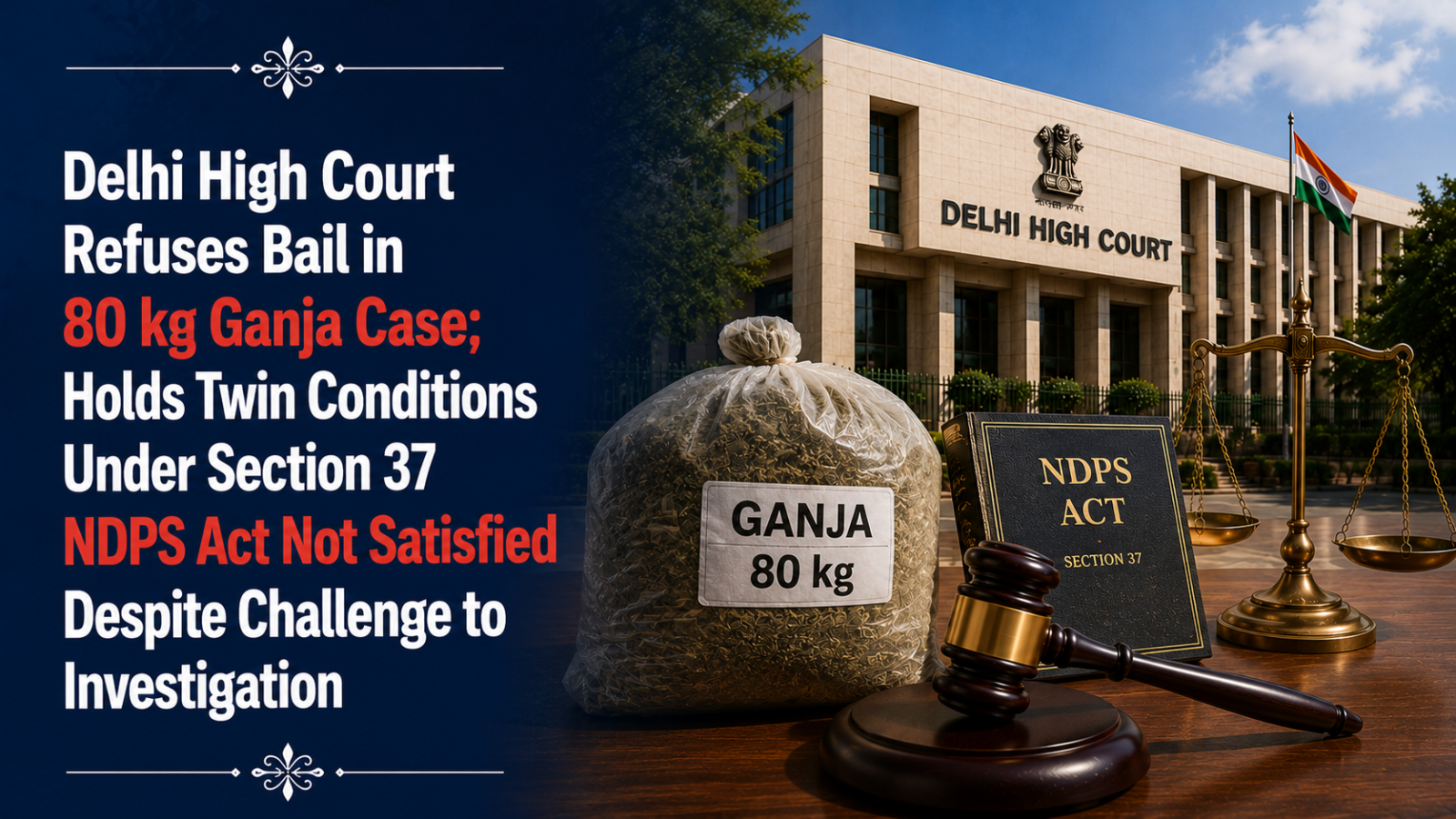
Delhi High Court Denies Bail to Accused Found with 80 kg Ganja; Holds Section 37 NDPS Act Bar Applies to Commercial Quantity.
Facts
The appellant sought regular bail in FIR No. 76 of 2024 registered by the Crime Branch, Delhi, for offences under Sections 20, 25 and 29 of the NDPS Act.
According to the prosecution, acting on secret information, the police intercepted the applicant and a co-accused while they were travelling in a car. The police allegedly recovered four gunny bags containing 80 kilograms of ganja from the vehicle, leading to their arrest. Since the recovered quantity was four times the notified commercial quantity of 20 kilograms, the prosecution asserted that the stringent restrictions under Section 37 of the NDPS Act governed the bail application.
Issues
The Delhi High Court considered:
- Whether the applicant had satisfied the twin conditions prescribed under Section 37 of the NDPS Act for grant of bail.
- Whether alleged procedural irregularities in the investigation justified release on bail.
- Whether the applicant’s criminal antecedents and conduct during earlier interim bail disentitled him to discretionary relief.
Applicant’s Arguments
The applicant contended that he was innocent and had not been in conscious possession of the alleged contraband.
He argued that the investigation suffered from several defects, including failure to obtain arrest warrants, improper compliance with Section 50 of the NDPS Act, failure to identify either the source or intended destination of the recovered ganja, and omission to lift fingerprints from the gunny bags.
It was also submitted that these deficiencies would ultimately result in his acquittal after trial and therefore his liberty ought to be protected by granting bail. During the hearing, the defence clarified that a notice under Section 50 had in fact been served, but alleged that it had been issued mechanically and in violation of his fundamental rights.
State’s Arguments
The prosecution opposed the bail application on the ground that the alleged recovery of 80 kilograms of ganja constituted a commercial quantity, thereby attracting the rigours of Section 37 of the NDPS Act.
The State further pointed out that the applicant was involved in four other criminal cases, including another prosecution under the NDPS Act.
It was also highlighted that the co-accused had previously obtained interim bail but thereafter absconded and was declared a proclaimed offender. Additionally, the present applicant himself had failed to surrender on the date directed by the High Court after withdrawal of an earlier bail application and surrendered only several days later. According to the prosecution, these circumstances demonstrated that the applicant was likely to commit further offences or evade the process of law if enlarged on bail.
Analysis of the Law
The High Court reiterated that where the recovered contraband constitutes a commercial quantity, bail cannot be granted unless both conditions prescribed under Section 37 of the NDPS Act are satisfied.
First, the Court must be satisfied that there are reasonable grounds for believing that the accused is not guilty of the alleged offence.
Secondly, the Court must also be satisfied that the accused is not likely to commit any offence while on bail.
The Court observed that these statutory requirements impose a substantially higher threshold than ordinary bail principles and must be affirmatively satisfied before release can be ordered.
Court’s Reasoning
The Court found that none of the procedural objections raised by the applicant—including the alleged defects regarding Section 50 compliance, fingerprints, arrest procedure or investigation—created reasonable grounds at the bail stage to conclude that he was not guilty of the alleged offence.
The Court further noted that the applicant had criminal antecedents involving four previous cases, including another NDPS prosecution. His conduct in failing to surrender on the date earlier directed by the Court after enjoying interim bail also weighed heavily against him.
These circumstances persuaded the Court that the second statutory condition under Section 37 was equally unsatisfied, as there was no basis to conclude that the applicant would refrain from committing offences or would faithfully comply with future bail conditions.
Consequently, neither limb of the statutory test stood fulfilled.
Conclusion
The Delhi High Court held that the recovery involved a commercial quantity of ganja and that the applicant had failed to satisfy either of the mandatory twin conditions under Section 37 of the NDPS Act.
Finding no reasonable grounds to believe that the applicant was not guilty and no assurance that he would refrain from committing further offences while on bail, the Court dismissed the regular bail application.
Case Details
Case: Saurabh Singh @ Sonu v. State (Govt. of NCT of Delhi)
Court: High Court of Delhi
Case Number: Bail Application No. 2070 of 2026
Judge: Justice Girish Kathpalia
Date: 29 July 2026
Result: Bail application dismissed. The Delhi High Court held that the alleged recovery of 80 kilograms of ganja attracted the rigours of Section 37 of the NDPS Act and that the applicant failed to satisfy either of the mandatory conditions required for grant of bail.