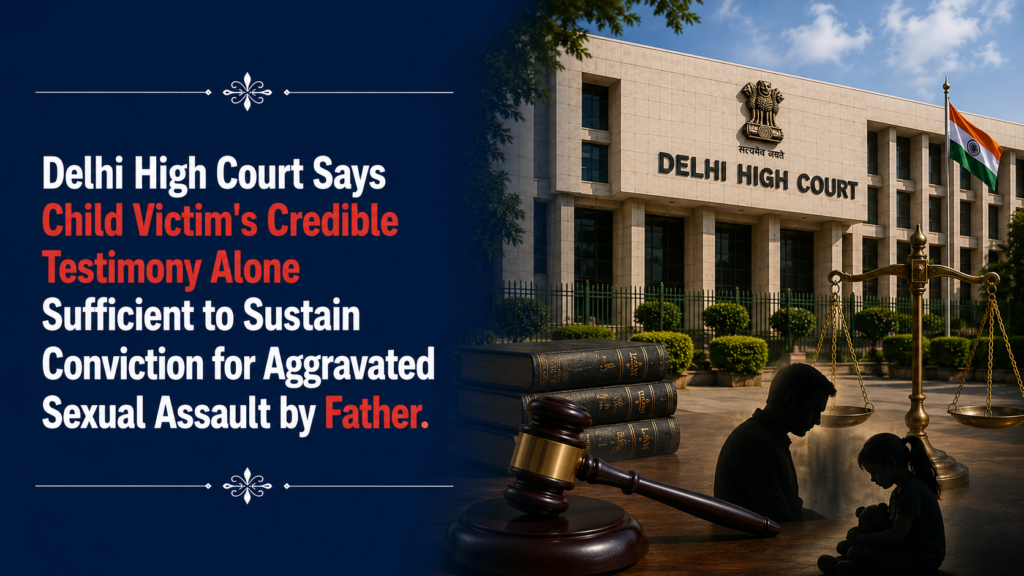
Delhi High Court Says Child Victim’s Credible Testimony Alone Sufficient to Sustain Conviction for Aggravated Sexual Assault by Father.

Delay in Reporting During COVID Lockdown Does Not Weaken POCSO Prosecution; Delhi High Court Upholds Father’s Conviction.
Facts
The appellant, the biological father of a ten-year-old girl, challenged his conviction under Section 10 of the Protection of Children from Sexual Offences Act, 2012 (POCSO Act) and Section 354B IPC.
According to the prosecution, around 4–5 days before 30 April 2021, at about 11:00 p.m., the child was sleeping beside her mother when she woke up to find her father lying naked on top of her after removing her lower garment. She screamed, waking her mother, who immediately pushed the accused away and took the child into another room. The accused allegedly attempted to force his way into that room and later threatened them.
An FIR was registered on 30 April 2021. After investigation, the accused was chargesheeted and ultimately convicted by the Special POCSO Court, which sentenced him to seven years’ rigorous imprisonment and a fine of ₹25,000 under Section 10 of the POCSO Act. He appealed before the Delhi High Court.
Issues
The Delhi High Court considered:
- Whether the prosecution had proved the offence of aggravated sexual assault beyond reasonable doubt.
- Whether delay in lodging the FIR, absence of medical injuries and non-conduct of internal examination weakened the prosecution case.
- Whether the testimony of the child victim alone was sufficient to sustain conviction.
- Whether the defence of false implication arising from an alleged property dispute created reasonable doubt.
Appellant’s Arguments
The appellant argued that the conviction was unsustainable because there was unexplained delay in registration of the FIR, inconsistencies between the FIR, the child’s statement under Section 164 CrPC and her deposition before the trial court, and absence of corroborative medical evidence.
It was also argued that the child’s mother refused internal medical examination, no site plan was prepared, the victim’s siblings were not examined as witnesses, and the prosecution failed to establish the allegations beyond reasonable doubt.
The appellant further contended that the case was fabricated owing to an ongoing property dispute between him and his wife.
Respondent’s Arguments
The State argued that the testimony of the child victim was natural, consistent and wholly reliable. It submitted that minor discrepancies were insignificant and that settled law recognises that conviction in sexual offence cases can rest solely upon the testimony of the prosecutrix if found credible.
The prosecution further contended that the delay in reporting was satisfactorily explained because the incident occurred during the COVID-19 lockdown and the family approached the police at the earliest practicable opportunity.
It was also argued that the allegation of property dispute remained completely unsubstantiated.
Analysis of the Law
The High Court reiterated the settled principles governing appreciation of evidence in sexual offence cases involving children.
The Court held that delay in lodging an FIR is not automatically fatal where the surrounding circumstances furnish a natural explanation. The COVID-19 lockdown and the incident occurring during late-night hours adequately explained the short delay in reporting.
The Court further held that absence of medical injuries or refusal to permit an internal medical examination did not weaken the prosecution because the allegation was one of attempted aggravated penetrative sexual assault, not completed penetration.
The Court also observed that omission to examine every available witness or prepare a detailed site plan does not necessarily create reasonable doubt where the direct evidence of the victim is trustworthy.
Precedent Analysis
The Court relied upon State of Punjab v. Gurmit Singh, reaffirming that the testimony of a victim of sexual assault ordinarily does not require corroboration if it inspires confidence.
It further relied upon Ganesan v. State, State of Madhya Pradesh v. Balveer Singh, and State of Rajasthan v. Chatra, reiterating that conviction may safely rest upon the sole testimony of a child victim where the evidence is natural, consistent and withstands cross-examination.
On the defence burden, the Court referred to Harbhajan Singh, V.D. Jhingan, and Munshi Ram, holding that although an accused need establish a defence only on a preponderance of probabilities, some material evidence must nevertheless be produced when a specific defence is pleaded.
Court’s Reasoning
The High Court found the testimony of the child victim to be clear, spontaneous and consistent on all material particulars. Her account of waking to find her father lying naked over her after pulling down her lower garment was substantially corroborated by her mother’s testimony regarding the child’s alarm, the accused’s conduct and the immediate events that followed.
The Court rejected the challenge based on delay in the FIR, observing that the incident occurred during the nationwide COVID-19 lockdown and the explanation offered by the mother remained unshaken during cross-examination.
The Court also rejected the property dispute defence, noting that apart from a bare suggestion during cross-examination, the appellant produced no documentary or oral evidence establishing any such dispute. The Court considered it inherently improbable that a ten-year-old child would falsely implicate her own father in such grave allegations without compelling reason.
Finally, the Court held that the appellant’s conduct clearly constituted sexual assault under Section 7 of the POCSO Act because, with sexual intent, he physically contacted the child after removing her lower garment and lying naked upon her. Since the victim was below twelve years of age and the accused was her biological father, the offence squarely fell within Sections 9(m) and 9(n), making it aggravated sexual assault punishable under Section 10 of the Act. The ingredients of Section 354B IPC were also established.
Conclusion
The Delhi High Court dismissed the appeal and affirmed both the conviction and sentence.
The Court held that the prosecution had established the offence beyond reasonable doubt through the credible testimony of the child victim, corroborated by her mother. Minor inconsistencies, absence of medical injuries, non-examination of additional witnesses and delay during the COVID-19 lockdown did not create any reasonable doubt.
Accordingly, the conviction under Section 10 of the POCSO Act and Section 354B IPC, along with the sentence of seven years’ rigorous imprisonment, was upheld.
Case Details
Case: Shah Nawaz v. State (NCT of Delhi)
Court: High Court of Delhi
Case Number: Criminal Appeal No. 1190 of 2025
Judge: Justice Chandrasekharan Sudha
Date: 29 July 2026
Result: Appeal dismissed. The Delhi High Court upheld the conviction and sentence of the appellant under Section 10 of the POCSO Act and Section 354B IPC, holding that the child victim’s reliable testimony alone was sufficient to sustain the conviction.