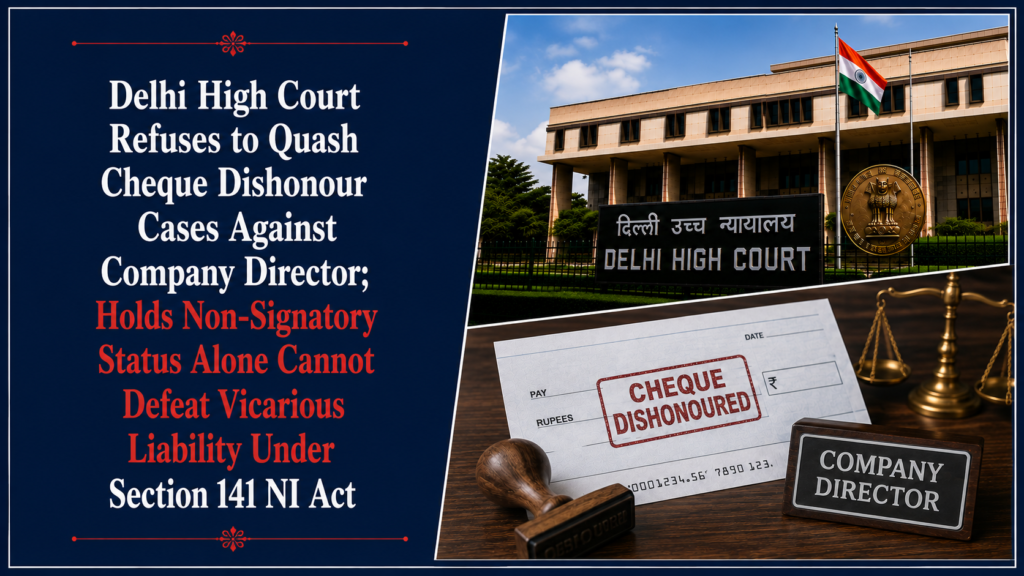
Delhi High Court Refuses to Quash Cheque Dishonour Cases Against Company Director; Holds Non-Signatory Status Alone Cannot Defeat Vicarious Liability Under Section 141 NI Act

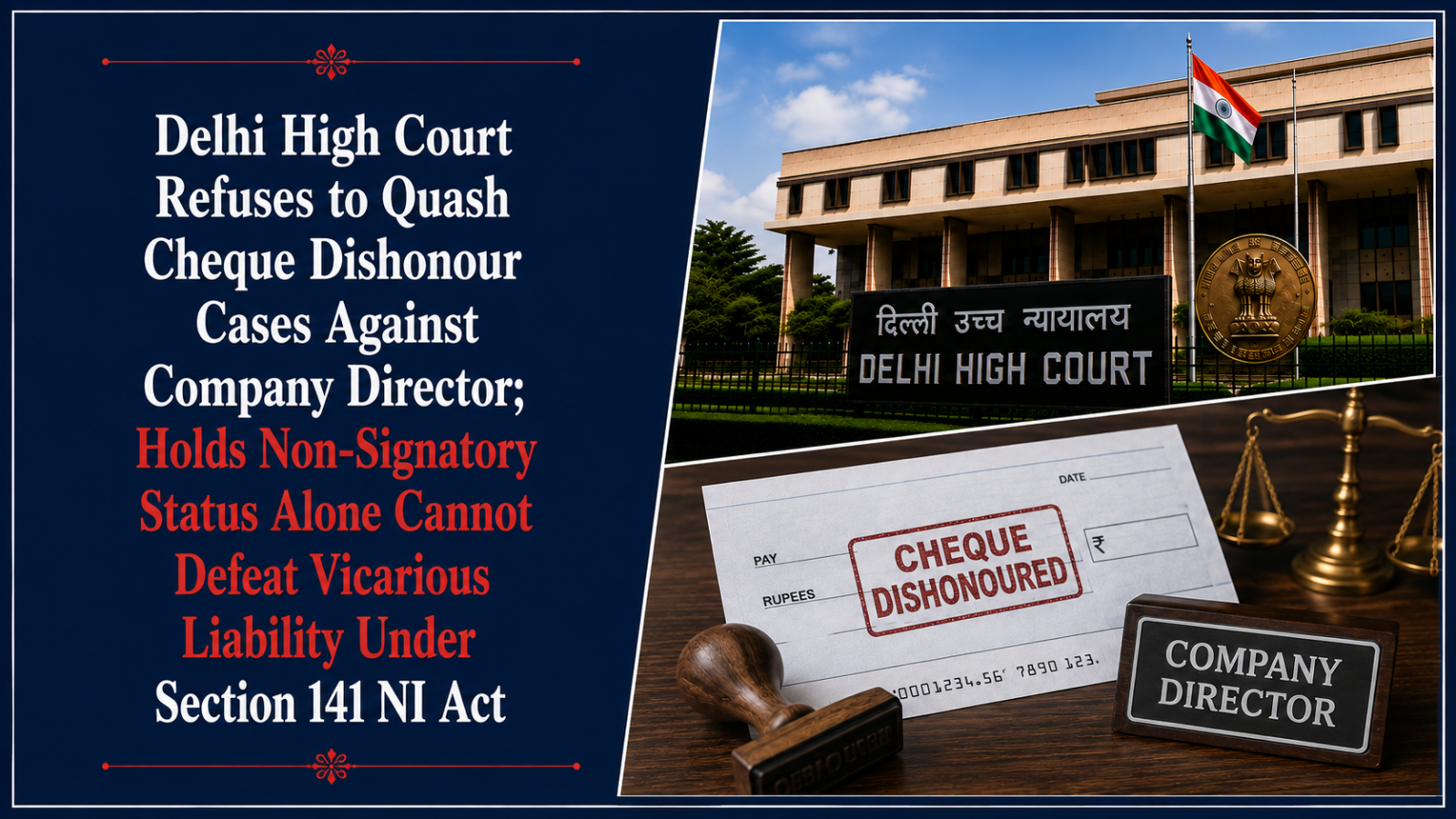
Delhi High Court Dismisses Director’s Challenge to Three Cheque Bounce Cases; Finds No Patent Illegality or Non-Application of Mind in Summoning Orders
Facts
Seema Oberoi filed three petitions under Section 482 Cr.P.C. seeking quashing of summoning orders dated 10 August 2017 passed by the Metropolitan Magistrate, Dwarka Courts, in complaints instituted by Axis Bank Ltd. under Sections 138 and 141 of the Negotiable Instruments Act, 1881 against M/s Dev Bhoomi Automobiles Pvt. Ltd. and its Directors.
The company had availed various loan facilities from Axis Bank. Towards repayment of outstanding liabilities, three cheques dated 5 June 2017 were issued for ₹5,50,000, ₹3,80,000 and ₹4,91,667, respectively.
In one of the complaints, concerning an auto loan of ₹11.40 lakh, the cheque for ₹3.80 lakh was dishonoured with the remark “Account Blocked.” Similar complaints were instituted concerning the other dishonoured cheques. After statutory demand notices were issued and payment was not made within the prescribed period, Axis Bank initiated proceedings against the company and its Directors.
The Magistrate considered the complaints, pre-summoning evidence by affidavit and supporting documents and found a prima facie case under Section 138 NI Act. Summons were consequently issued against the accused, including Seema Oberoi.
She approached the High Court contending principally that she had neither signed the dishonoured cheques nor participated in the day-to-day affairs of the company.
Issues
The principal issues were:
- Whether a Director who was not a signatory to the dishonoured cheques could nevertheless be proceeded against under Section 141 NI Act.
- Whether the complaints contained sufficient foundational averments that the petitioner was in charge of and responsible for the company’s business when the offences were committed.
- Whether the petitioner’s actual involvement in the company’s management could be conclusively examined in proceedings under Section 482 Cr.P.C.
- Whether the Magistrate’s summoning orders demonstrated sufficient application of mind to justify continuation of the criminal proceedings.
Petitioner’s Arguments
The petitioner argued that she had been made an accused solely because she was designated as a Director of the borrower company.
She was admittedly not a signatory to any of the dishonoured cheques, which had been signed by another accused. The complaints and pre-summoning evidence, according to her, did not attribute any specific role to her in the underlying transactions.
She further contended that the complaints merely reproduced the statutory language of Section 141 without laying a factual foundation to show that she was actually in charge of and responsible for the day-to-day business of the company.
The loan documents did not bear her signature, and there was allegedly no material showing her participation in the sanction, availing or operation of the loan facilities.
The petitioner also argued that the statutory demand notices were never served upon her.
Relying upon Himanshu v. B. Shivamurthy and Sunita Palita v. Panchami Stone Quarry, she submitted that mere designation as a Director cannot automatically attract vicarious criminal liability under Section 141 NI Act and that specific allegations concerning the Director’s role are necessary.
Respondent’s Arguments
Axis Bank opposed the petitions and argued that the complaints, pre-summoning evidence and documents disclosed the essential ingredients necessary to proceed under Sections 138 and 141 NI Act.
The Bank emphasised that the petitioner was admittedly reflected in Ministry of Corporate Affairs records as a Director of the company during the relevant period when the loans were availed, the cheques were issued and the alleged offences occurred.
It contended that the complaints specifically alleged that all accused Directors were in charge of and responsible for the company’s business. Such averments were sufficient at the summoning stage.
The Bank further argued that liability under Section 141 is not restricted to the person who physically signs the cheque. Whether the petitioner actually participated in day-to-day management and exercised control over the company were factual matters requiring evidence at trial.
Accordingly, the petitioner’s arguments constituted defences and disputed questions of fact inappropriate for adjudication under Section 482 Cr.P.C.
Analysis of the Law
The High Court reiterated that the scope of enquiry at the summoning stage is limited.
The Magistrate is not required to determine whether the material is sufficient to ultimately convict the accused. The enquiry is confined to whether the complaint, supporting affidavit and documents disclose sufficient grounds for proceeding.
Relying upon Sunil Todi v. State of Gujarat, the Court noted that the Magistrate’s task at the stage of issuance of process is to assess whether a prima facie case exists rather than conduct a detailed evaluation of the probable defence or evidentiary sufficiency for conviction.
On Section 141 NI Act, the Court held that liability is not confined to the signatory of the dishonoured cheque. A person who was in charge of and responsible for the conduct of the company’s business when the offence occurred may also be proceeded against.
At the quashing stage, the High Court cannot conduct a meticulous examination of whether the Director was actually involved in management. Such questions ordinarily require evidence.
Precedent Analysis
The petitioner relied on Himanshu v. B. Shivamurthy, AIR 2019 SC 3052 and Sunita Palita v. Panchami Stone Quarry, AIR 2022 SC 3548, to argue that vicarious liability cannot be imposed merely because a person holds the office of Director and that the complaint must contain sufficient allegations regarding the Director’s responsibility for the company’s business.
The High Court relied upon Sunil Todi v. State of Gujarat, which in turn discussed Birla Corporation Ltd. v. Adventz Investments & Holdings Ltd., Chief Controller of Imports & Exports v. Roshanlal Agarwal and Bhushan Kumar v. State (NCT of Delhi). These authorities establish that at the summoning stage the Magistrate examines whether sufficient grounds exist to proceed, not whether the prosecution evidence will ultimately sustain a conviction.
Significantly, the Court relied upon the Supreme Court’s decision in HDFC Bank Ltd. v. State of Maharashtra & Anr., 2025 INSC 759.
The Court noted that HDFC Bank reiterates that proceedings against a Director cannot be quashed merely because the complaint fails to reproduce the exact language of Section 141. The complaint must instead receive a meaningful reading as a whole to determine whether its allegations indicate the Director’s involvement in the company’s affairs and relevant transaction. Substance must prevail over form, and hyper-technical scrutiny at the threshold is impermissible.
Court’s Reasoning
The Court found that the complaints did more than simply identify Seema Oberoi as a Director.
They alleged that the Directors were responsible for and in charge of the company’s affairs and business at the relevant time. MCA records also showed that the petitioner continued to be a Director when the transactions occurred and the cheques were issued.
Her non-signatory status was not sufficient to terminate the proceedings because Section 141 creates vicarious liability extending beyond the person who physically signs the cheque.
The crucial question was whether she was actually involved in management, exercised control over the company’s business and was responsible for its affairs when the offence occurred. Those were evidentiary questions requiring trial, rather than matters capable of final determination under Section 482.
The Court also rejected the argument that the complaints lacked sufficient Section 141 averments. Reading the complaints meaningfully and as a whole, they contained the necessary foundational allegations to sustain proceedings at the threshold.
Finally, the Magistrate had considered the complaint, affidavit evidence and accompanying documents before concluding that sufficient grounds existed to proceed. The High Court therefore found no patent illegality, perversity or non-application of mind in the summoning orders.
Conclusion
The Delhi High Court dismissed all three petitions and refused to quash the Section 138/141 NI Act proceedings against Seema Oberoi.
The Court held that the complaints and accompanying material disclosed a prima facie case sufficient to proceed against her. Her contentions that she was not involved in the company’s affairs and could not incur vicarious liability were defences that could appropriately be raised before the Trial Court after evidence was led.
No exceptional circumstance existed warranting exercise of the High Court’s inherent powers to quash the complaints or summoning orders at the threshold.
Case Details
Case: Seema Oberoi v. Axis Bank Limited & Ors.
Court: High Court of Delhi at New Delhi
Case Numbers: CRL.M.C. 4786/2023, CRL.M.C. 6152/2023 & CRL.M.C. 8053/2023
Judge: Hon’ble Ms. Justice Madhu Jain
Reserved on: 27 July 2026
Date: 11 August 2026
Result: All three petitions dismissed; summoning orders and proceedings under Sections 138 and 141 of the Negotiable Instruments Act allowed to continue.