


1. Court’s decision
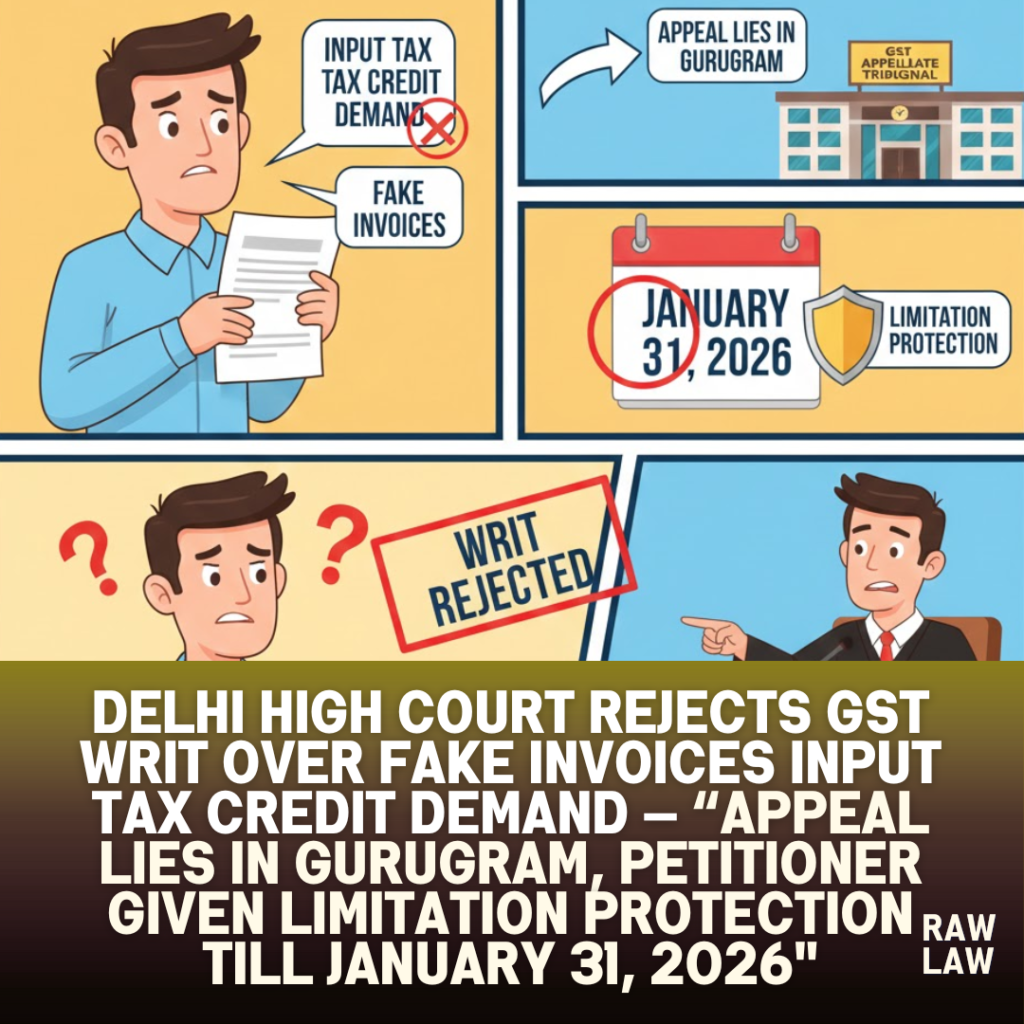
The Delhi High Court disposed of a writ petition challenging a GST adjudication order raising demands for alleged fraudulent availment of input tax credit. The Court held that the objections on “proper officer”/designation on the GST portal and territorial confusion about where the appeal lies were not tenable on the record, and that the petitioner should pursue the statutory appellate remedy under Section 107 of the Central Goods and Services Tax Act, 2017. Importantly, the Court clarified that the Commissioner (Appeals), Gurugram is the correct appellate forum and granted a protective direction: if the appeal is filed by 31 January 2026 with the required pre-deposit, it shall not be dismissed on limitation and must be decided on merits.
2. Facts
The petition challenged an order dated 14 February 2025 passed by a Joint Commissioner raising demands against the petitioner for alleged fraudulent input tax credit. The records described a multi-city “chain” of entities and individuals allegedly involved in issuance of fake invoices without actual supply of goods/services, with one individual identified as running a network of fake firms. The petitioner, stated to be proprietor of a firm, was alleged to be part of the chain by claiming to have availed manpower from one of the fake firms.
The petitioner raised two procedural/legal objections: first, that the show cause notice dated 4 August 2024 could not have been issued by a Superintendent of the Directorate General of Goods and Services Tax Intelligence (DGGI) given the monetary stakes and should have been at a higher level; and second, that although proceedings took place in Faridabad, the final order and portal summary suggested Delhi as well, creating uncertainty about appellate jurisdiction.
3. Issues
The Court dealt with: (i) whether the show cause notice was invalid because it was shown on the GST portal under a Superintendent’s name, allegedly contrary to monetary-limit allocations; (ii) whether there was genuine uncertainty on where the appeal lies because the order appeared connected to both Faridabad and Delhi; and (iii) whether these objections warranted writ interference despite the availability of an efficacious statutory appeal mechanism in a case involving allegations of fraudulent ITC.
4. Petitioner’s arguments
The petitioner argued that given the amount involved, the show cause notice could not lawfully have been issued by a Superintendent of DGGI and had to be issued at the Joint Director level. The petitioner also contended that the proceedings were conducted in Faridabad, but the final order appeared to have been passed from both Delhi and Faridabad by the same officer and that the DRC-07 summary reflected “Joint Commissioner, South Delhi,” creating confusion about the correct appellate forum and the place where the order was truly passed. On these grounds, the petitioner sought writ relief to set aside the impugned order and corresponding demands.
5. Respondent’s arguments
The respondents stated that although the show cause notice was reflected on the portal under the Superintendent’s name, it was actually signed by the Joint Director. On the appellate-jurisdiction question, the respondents produced a CBIC circular dated 24 June 2025 on review/revision/appeal for orders passed by “common adjudicating authorities,” and also relied on Notification No. 02/2017-Central Tax (Table III), asserting that appeals against such orders would lie before the Commissioner (Appeals) corresponding to the territorial jurisdiction of the Commissionerate under which the adjudicating authority is posted—here, indicating Gurugram as the appellate forum for Faridabad/Gurugram Commissionerates.
6. Analysis of the law
The Court approached the matter through two regulatory building blocks. First, it considered the CBIC’s framework on “common adjudicating authorities,” which clarifies that for Orders-in-Original passed by such authorities, the appeal lies before the Commissioner (Appeals) corresponding to the territorial jurisdiction of the Principal Commissioner/Commissioner under whom the adjudicating authority is posted. Second, the Court examined the older CBIC circular prescribing monetary limits for different levels of officers to issue show cause notices and pass orders under Sections 73 and 74 of the CGST Act, while also explaining the special mechanism for DGGI-originated cases involving multiple noticees across jurisdictions, where Additional/Joint Commissioners may be empowered with all-India jurisdiction for adjudication.
Given this structure, the Court treated the “designation on portal” argument as a form-versus-substance objection—especially where the respondents asserted the show cause notice was signed by the competent Joint Director. The Court also treated jurisdictional clarity for appeals as ascertainable from the order itself and the relevant notifications/circulars.
7. Precedent analysis
This order is driven primarily by statutory remedies and CBIC circular/notification architecture rather than judicial precedents. The Court did not build its reasoning on reported case law; instead, it relied on the text of the impugned order and administrative circulars to resolve the appeal-forum confusion, and then applied the principle of exhausting statutory appeals in GST adjudication—especially in fraud-related input tax credit disputes.
8. Court’s reasoning
On appellate forum, the Court undertook a close reading of the impugned adjudication order, noting it expressly stated that the appeal lies before the Commissioner (Appeals), Gurugram, with the address provided and a ninety-day period under Section 107. The Court also clarified that the DRC-07 was merely an uploaded summary and could be uploaded by the jurisdictional Commissionerate (here, South Delhi) even if the adjudication was by the authority at Faridabad. This removed the claimed uncertainty about where the appeal should be filed.
On the “Superintendent issuance” point, the Court accepted the respondents’ explanation that the show cause notice appearing under the Superintendent’s name on the portal was not decisive because it was actually signed by the Joint Director, and it further observed that, in multi-noticee DGGI matters spanning multiple jurisdictions, adjudication can be fixed based on where the highest tax demand lies, avoiding fragmented adjudication. The Court concluded the petitioner’s objections were not tenable and, in any case, could be raised before the appellate authority.
Finally, given the allegations of fraudulent ITC, the Court relegated the petitioner to the statutory appeal. To avoid limitation injustice arising from time spent in the writ, it granted a firm protective window: if the appeal is filed by 31 January 2026 with the pre-deposit, it shall not be rejected as time-barred and must be decided on merits.
9. Conclusion
The Delhi High Court declined writ intervention in a GST input tax credit fraud demand dispute, clarified that the correct appellate forum is the Commissioner (Appeals), Gurugram, and directed the petitioner to file a statutory appeal. The Court’s key practical relief was limitation protection up to 31 January 2026, ensuring the appeal route remains meaningful notwithstanding the pendency of the writ petition.
10. Implications
For GST taxpayers facing DGGI-led investigations and adjudications involving multiple noticees across jurisdictions, the decision reinforces that jurisdictional complexity is addressed through CBIC’s “common adjudicating authority” framework, and that portal entries like DRC-07 or officer labels are not determinative if the adjudication order and signatures show the competent authority. The order is also significant for appellate strategy: it clarifies that appellate jurisdiction follows where the adjudicating authority is posted (as per the relevant notification/table), and courts may grant specific, date-certain limitation protection when relegating parties to appeal—particularly where fraud allegations make writ bypass unattractive.
Case law references
No external case citations form the basis of the decision. The order relies primarily on CBIC Circular No. 250/07/2025-GST (24 June 2025), Notification No. 02/2017-Central Tax (19 June 2017) (Table III), and Circular No. 31/05/2018-GST (9 February 2018) to address officer competence and appellate forum in DGGI/common adjudication cases.
FAQs
1) Where do I file a GST appeal if the adjudication is by a “common adjudicating authority” and the portal shows another commissionerate on DRC-07?
This order clarifies that the appeal lies before the Commissioner (Appeals) corresponding to the territorial jurisdiction of the Principal Commissioner/Commissioner under whom the common adjudicating authority is posted. Here, despite the DRC-07 showing South Delhi, the adjudication order indicated the appeal lies before Commissioner (Appeals), Gurugram.
2) Can a GST show cause notice be challenged because it is shown on the portal under a Superintendent’s name?
Not necessarily. The respondents explained that the notice was actually signed by the competent Joint Director, and the Court treated the portal display as not decisive. Such objections can be raised in statutory appeal.
3) Will the High Court entertain a writ petition against a GST order alleging fraudulent input tax credit?
Generally, courts may insist on exhausting the statutory appeal remedy. In this case involving fraudulent ITC allegations, the High Court relegated the petitioner to appeal and provided limitation protection if the appeal is filed by 31 January 2026 with pre-deposit.