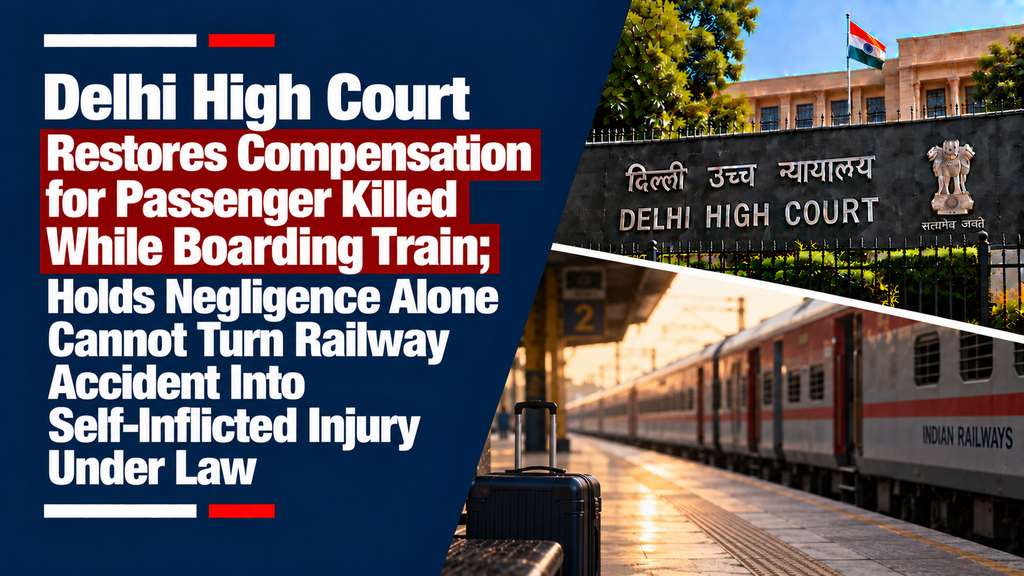
Delhi High Court Restores Compensation for Passenger Killed While Boarding Train; Holds Negligence Alone Cannot Turn Railway Accident Into Self-Inflicted Injury Under Law

Mere Negligence Is Not Self-Inflicted Injury: Delhi High Court Restores Compensation Claim After Fatal Railway Accident
Facts
The case arose from the death of Santosh Kumar, who had purchased a valid second-class superfast railway ticket on 24 November 2012 for travelling from Kudal to Ahmedabad.
According to his family, there was no direct train from Kudal to Ahmedabad. Santosh therefore got down at Mumbai Central and boarded Train No. 59439 for Ahmedabad. Because of heavy rush in the compartment, he allegedly fell from the moving train following a sudden jerk and sustained fatal injuries. He was taken to Nair Hospital, where he was declared dead.
The Railway Claims Tribunal nevertheless dismissed the compensation claim filed by his family.
A crucial reason was that Santosh’s ticket showed the journey from Kudal to Ahmedabad via Dadar, whereas the accident occurred at Mumbai Central. The Tribunal therefore doubted whether he was a bona fide passenger at the relevant place and time.
His widow Anita and other family members challenged that decision before the Delhi High Court.
Issues
The High Court essentially examined two questions:
First, whether Santosh continued to be a bona fide passenger despite being at Mumbai Central instead of changing trains at Dadar as reflected in the route on his ticket.
Second, whether his death constituted an “untoward incident” under Sections 123(c) and 124-A of the Railways Act, 1989, particularly when the Railways itself claimed that he was injured while attempting to board the train.
A further question was whether alleged negligence while boarding a train could be treated as a “self-inflicted injury” so as to exclude compensation under Section 124-A.
Appellants’ Arguments
The family argued that the Tribunal had adopted an excessively strict approach while determining Santosh’s passenger status.
A valid Kudal-Ahmedabad ticket was admittedly recovered from his body, and its genuineness was never disputed.
According to the appellants, merely because Santosh was found at Mumbai Central rather than Dadar could not convert him into a ticketless passenger or establish that he had abandoned his journey to Ahmedabad.
They further argued that even the Railways’ own version suggested that Santosh was attempting to board Train No. 59439 when the accident occurred.
Under the Supreme Court’s interpretation of the Railways Act, an injury or death occurring while boarding or de-boarding a train falls within the concept of an “untoward incident.”
Respondent’s Arguments
The Union of India argued that Santosh had no reason to be at Mumbai Central because the route printed on his ticket required him to travel via Dadar.
The Railways also relied upon contemporaneous police material suggesting that Santosh was struck while crossing the railway line.
The DRM report contained a somewhat different version: it stated that Santosh was attempting to board the empty rake of Train No. 59439 while it was being placed at Platform No. 1, and was hit during that attempt.
According to the Railways, this conduct was negligent and justified rejection of the compensation claim.
Analysis of the Law
Valid Ticket Was Enough to Discharge Initial Burden
The High Court first addressed Santosh’s status as a bona fide passenger.
Relying upon Union of India v. Rina Devi and Lata v. Union of India, the Court reiterated that the initial burden upon claimants in railway compensation cases is not onerous.
Here, a valid ticket bearing No. 58115035 for travel from Kudal to Ahmedabad was recovered from Santosh’s body.
The Tribunal itself had never found the ticket forged, fabricated or otherwise invalid.
Accordingly, recovery of that valid ticket was sufficient to discharge the family’s initial burden of establishing bona fide passenger status.
Being at Mumbai Central Instead of Dadar Did Not Make Him Ticketless
This was one of the judgment’s important findings.
The ticket showed a route through Roha, Dadar, Bassein Road and Vadodara. The Tribunal reasoned that Santosh should therefore have changed trains at Dadar rather than travelling to Mumbai Central.
The High Court rejected the inference that this automatically destroyed his passenger status.
It held that being found at Mumbai Central:
“does not establish that he was a ticketless traveller or that he had abandoned the journey covered by the ticket.”
The Court also noted that the Tribunal itself had accepted that a passenger travelling from Kudal to Ahmedabad could either change at Dadar or proceed by road to Mumbai Central and board an Ahmedabad-bound train from there.
Thus, Dadar was not the only possible changeover point.
The mere fact that Santosh chose Mumbai Central could not, by itself, defeat his family’s claim.
Attempting to Board Train Is an “Untoward Incident”
The Court then addressed the circumstances of Santosh’s death.
There were differences between the versions on record.
The family claimed that Santosh had boarded Train No. 59439 and fell after a sudden jerk.
The inquest panchnama suggested that he was hit by the train while crossing the railway lines.
The DRM report, meanwhile, stated that he was attempting to board the empty rake while it was being placed on the platform.
The High Court held that these differences were not sufficient to defeat the claim.
Even if the Railways’ own DRM version was accepted—that Santosh was attempting to board Train No. 59439—the case would still fall within the statutory compensation scheme.
Relying upon Rina Devi, the Court reiterated that:
death or injury occurring in the course of boarding or de-boarding a train constitutes an “untoward incident.”
Negligence Is Not the Same as Self-Inflicted Injury
This is the strongest legal proposition from the judgment.
Section 124-A excludes compensation in certain specified circumstances, including self-inflicted injury.
But the High Court stressed that mere negligence by the passenger does not amount to a self-inflicted injury.
For an injury to fall within that exclusion, there must be an intention to inflict the injury upon oneself.
Therefore, even assuming Santosh negligently attempted to board the train while it was moving or being positioned at the platform, that negligence alone was insufficient to remove the accident from the statutory compensation regime.
The Railways had produced no evidence that Santosh intended to injure himself, nor had it established any other statutory exclusion under Section 124-A.
Precedent Analysis
Union of India v. Rina Devi
Union of India v. Rina Devi, (2019) 3 SCC 572 was the principal authority governing the case.
The Delhi High Court applied two important propositions from Rina Devi.
First, the claimant’s initial burden of proving bona fide passenger status is not onerous. Here, recovery of the undisputed valid Kudal-Ahmedabad ticket satisfied that requirement.
Second, and more importantly, death or injury while boarding or de-boarding a train falls within the concept of an untoward incident, and mere negligence by the passenger does not convert the injury into a self-inflicted one.
“Self-inflicted injury” requires intention—not merely careless conduct.
Lata v. Union of India
The Court also relied upon the recent decision in Lata v. Union of India, 2026 SCC OnLine SC 1350, which reiterated the principles governing the initial evidentiary burden in railway compensation claims.
Together, these authorities prevented the Tribunal from applying an excessively technical standard to deny compensation merely because Santosh changed trains differently from the route the Tribunal expected.
Court’s Reasoning
The High Court identified two fundamental errors in the Tribunal’s approach.
First, it gave disproportionate importance to the fact that Santosh was found at Mumbai Central instead of Dadar, despite an admittedly genuine ticket covering his overall journey from Kudal to Ahmedabad.
That circumstance might raise a question about how he continued his journey, but it did not establish that he had become a ticketless traveller.
Second, the Tribunal treated discrepancies concerning the exact mechanics of the accident as fatal to the claim.
The High Court held that even the Railways’ own version—that Santosh was attempting to board the train—could constitute an untoward incident under the law.
Accordingly, the Railways needed to establish one of the specific statutory exclusions under Section 124-A to defeat compensation. It failed to do so.
The Court also emphasised the beneficial nature of the Railways Act, holding that a compensation claim should not be rejected merely because different records contain variations regarding precisely how the accident occurred.
Conclusion
The Delhi High Court allowed the family’s appeal and set aside the Railway Claims Tribunal’s order dismissing their compensation claim.
The Court held that Santosh’s valid Kudal-Ahmedabad ticket sufficiently established his status as a bona fide passenger, and his presence at Mumbai Central instead of Dadar did not automatically negate that status.
More significantly, even accepting the Railways’ allegation that he was attempting to board the train when the accident occurred, such an occurrence remained within the statutory concept of an “untoward incident.”
Passenger negligence, without an intention to cause self-harm, cannot be equated with “self-inflicted injury” to deny railway compensation.
The matter was remanded to the Railway Claims Tribunal to assess the compensation payable and direct its disbursement within two months from receipt of the High Court’s order.
Case Details
Case: Anita & Ors. v. Union of India
Court: High Court of Delhi at New Delhi
Case No.: FAO 199/2019
CNR: DLHC010216742019
Judge: Justice Manoj Kumar Ohri
Reserved: 3 August 2026
Pronounced: 15 September 2026
Key Provisions: Sections 123(c) and 124-A, Railways Act, 1989; Section 23, Railway Claims Tribunal Act, 1987
Result: Appeal allowed; Tribunal’s dismissal set aside; matter remanded for assessment and disbursement of compensation within two months.