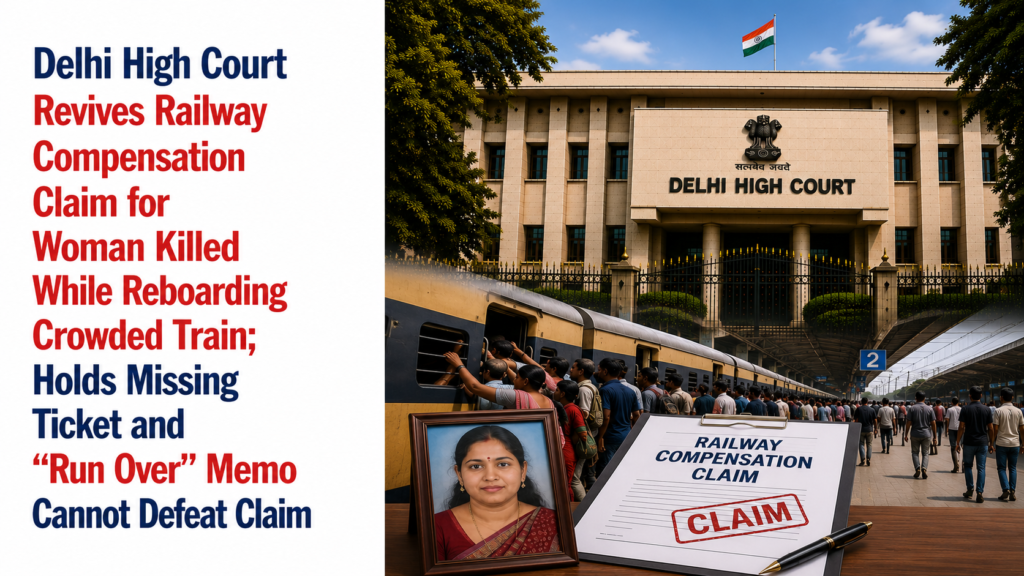
Delhi High Court Revives Railway Compensation Claim for Woman Killed While Reboarding Crowded Train; Holds Missing Ticket and “Run Over” Memo Cannot Defeat Claim

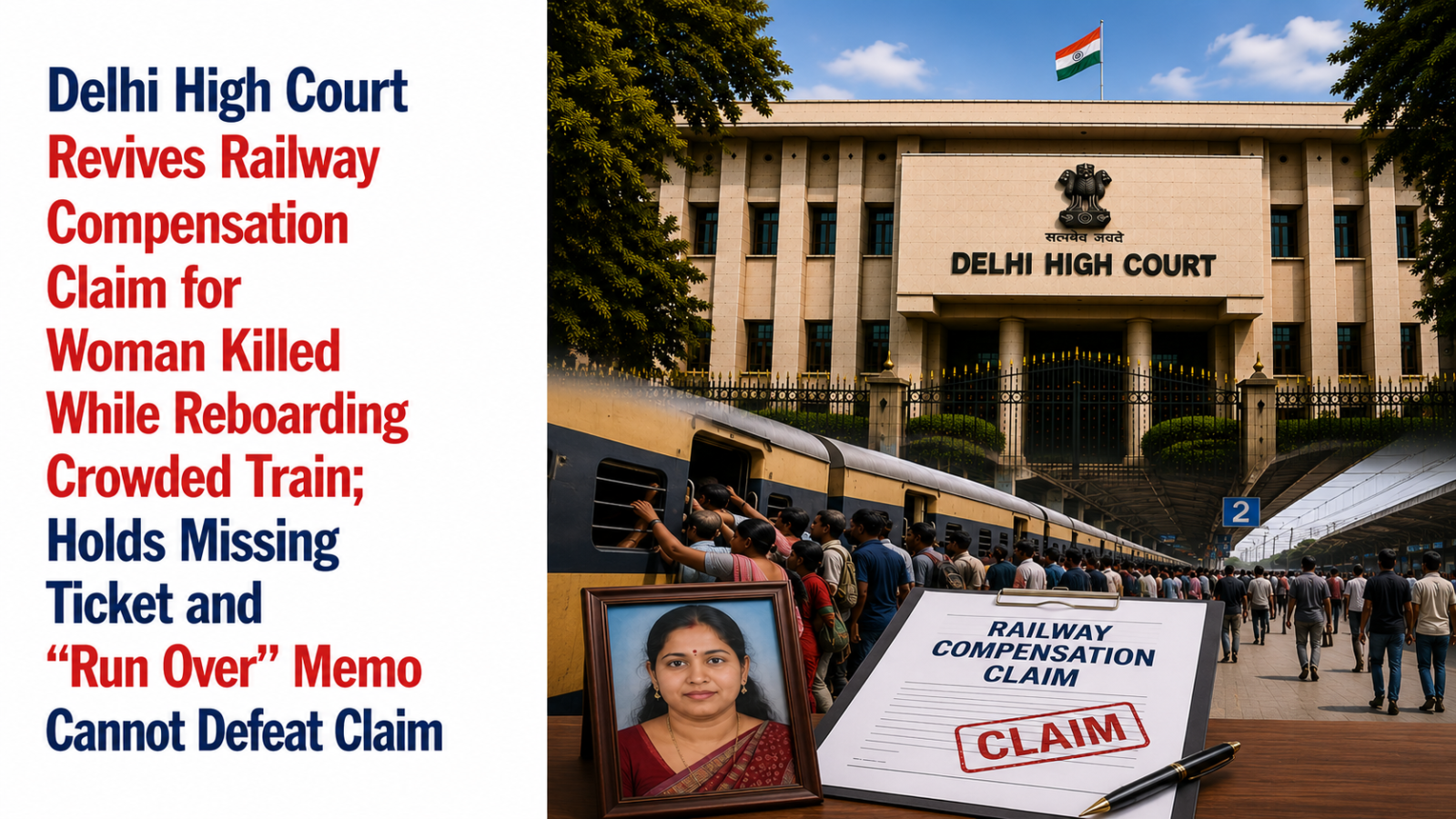
Delhi High Court Sets Aside Railway Tribunal Rejection; Holds Woman Who Fell While Reboarding Crowded Train Was Bona Fide Passenger in Untoward Incident
Facts
The appeal arose from the death of Smt. Shahana, who on 25 January 2018 was travelling with her minor daughter from Delhi Sarai Rohilla to Najibabad by Mussoorie Express. The claimants’ case was that a valid journey ticket bearing No. UAA-80610648 had been purchased by her son.
According to the claim application, the deceased and her daughter were initially in a reserved coach. After the TTE asked them to leave that compartment, they deboarded at Ghaziabad. While the deceased was attempting to reboard the crowded general coach, there was a sudden jerk and push from passengers, causing her to fall from the moving train and die on the spot.
The Railway Claims Tribunal dismissed the claim, holding that the deceased was neither a bona fide passenger nor the victim of an “untoward incident” under the Railways Act, 1989.
The deceased’s family appealed under Section 23 of the Railway Claims Tribunal Act, 1987.
Issues
The principal issues were:
- Whether the deceased could be treated as a bona fide passenger despite the journey ticket not having been recovered during panchnama or jamatalashi.
- Whether the claimants had sufficiently discharged the initial burden of proving valid travel.
- Whether the deceased’s fall while attempting to board or reboard the train constituted an “untoward incident” under the Railways Act.
- Whether the Railways’ version that the deceased had been “run over” was sufficiently proved.
- Whether minor inconsistencies in records concerning the purchase of the ticket could defeat the compensation claim.
Appellants’ Arguments
The appellants contended that the Tribunal erred in rejecting the claim merely because the journey ticket was not recovered from the deceased.
They relied upon Union of India v. Rina Devi to argue that non-recovery of a ticket does not automatically negate bona fide passenger status.
They further relied upon Union of India v. Prabhakaran Vijaya Kumar and Jameela v. Union of India for the principle that negligence while boarding or travelling does not by itself amount to self-inflicted injury falling within the statutory exceptions to railway liability.
Their case was that the deceased was lawfully travelling, was asked to shift from the reserved coach and suffered a fatal accidental fall while boarding the general compartment.
Respondent’s Arguments
The Union of India defended the Tribunal’s decision.
It argued that the alleged journey ticket was not found on the deceased’s body and was neither recorded in the panchnama nor in the jamatalashi.
According to the Railways, the subsequent claim that the ticket was in the bag carried by the minor daughter lacked contemporaneous corroboration.
The respondent also argued that the deceased did not accidentally fall from the train but had instead been run over, relying upon the Station Master’s memo.
Analysis of the Law
The High Court reiterated that under Rina Devi, non-recovery of a ticket is not conclusive proof that the deceased was not a bona fide passenger.
The principle was further reinforced by Lata v. Union of India, where the Supreme Court clarified that the claimant’s initial burden may be discharged through affidavit evidence and that mere absence of a recovered ticket does not destroy the claim where the fact of travel is otherwise supported and no statutory exception applies.
The Court therefore treated the question of bona fide passenger status as one to be assessed on the totality of the evidence, not simply on physical recovery of the ticket.
On “untoward incident”, the Court followed Rina Devi in holding that a fall while boarding or deboarding a train falls within the statutory definition.
Precedent Analysis
The Court relied principally upon four Supreme Court decisions:
Union of India v. Rina Devi — for the proposition that non-recovery of a ticket does not conclusively negate bona fide passenger status and that falls while boarding or deboarding can constitute untoward incidents.
Union of India v. Prabhakaran Vijaya Kumar — supporting the strict-liability framework applicable to railway accident compensation.
Jameela v. Union of India — reinforcing that ordinary negligence does not by itself amount to self-inflicted injury under the statutory exceptions.
Lata v. Union of India — clarifying that the claimant may discharge the initial burden of proving bona fide travel through affidavit evidence even where the ticket itself is not recovered.
Court’s Reasoning
The High Court found that the deceased’s son, Sameer Aftab, had successfully discharged the initial burden of proving bona fide travel.
He stated in his affidavit that he had personally gone to Delhi Sarai Rohilla station, seen off his mother and sister, and purchased journey ticket No. UAA-80610648 for the deceased.
The Tribunal had rejected his testimony largely because of inconsistencies between his account and the transaction record relating to the platform ticket purchased by him.
The High Court held that such minor and peripheral discrepancies could not outweigh the consistent substantive evidence that he had personally purchased the journey ticket.
On the manner of death, the Court rejected the Tribunal’s reasoning that an accidental fall was improbable merely because Mussoorie Express halted at Ghaziabad for about two minutes.
The duration of the halt did not prove that the deceased could not have attempted to change coaches or reboard the train.
The Railways’ “run over” theory was also found insufficient.
The Station Master’s memo merely recorded that the deceased had been run over, but there was no eyewitness or other cogent evidence supporting that conclusion. No independent witness was examined who had actually seen her on the tracks or witnessed her being run over.
Accordingly, the Court held that the unsupported “run over” version could not displace the plausible case of accidental fall from the train.
Conclusion
The Delhi High Court set aside the Railway Claims Tribunal’s judgment.
It held that the claim could not be rejected merely because the ticket was not recovered from the deceased and that the claimants had sufficiently established bona fide travel through affidavit evidence.
It further held that the fatal fall while attempting to reboard the train was capable of constituting an untoward incident under the Railways Act.
The matter was therefore remanded to the Railway Claims Tribunal to assess the compensation payable, with a direction that the amount be disbursed within two months from receipt of the High Court’s order. The matter was directed to be listed before the Tribunal on 7 September 2026.
The appeal was accordingly allowed.
Case Details
Case: Nasim Ahmad & Ors. v. Union of India
Court: High Court of Delhi at New Delhi
Case Number: FAO 359/2019
Judge: Justice Manoj Kumar Ohri
Date: 17 August 2026; reserved on 10 August 2026
Result: Appeal allowed; Tribunal judgment set aside and matter remanded for assessment and disbursement of railway compensation within two months.