
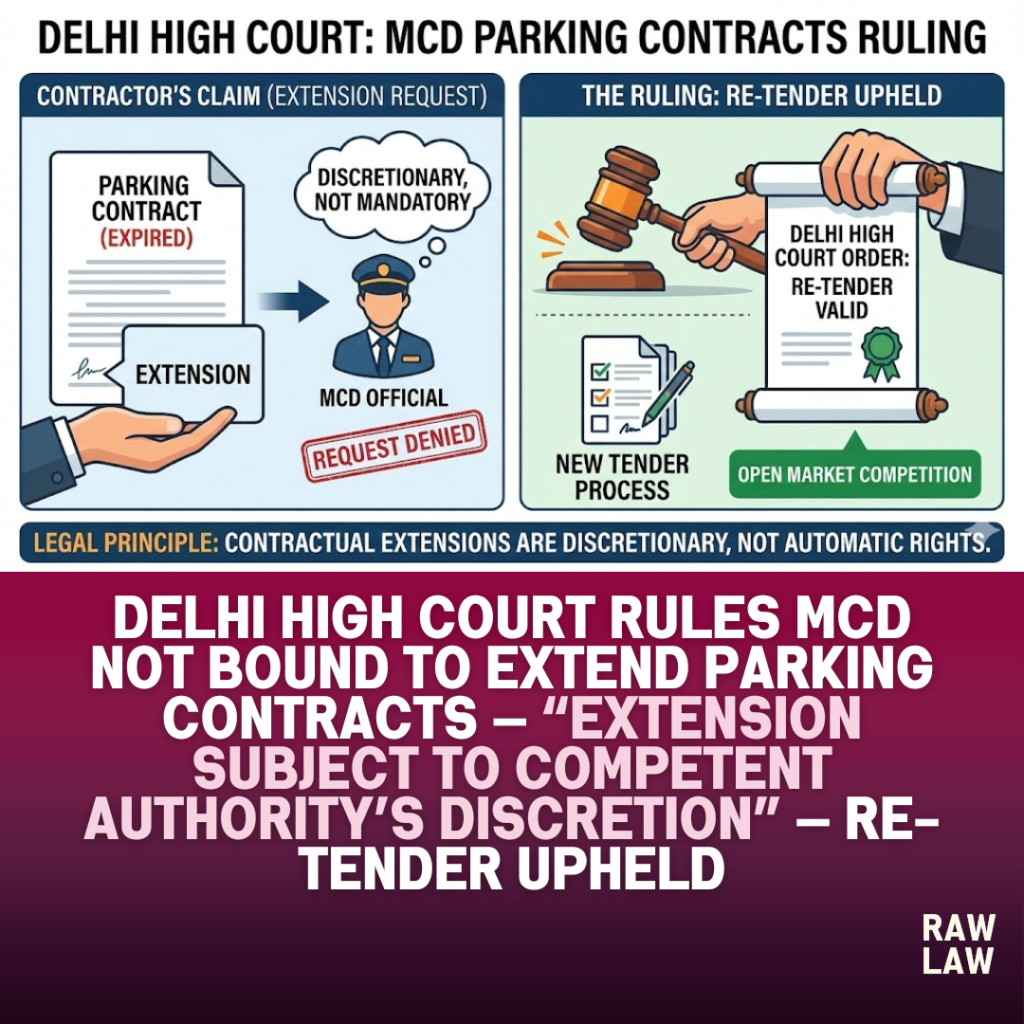

Court’s decision
The Delhi High Court dismissed four writ petitions filed by authorised parking contractors challenging the Municipal Corporation of Delhi’s (MCD) decision to float a fresh tender for the same parking sites instead of granting them a two-year extension. The Court held that the tender clause providing a 3+2 year tenure did not confer an automatic right of extension. Even if performance was satisfactory, extension remained subject to the decision of the Competent Authority. The Court found no arbitrariness in MCD’s decision to re-tender the sites in order to ensure better revenue realisation and dismissed the petitions.
Facts
The petitioners were authorised parking contractors allotted surface parking sites under a 2022 tender issued by the Municipal Corporation of Delhi. The Notice Inviting Tender (NIT) stipulated that the parking sites would be allotted for an initial period of three years, further extendable for two years subject to satisfactory performance and as decided by the Competent Authority.
As the initial three-year term approached completion, the petitioners sought extension for the additional two-year period. They contended that they had complied with all contractual conditions, paid Monthly License Fee (MLF) regularly, and maintained operations without default.
However, before deciding their extension requests, MCD issued a fresh tender dated 15.01.2026 inviting bids for allotment of authorised parking sites, including those currently operated by the petitioners. Aggrieved, the contractors approached the High Court alleging arbitrariness and violation of Article 14.
Issues
The principal issues before the Court were:
- Whether the extension clause in the NIT created a contractual right to automatic extension upon satisfactory performance.
- Whether MCD’s decision to re-tender the sites without granting extension was arbitrary or violative of Article 14.
- Whether continuation of work beyond the initial three-year term resulted in deemed extension.
- Whether re-tendering amounted to constructive termination without due process.
- Whether the doctrine of legitimate expectation applied in favour of the contractors.
Petitioners’ arguments
The petitioners argued that a conjoint reading of Clause 8 and Clause 10 of the NIT created a structured “3+2” tenure architecture, under which the two-year extension was contractually embedded and not discretionary in nature. They submitted that once satisfactory performance was demonstrated, the discretion of the Competent Authority stood exhausted and extension followed as a contractual consequence.
It was contended that MCD had issued no show-cause notices, no adverse performance reports, and no penalties during the three-year term, thereby affirming satisfactory performance. The petitioners further argued that they had made significant financial commitments based on a five-year tenure expectation, including furnishing security deposits and performance guarantees structured around a 3+2 model.
They relied upon principles of legitimate expectation and fairness under Article 14, contending that re-tendering without deciding extension requests rendered the extension clause illusory. It was also argued that fresh tendering amounted to constructive termination of subsisting contractual rights without notice.
Respondent’s arguments
MCD contended that the extension clause was discretionary and not mandatory. The contract clearly provided that extension was subject to satisfactory performance and “as decided by the Competent Authority.” Thus, even if performance was satisfactory, extension was not automatic.
The Corporation argued that it had a fiduciary duty as a public body to maximise revenue from public resources. Considering improved market conditions and increasing demand for parking spaces, re-tendering was necessary for price discovery and revenue optimisation.
MCD further submitted that it was under financial stress and was obligated under Section 200 of the Delhi Municipal Corporation Act to act prudently in financial matters. The decision not to extend was formally communicated to the petitioners via order dated 11.02.2026.
Analysis of the law
The Court examined Clause 10 of the NIT, which stated that parking sites shall be allotted for three years and “further extendable to another period of two years subject to satisfactory performance of the firm and as decided by the Competent Authority.”
The Court emphasised the conjunctive use of the word “and,” holding that two independent conditions must be satisfied: satisfactory performance and a decision by the Competent Authority. The latter conferred a broad discretionary power.
Relying on a coordinate bench judgment in Himalayan Flora and Aromas Pvt. Ltd. v. MCD (LPA 351/2025), the Court reiterated that such clauses vest wider discretion in the municipal authority and do not mandate automatic renewal merely on satisfactory performance.
The Court rejected the interpretation that extension was a vested right. Instead, it held that the clause created a conditional possibility, not an enforceable entitlement.
Precedent analysis
The Court relied primarily on its earlier decision in Himalayan Flora and Aromas Pvt. Ltd. v. MCD, which interpreted an identical extension clause. There, the Division Bench held that even satisfactory performance does not compel extension, as the Commissioner retains discretion to consider other relevant factors.
The petitioners’ reliance on S.K. Associates v. MCD was distinguished. In that case, the extension clause did not reserve discretion to the authority in the same manner, making extension conditional solely on performance.
The Court also declined to apply the doctrine of legitimate expectation as laid down in Union of India v. Hindustan Development Corporation, observing that where the contract explicitly conditions extension on discretion, no enforceable expectation arises.
Court’s reasoning
The Court found that:
- Extension was not automatic; it was conditional and discretionary.
- The Competent Authority had consciously decided against extension for revenue maximisation.
- Re-tendering after expiry of the initial three-year term did not amount to constructive termination.
- There was no deemed extension merely because contractors continued operating pending decision.
- The financial prudence rationale and price discovery considerations were legitimate administrative factors.
The Court held that judicial review under Article 226 does not permit substituting administrative discretion unless the decision is arbitrary, irrational, or mala fide. No such infirmity was found.
Conclusion
The Delhi High Court concluded that the petitioners had no vested right to extension beyond three years. The extension clause conferred discretion on MCD, and the decision not to extend—based on revenue optimisation and market alignment—was neither arbitrary nor unconstitutional.
Accordingly, all writ petitions were dismissed.
Implications
This ruling reinforces that extension clauses in public contracts do not automatically translate into enforceable renewal rights, especially where discretion is explicitly reserved to the authority.
For contractors, the judgment underscores that a “3+2” structure does not guarantee five years of operation unless the clause removes discretion. For public authorities, the decision affirms their duty to prioritise revenue optimisation and market alignment in managing public resources.
The judgment strengthens municipal autonomy in re-tendering decisions while clarifying limits of legitimate expectation in public procurement.
FAQs
1. Does satisfactory performance guarantee extension of a government contract?
No. If the contract states that extension is subject to the decision of a competent authority, satisfactory performance alone does not create an automatic right to renewal.
2. Can a public authority re-tender a contract after expiry of its term?
Yes. Once the initial contractual period expires, the authority may re-tender, especially if extension is discretionary and not mandatory.
3. What is the doctrine of legitimate expectation in tender matters?
Legitimate expectation arises when a public authority’s representation creates a reasonable expectation of benefit. However, it cannot override express contractual discretion.


