Delhi High Court Sets Aside ₹14.27 Lakh Ex-Parte Recovery Decree; Holds Unproved Electronic Account Statements and Bald Claims Cannot Establish Contractual Dues

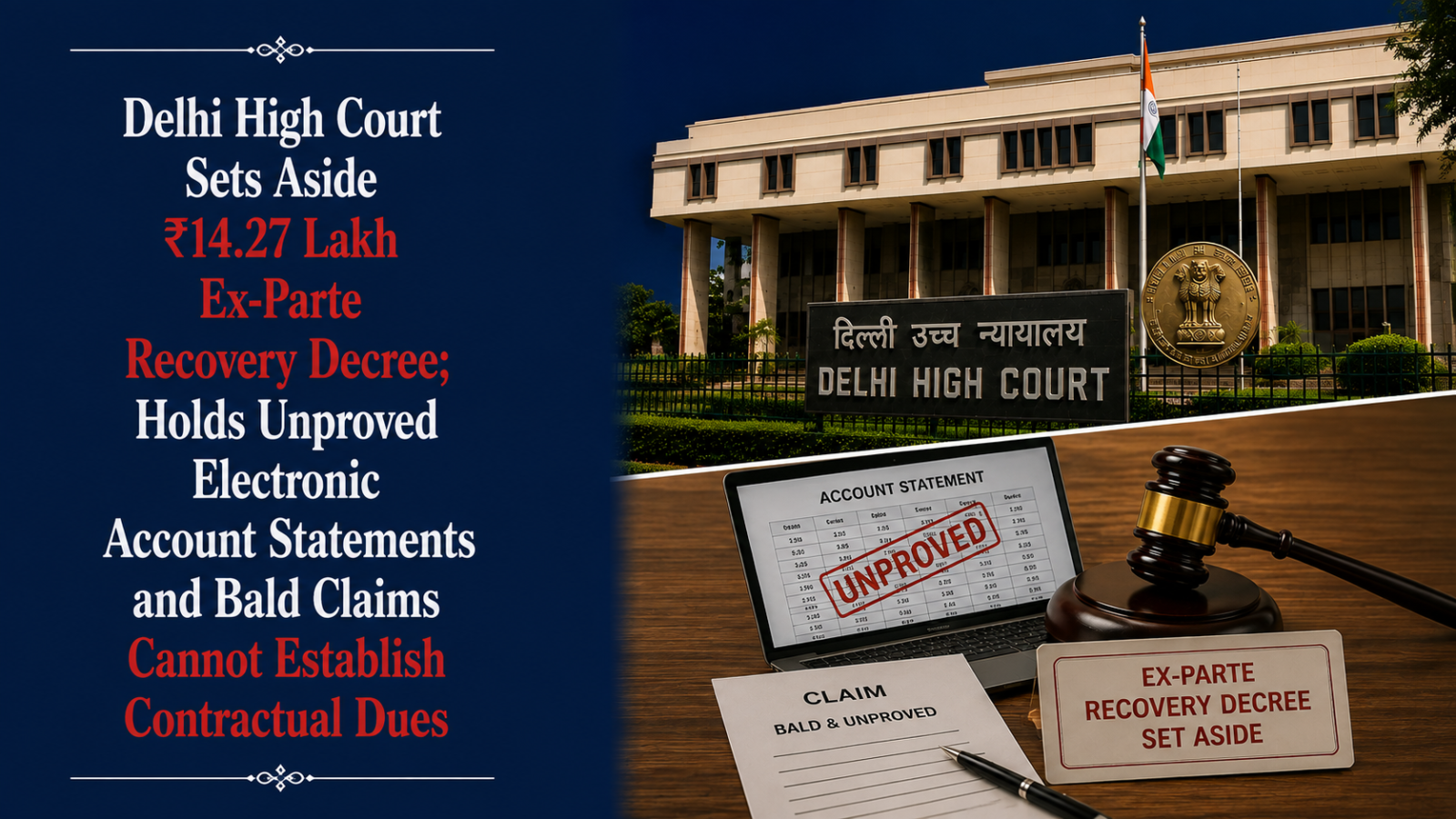
Regular Appeal Against Ex-Parte Decree Maintainable Despite Failed Order IX Rule 13 Application, Delhi High Court Holds; Recovery Suit Ultimately Dismissed
Facts
M/s Malik Enterprises instituted a civil suit against M/s D.B. Project Engineers seeking recovery of ₹14,27,640, along with pendente lite and future interest at 18% per annum. The plaintiff claimed that both entities were engaged in electrical contract work and that it had acted as a subcontractor for the defendant.
According to the plaintiff, it completed various jobs assigned by the defendant and received only part payment. A payment of ₹25,000 was made through RTGS on 22 October 2014, after which no further amount was paid. Its accounts allegedly reflected an outstanding balance of ₹14,27,640. Despite a demand notice dated 25 April 2015, the amount remained unpaid.
Summons were issued to the defendant. A process server found an employee named Sonu at the premises, who stated that the owner visited only occasionally. The Trial Court subsequently treated the defendant as served and proceeded ex parte against it on 18 July 2016.
The plaintiff examined its sole proprietor and relied principally upon three Statements of Accounts and the legal demand notice. The Additional District Judge accepted this evidence and passed an ex-parte decree for ₹14,27,640 with pendente lite and future interest at 12% per annum.
The defendant’s subsequent application under Order IX Rule 13 CPC for setting aside the ex-parte decree was dismissed. It thereafter filed a Regular First Appeal under Section 96 CPC challenging the underlying ex-parte judgment and decree.
Issues
The principal issues before the High Court were:
- Whether a Regular First Appeal under Section 96 CPC against an ex-parte decree remained maintainable despite dismissal of the defendant’s application under Order IX Rule 13 CPC.
- Whether the plaintiff was still required to affirmatively prove its recovery claim even though the defendant had been proceeded ex parte.
- Whether electronically generated Statements of Accounts, unsupported by underlying contractual and banking documents and without a Section 65B certificate, were sufficient to prove the outstanding amount.
- Whether the ex-parte recovery decree could legally be sustained on the evidence produced by the plaintiff.
Appellant’s Arguments
M/s D.B. Project Engineers contended that it had not been properly served and alleged that the plaintiff had intentionally furnished an incorrect address to procure an ex-parte decree.
More importantly, it argued that even where a defendant is ex parte, a plaintiff cannot obtain a decree merely on the strength of the averments in the plaint. The plaintiff must establish its claim through legally admissible and reliable evidence.
Reliance was placed on Bogidhola Tea & Trading Co. Ltd. v. Hira Lal Somani, (2007) 14 SCC 606, for the proposition that an ex-parte proceeding does not dispense with the plaintiff’s obligation to prove its case.
The appellant argued that no primary evidence had been produced to establish either the subcontractual relationship, the work allegedly performed or the amount outstanding. The Trial Court had therefore wrongly relied upon three Statements of Accounts.
Respondent’s Arguments
M/s Malik Enterprises raised a preliminary objection that the dismissal of the Order IX Rule 13 application could be challenged only by an appeal under Order XLIII Rule 1(d) CPC and could not be questioned in the present Regular First Appeal.
On merits, it maintained that the defendant had been duly served but deliberately failed to appear.
It further contended that the three Statements of Accounts had been duly proved and provided sufficient basis for the Trial Court to decree the recovery claim.
Analysis of the Law
The High Court first distinguished between the two remedies available to a defendant against an ex-parte decree.
It agreed that an order dismissing an application under Order IX Rule 13 CPC is separately appealable under Order XLIII Rule 1(d). However, the present appeal was directed against the original ex-parte decree itself under Section 96 CPC, not against the order dismissing the Order IX Rule 13 application.
The Court held that these remedies operate independently. Therefore, the outcome of proceedings under Order IX Rule 13 did not bar the defendant from maintaining a Regular First Appeal against the underlying ex-parte decree.
The Court then examined whether the plaintiff had established its substantive claim.
Although the plaintiff asserted that it was the defendant’s subcontractor and had completed assigned electrical work, it produced no subcontract agreement, work order, purchase order, bill, invoice or other document demonstrating what work had been assigned, what work had actually been performed, or what amount remained unpaid.
The plaintiff’s claim therefore rested essentially upon its own testimony and three Statements of Accounts.
Precedent Analysis
The appellant relied upon Bogidhola Tea & Trading Co. Ltd. v. Hira Lal Somani, (2007) 14 SCC 606.
The principle invoked was that the mere absence of the defendant does not automatically entitle a plaintiff to a decree. Even in ex-parte proceedings, the court must determine whether the plaintiff has established its entitlement to relief through adequate evidence.
The High Court applied this evidentiary principle directly to the recovery claim. The Trial Court could not treat the plaintiff’s assertions as proved merely because there was no contest from the defendant.
The Court also applied the statutory requirement under Section 65B of the Indian Evidence Act to the electronically generated Statements of Accounts. Since no requisite certificate had been produced, the electronic records remained unproved.
Court’s Reasoning
The Court found that the plaintiff’s three Statements of Accounts were essentially self-serving entries.
They were not corroborated by corresponding bank statements showing the payments allegedly received from the defendant. More fundamentally, the underlying transactions themselves had not been established through contracts, invoices, bills, purchase orders or other documentary material.
The evidentiary deficiency was compounded by the fact that the Statements of Accounts were electronically generated but were not accompanied by a certificate under Section 65B of the Indian Evidence Act.
The Court therefore held that the Trial Court had erred in accepting the plaintiff’s bald testimony without corroborative documentary evidence.
Importantly, the High Court did not merely remand the matter to provide the plaintiff another opportunity to prove its claim. It observed that even during the appeal no supporting documents had been produced from which an appropriate opportunity to lead further evidence could be justified.
Accordingly, the Court found no ground to give the plaintiff a fresh opportunity to cure the deficiencies in its case.
Conclusion
The Delhi High Court held that the ex-parte decree could not be sustained because the plaintiff had failed to produce legally sufficient evidence establishing its recovery claim.
The Court found that:
- no subcontract agreement, work order, bill, invoice or purchase order had been produced;
- the Statements of Accounts were self-serving and unsupported by corresponding bank records;
- the electronically generated accounts were not accompanied by a Section 65B certificate; and
- the plaintiff’s oral assertions alone could not justify a money decree merely because the defendant had remained ex parte.
Since no evidence substantiated the claim and no case was made out for granting another opportunity to lead evidence, the High Court dismissed the plaintiff’s recovery suit itself rather than remanding the matter.
The appeal was consequently allowed, and the ex-parte judgment and decree dated 18 January 2018 were set aside.
Case Details
Case: M/s D.B. Project Engineers v. M/s Malik Enterprises
Court: High Court of Delhi at New Delhi
Case Number: RFA 194/2020, CM APPL. 9932/2020
Judge: Hon’ble Ms. Justice Neena Bansal Krishna
Date: 11 August 2026
Result: Appeal allowed; ₹14.27 lakh ex-parte recovery decree set aside and the plaintiff’s recovery suit dismissed for failure to prove the underlying claim with admissible and corroborative evidence