


Court’s decision
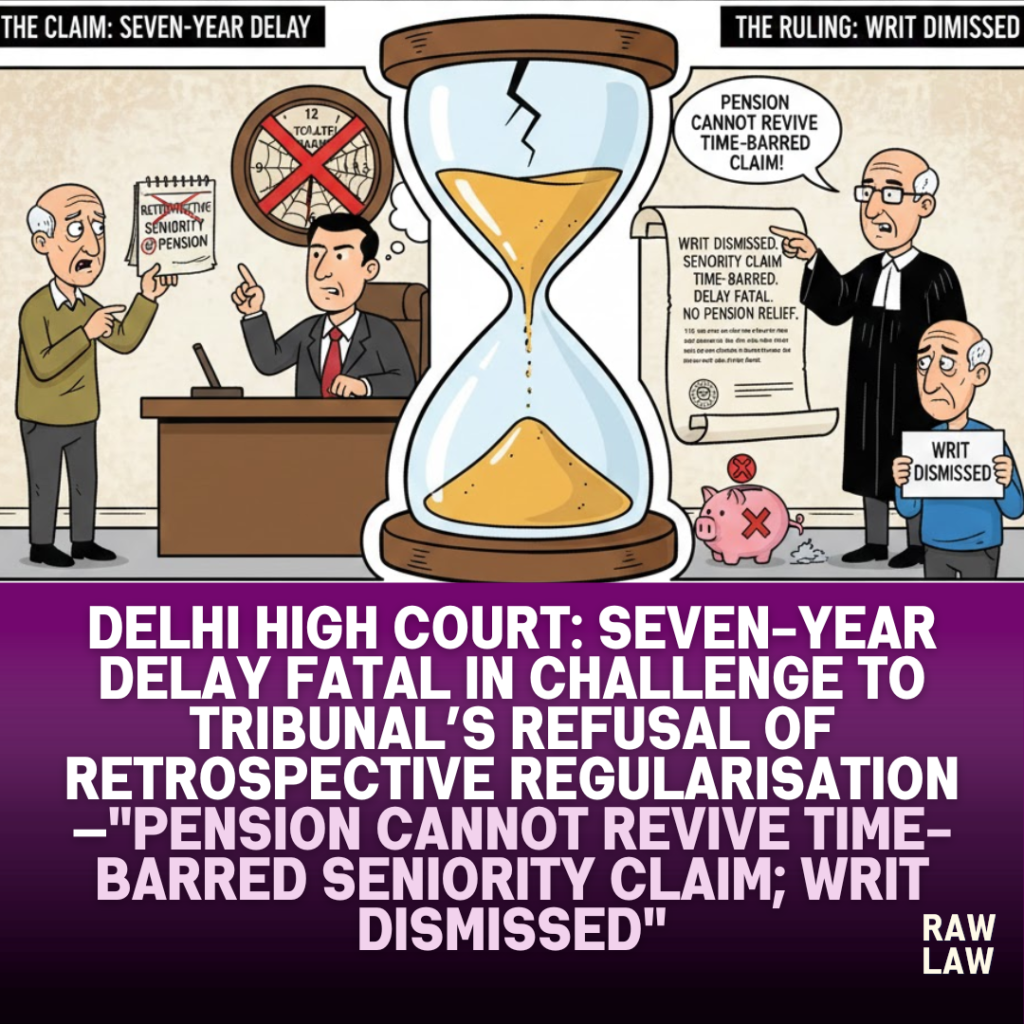
The Delhi High Court dismissed a writ petition challenging the Central Administrative Tribunal’s order refusing retrospective regularisation and seniority. The Court held that the petitioners approached the High Court after an inordinate delay of nearly seven years from the Tribunal’s decision dated 06.02.2019.
Rejecting the plea that pension constitutes a continuing cause of action, the Court ruled that consequential pensionary benefits cannot resurrect a foundational claim already barred by delay and laches. Finding no jurisdictional error or perversity in the Tribunal’s order, the writ petition was dismissed.
Facts
The petitioners had filed an Original Application before the Central Administrative Tribunal seeking retrospective regularisation from 08.02.1988 and corresponding seniority benefits. They had, however, been regularised with effect from 30.01.2004.
By order dated 06.02.2019, the Tribunal dismissed the Original Application, holding that the claim for retrospective regularisation and seniority was highly belated and barred by limitation. It further recorded that the petitioners already stood regularised from 2004 and no further relief survived.
A Review Application filed in 2021 was dismissed as withdrawn on 17.07.2023. The writ petition challenging the Tribunal’s order was filed in 2026, after substantial delay.
Issues
The principal issue before the High Court was whether the writ petition challenging the Tribunal’s 2019 order could be entertained after a lapse of nearly seven years.
A connected issue was whether the doctrine of continuing cause of action, particularly in relation to pension, could be invoked to revive a time-barred claim for retrospective regularisation and seniority.
The Court also examined whether the doctrine of merger applied on dismissal of the Review Application.
Petitioners’ arguments
The petitioners sought to explain the delay by submitting that they were unaware of the dismissal of their Original Application and that difficulties with their erstwhile counsel contributed to the delay. It was further argued that the COVID-19 pandemic caused disruption, thereby justifying belated filing.
Reliance was placed on the Supreme Court’s decision in M.L. Patil v. State of Goa (2022 INSC 622), contending that pension is a continuing cause of action and that denial of correct pensionary benefits justifies judicial intervention even after delay.
The petitioners argued that the denial of retrospective regularisation adversely impacted their pension and thus gave rise to recurring consequences.
Respondents’ arguments
The respondents opposed the writ petition on grounds of gross delay and laches. It was submitted that the Tribunal’s order dated 06.02.2019 had attained finality and the writ petition was filed after nearly seven years.
The respondents contended that dismissal of the Review Application as withdrawn did not result in merger of the original order and therefore limitation must be reckoned from 2019.
It was further argued that pensionary relief cannot be claimed independently once the foundational claim for retrospective regularisation stands rejected as time-barred.
Analysis of the law
The Court reiterated that writ jurisdiction under Article 226 is discretionary and equitable. Claims suffering from unexplained delay and laches cannot ordinarily be entertained.
The Court examined the doctrine of merger and clarified that where a review application is dismissed as withdrawn without adjudication on merits, the original order does not merge with the review order.
On the principle of continuing cause of action, the Court distinguished cases where entitlement to service continuation had been judicially determined. In such cases, pensionary benefits flow as a consequence of an already adjudicated right.
However, in the present case, the foundational right to retrospective regularisation had been rejected on grounds of delay and was never judicially recognised.
Precedent analysis
The petitioners relied on M.L. Patil v. State of Goa, where the Supreme Court held that pensionary benefits may constitute a continuing cause of action when entitlement to service continuity has already been adjudicated.
The High Court distinguished this precedent, observing that in M.L. Patil, the core issue—continuation in service up to correct superannuation age—had been decided in favour of the employee.
In contrast, the petitioners’ claim for retrospective regularisation was rejected on limitation and had attained finality. The Court held that pension cannot be treated as an independent or standalone right divorced from the foundational service claim.
Court’s reasoning
The Court found that the writ petition was filed after an inordinate delay of seven years from the Tribunal’s order and nearly three years even from dismissal of the Review Application.
The explanation that the petitioners were unaware of dismissal of their own Original Application was found unsubstantiated and unsupported by contemporaneous material.
The Court held that once the claim for retrospective regularisation was barred by limitation and rejected, the consequential claim for enhanced pension could not revive the stale primary claim.
The Court emphasized that writ jurisdiction cannot be used to reopen issues that have attained finality. No jurisdictional error, perversity, or manifest illegality in the Tribunal’s order was demonstrated.
The petitioners had accepted regularisation from 30.01.2004 and approached the Tribunal only in 2016, decades after the relevant events. Their conduct reflected acquiescence.
Conclusion
The Delhi High Court held that the writ petition was barred by delay and laches and that no ground existed to interfere with the Tribunal’s order dated 06.02.2019.
The Court dismissed the writ petition along with pending applications, reaffirming that stale claims cannot be revived through pensionary consequences.
Implications
This ruling reinforces three key principles in service jurisprudence:
- Writ jurisdiction is discretionary and cannot revive time-barred claims.
- Dismissal of a review application as withdrawn does not attract the doctrine of merger.
- Pensionary consequences cannot resurrect a foundational claim already barred by limitation.
The judgment underscores judicial reluctance to entertain belated service claims and clarifies the limits of the continuing cause of action doctrine in pension matters.
Case law references
- M.L. Patil v. State of Goa (2022 INSC 622): Held that pension may constitute a continuing cause of action where entitlement to service continuity has already been judicially determined; distinguished in present case.
FAQs
1. Can a writ petition be filed years after a Tribunal’s order?
Generally no. Unexplained delay and laches can lead to dismissal, especially when the order has attained finality.
2. Does dismissal of a review application extend limitation?
Not if the review is dismissed as withdrawn without adjudication. The original order remains operative.
3. Can pension claims revive a time-barred service claim?
No. Pensionary benefits dependent on a foundational service claim cannot independently resurrect a stale claim.