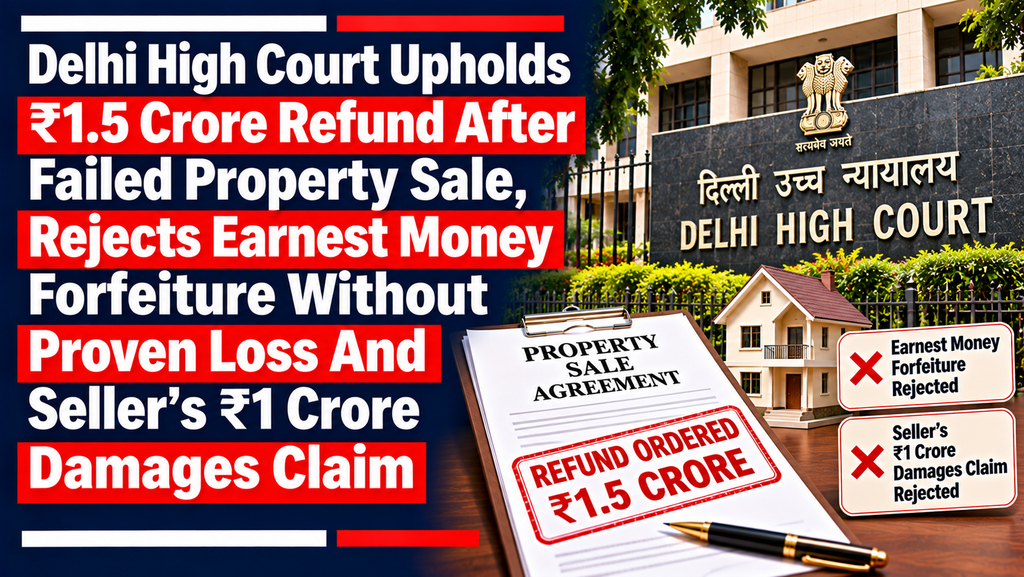
Delhi High Court Upholds ₹1.5 Crore Refund After Failed Property Sale, Rejects Earnest Money Forfeiture Without Proven Loss And Seller’s ₹1 Crore Damages Claim

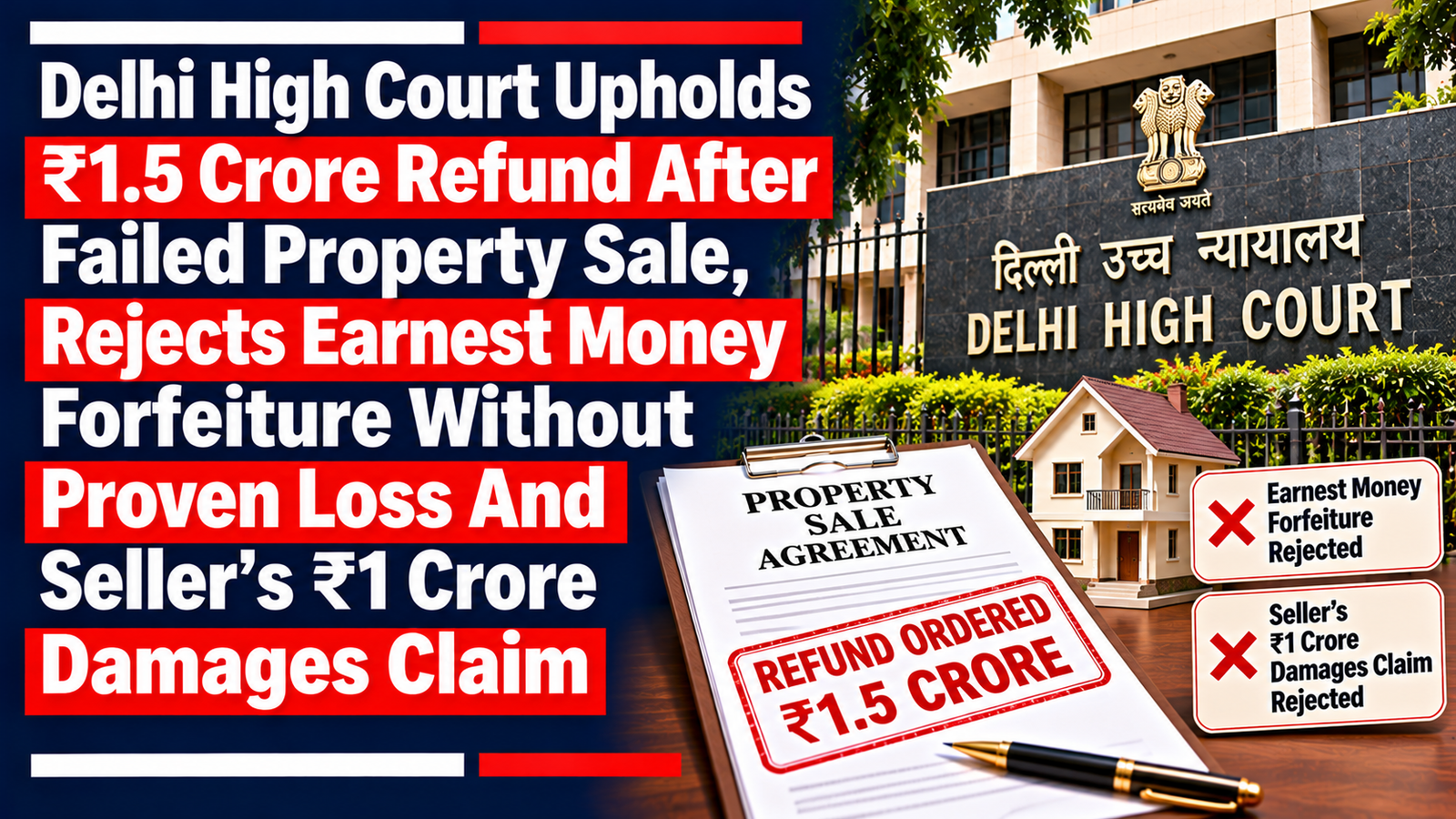
Delhi High Court Orders Return Of ₹1.5 Crore Property Payment, Holds Bayana Label Alone Cannot Establish Lawful Forfeiture, Dismisses Seller’s Counterclaim And Additional Evidence Plea
Facts
A February 2016 agreement concerned K.G. Krishnamurthy’s 336.87-square-yard residential property at Yojna Vihar, Delhi, agreed to be sold to Vijyeta Gupta for ₹12.80 crore. Gupta paid ₹1.50 crore—₹1.05 crore in cash and ₹45 lakh by demand draft—and had to pay ₹11.30 crore by 15 August 2016. The agreement contemplated a housing loan and provision of necessary legal/KYC documents. Gupta alleged that the seller did not furnish original title papers needed for financing, but later purchased another house for ₹4.25 crore in May 2016 without informing him. After the transaction failed, the seller purported to forfeit the sum as bayana. Gupta sued for its return; Krishnamurthy counterclaimed ₹1 crore in damages. On 4 March 2021 the District Judge decreed refund with 4% pendente lite and future interest and dismissed the counterclaim. The seller appealed.
Issues
Whether the ₹1.50 crore was forfeitable earnest money or an advance/part-payment of the purchase price; whether the seller established compensable loss under Sections 73–74 of the Contract Act; whether his ₹1 crore damages counterclaim could survive; and whether further price-related evidence was admissible in the first appeal under Order XLI Rule 27 CPC.
Petitioner’s Arguments
Appellant-seller Krishnamurthy maintained that Clause 8 expressly permitted forfeiture when the purchaser failed to pay the balance consideration. He asserted readiness to complete the sale, including attending the Sub-Registrar’s office, while Gupta neither sought original papers contemporaneously nor completed financing. He pointed to her purchase of a nearby property for ₹4.25 crore, asserted a steep decline in Yojna Vihar values and loss of another sale opportunity, and claimed ₹1 crore as damages. Invoking Fateh Chand, Satish Batra and other decisions, he argued that earnest money could be forfeited and sought admission of sale deeds, revised circle rates and press reports as additional evidence.
Respondent’s Arguments
Respondent-buyer Gupta sought refund of the ₹1.50 crore paid towards the proposed purchase, submitting that the seller’s failure to furnish requisite documents obstructed her loan and completion. She contested the forfeiture and counterclaim, disputing the seller’s entitlement to retain the amount and questioning the agreement’s execution in her counterclaim defence. The trial court had already found no documentary proof that she sought the originals or applied for the alleged financing; nevertheless, the seller could not demonstrate that her non-performance caused a legally recoverable loss.
Analysis of the Law
Sections 73 and 74 of the Indian Contract Act require legally cognisable injury and permit only reasonable compensation for breach. Section 74 does not make every contractual forfeiture automatic: where loss is capable of proof, evidence of it is necessary; only where assessment is inherently difficult may a genuine pre-estimate support reasonable compensation. Whether a sum is earnest money or advance consideration turns on contractual intention and circumstances, not merely words such as “bayana”. Order XLI Rule 27 CPC permits additional appellate evidence in limited circumstances, including wrongful exclusion, diligence-based unavailability or the appellate court’s need for the material; it is not a second opportunity to repair an evidentiary failure.
Precedent Analysis
Shree Hanuman Cotton Mills v. Tata Air Craft Ltd., (1969) 3 SCC 522, distinguished security given to bind a bargain from recoverable part-payment. Videocon Properties Ltd. v. Bhalchandra Laboratories, (2004) 3 SCC 711, emphasised the parties’ intentions over contractual labels. Central Bank of India v. Shanmugavelu, (2024) 6 SCC 641, explained the relationship between earnest deposits and purchase-price advances. The Court applied Fateh Chand v. Balkishan Das, (1964) 1 SCR 515, and Kailash Nath Associates v. DDA, (2015) 4 SCC 136: Section 74 requires legal injury and proof of loss when it is provable. The seller cited Satish Batra v. Sudhir Rawal, but that reliance did not displace the factual and statutory findings.
Court’s Reasoning
Justice Neena Bansal Krishna read the ₹1.50 crore payment with the ₹12.80 crore sale price, the unpaid ₹11.30 crore balance and the contemplated home loan, finding that the amount was advance consideration intended for adjustment on completion—not forfeitable earnest merely because it was called bayana. Although Gupta had not substantiated requests for original title documents or the alleged loan application, that defect did not establish a right to forfeit. The seller produced no property-specific valuation proving depreciation or an actual resale loss; a cheaper purchase by Gupta and general newspaper reports showed neither diminution of his property’s value nor ₹1 crore damage. The proposed 2016 sale deed, 2021 circle-rate revision and news reports failed Order XLI Rule 27’s tests: they were earlier available, irrelevant to the decisive inquiry or unnecessary for adjudication.
Conclusion
The Delhi High Court dismissed RFA 268/2021, affirming the ₹1.50 crore refund decree together with 4% annual pendente lite and future interest, and upheld dismissal of the seller’s ₹1 crore counterclaim. The application for additional appellate evidence was separately rejected; pending applications stood disposed of. The decision illustrates that a property-sale deposit cannot be forfeited simply through the contractual description “bayana”: its true character and evidence of recoverable injury matter. A lower-priced transaction involving another property, without reliable proof of loss concerning the subject property, does not establish contractual damages.
Case: Sh. K.G. Krishnamurthy v. Ms. Vijyeta Gupta
Court: High Court of Delhi at New Delhi
Case Number: RFA 268/2021, CM APPL. 21677–21678/2021; 2026:DHC:9735
Judge: Justice Neena Bansal Krishna
Date: 2 November 2026 (reserved 14 August 2026)
Result: Appeal dismissed; ₹1.50 crore refund with 4% interest upheld; ₹1 crore counterclaim and additional evidence request rejected.