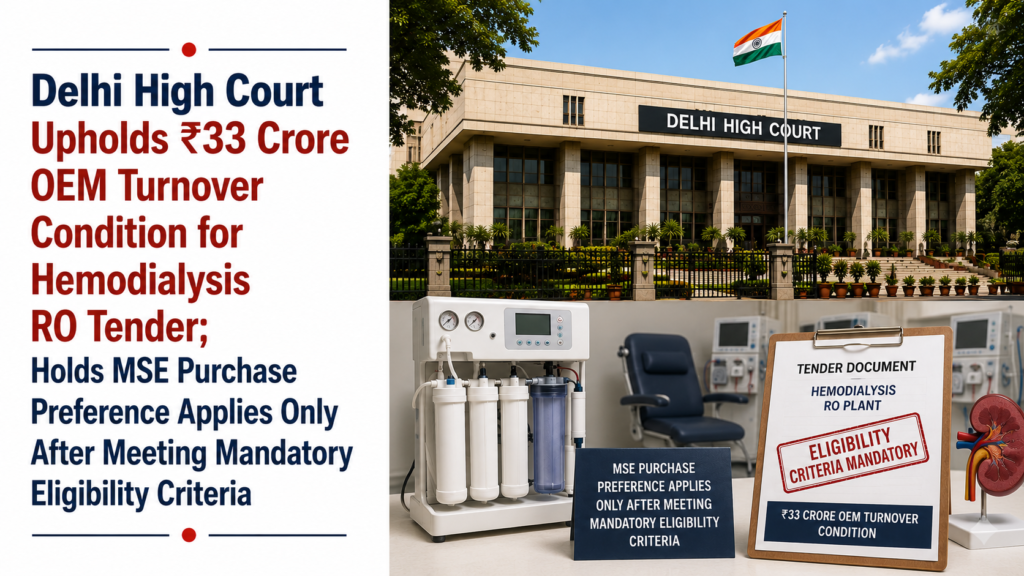
Delhi High Court Upholds ₹33 Crore OEM Turnover Condition for Hemodialysis RO Tender; Holds MSE Purchase Preference Applies Only After Meeting Mandatory Eligibility Criteria

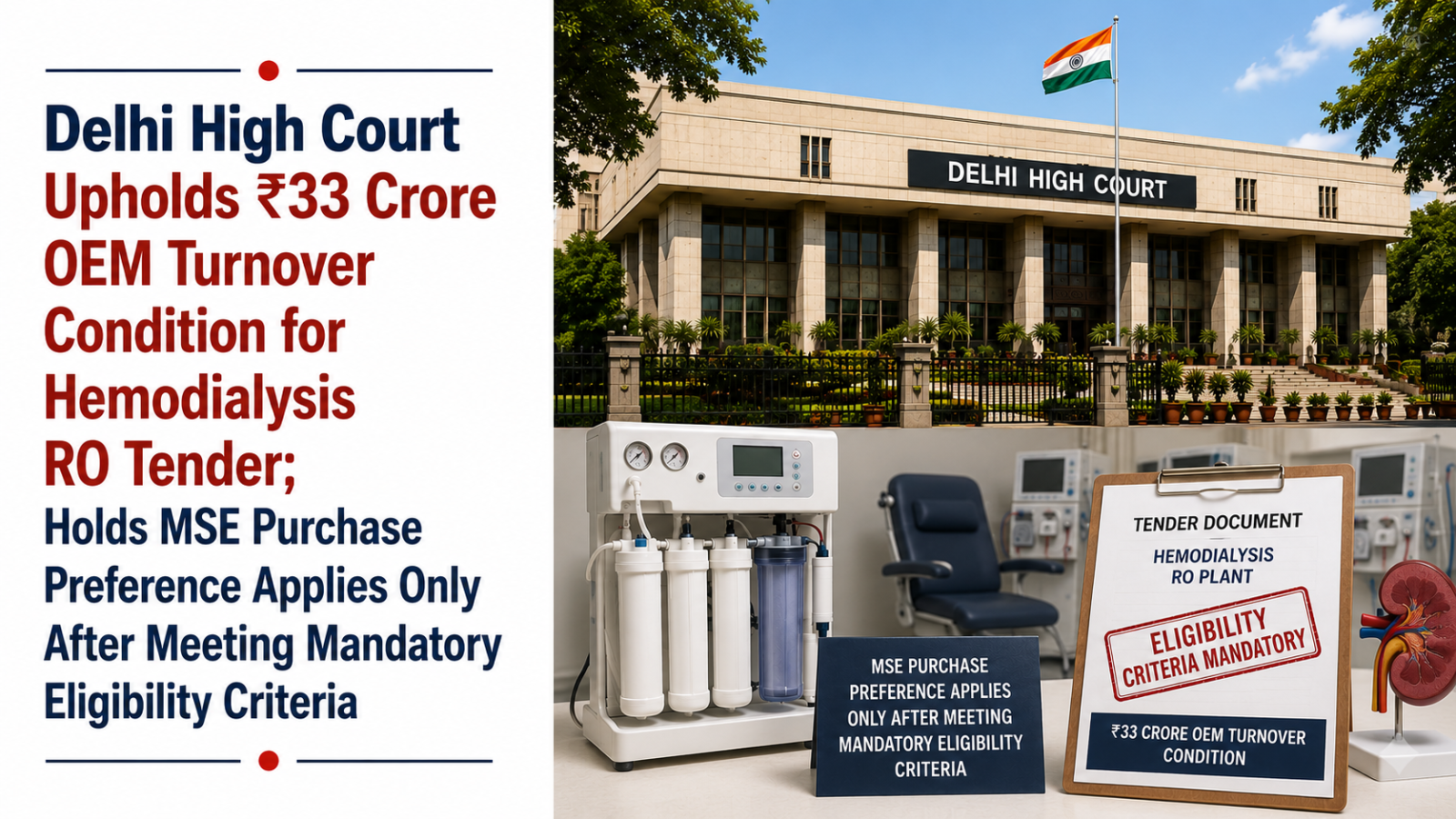
Delhi High Court Sustains Defence Procurement Turnover Norm but Directs Future Tender Correction; Finds Current MSE Preference Clause Anomalous Yet Not Invalidating Procurement
Facts
The petitioner, Althion Tech Innovations Pvt. Ltd., challenged a tender dated 17 July 2025 floated by the Director General Armed Forces Medical Services, Ministry of Defence, on the Government e-Marketplace for the supply, installation and commissioning of 13 RO water plants for hemodialysis.
The tender originally prescribed a minimum average annual turnover of ₹2 crore for the bidder and ₹48 crore for the Original Equipment Manufacturer (OEM) for the preceding three years. The OEM turnover requirement was later reduced to ₹33 crore, approximately 100% of the bid value.
The petitioner was a registered micro enterprise under the MSME Act and claimed to be the actual OEM of the dialysis-grade RO plants offered. It relied on its ISO 13485 certification, CDSCO Class C licence, DSIR recognition, patent and installations at institutions including AIIMS, NIMS Hyderabad, CMC Vellore, Tata Memorial Hospital and Sir Ganga Ram Hospital.
Its principal grievance was that the tender itself extended purchase preference to MSEs under Clause 5, but the ₹33 crore OEM turnover condition effectively excluded micro enterprises, whose turnover by statutory definition could not exceed ₹10 crore.
The petitioner therefore sought quashing of the turnover criteria or reconsideration of its bid without insisting on those conditions. Its bid had ultimately been rejected for failure to satisfy both the bidder and OEM annual turnover requirements.
Issues
The principal issue before the Delhi High Court was whether a registered micro enterprise could claim the MSE purchase preference under Clause 5 of the tender despite failing the prescribed ₹33 crore OEM turnover eligibility requirement.
The connected issues were:
- Whether the turnover criterion was arbitrary, disproportionate or violative of Articles 14 and 19(1)(g).
- Whether the Government’s public procurement policy required relaxation of prior turnover criteria in favour of MSEs.
- Whether such relaxation could legitimately be denied for procurement concerning public health, safety and critical medical equipment.
- Whether the MSE purchase preference clause overrode earlier eligibility clauses prescribing mandatory financial thresholds.
- Whether the tender authority’s interpretation of its own eligibility conditions warranted judicial interference.
Petitioner’s Arguments
The petitioner argued that the tender was internally contradictory.
Clause 5 expressly granted purchase preference to registered MSEs, yet the OEM turnover requirement of ₹33 crore could not be satisfied by a micro enterprise whose turnover ceiling was ₹10 crore. In its submission, the preference had therefore been rendered illusory.
It contended that technical quality was already independently secured through regulatory and technical specifications, meaning turnover was merely a financial barrier rather than a genuine measure of product quality.
The petitioner further relied upon its credentials and communication from the MSME Development and Facilitation Office dated 29 August 2025, which had noted that its experience aligned with the tender requirements and requested that it be afforded a fair opportunity to participate.
It characterised the ₹33 crore criterion as arbitrary, irrational and disproportionate and relied on Adhishri Swa Sahayata Samuh v. State of Chhattisgarh, 2026 SCC OnLine Chh 6697.
Respondent’s Arguments
The Union of India contended that the petitioner was participating both as bidder and OEM and therefore had to satisfy both sets of eligibility conditions.
It relied upon the Office Memorandum dated 20 September 2016, under which procurement entities may decline to relax prior turnover and experience requirements where procurement concerns public safety, health, critical security operations or equipment, provided adequate justification exists.
The respondent emphasised that the tender concerned ultra-pure RO water plants used for hemodialysis, which constituted life-support medical equipment directly connected to patient care in Armed Forces hospitals.
The turnover requirement was said to ensure:
- financial stability;
- manufacturing capability;
- organisational infrastructure;
- timely installation and commissioning;
- five-year warranty support;
- comprehensive maintenance;
- spare-part availability; and
- uninterrupted technical support.
The OEM threshold had already been reduced from ₹48 crore to ₹33 crore after representations and approval of the financial authorities. By contrast, the petitioner’s average annual turnover was only ₹75.22 lakh, substantially below the tender requirement and even below the approximate value of a single unit.
The respondent also argued that Clause 5 dealt only with purchase preference among otherwise eligible bidders and did not override the basic eligibility requirements in Clauses 1 to 3.
Analysis of the Law
MSE Purchase Preference Is Not the Same as Eligibility
The Court accepted the respondent’s distinction between eligibility and purchase preference.
Clause 5 becomes relevant only after a bidder crosses the threshold requirements and is otherwise technically and financially qualified.
A bidder cannot bypass mandatory eligibility criteria merely by asserting MSE status and directly invoke the purchase preference provision.
The Court therefore held that until the petitioner satisfied the ₹33 crore OEM turnover criterion, it could not claim the benefit of Clause 5.
Health Procurement May Justify Non-Relaxation
The Court relied significantly upon the OM dated 20 September 2016.
It accepted that in procurement concerning health and safety, prior turnover requirements need not be relaxed where adequate justification is available.
Here, the tender concerned hemodialysis equipment and had a bid value of about ₹33 crore. The OEM turnover threshold had itself been fixed at approximately 100% of the bid value after being reduced from ₹48 crore.
The Court found the respondent’s justification persuasive.
Express No-Exemption Clause Was Decisive
The bid document expressly stated that exemption from years of experience and turnover criteria was “No.”
The Court held that this express stipulation materially weakened the petitioner’s claim that its MSE status automatically entitled it to relaxation.
Because the tender itself excluded turnover relaxation, Clause 5 had to be read harmoniously with the eligibility conditions rather than as overriding them.
Tender Authority Is Best Placed to Interpret Its Conditions
The Court relied upon settled law that the author of the tender is ordinarily the best person to interpret its terms and requirements, subject to the interpretation not suffering from illegality, irrationality, mala fides, perversity or procedural impropriety.
It referred to Agmatel India Pvt. Ltd. v. Resoursys Telecom, (2022) 5 SCC 362, which in turn discussed Tata Cellular v. Union of India.
The Court found no such legal defect in the respondent’s interpretation.
Precedent Analysis
1. Agmatel India Private Limited v. Resoursys Telecom and Others, (2022) 5 SCC 362
This was the principal Supreme Court authority applied by the Delhi High Court.
The Court reiterated that the tender-floating authority is normally best placed to interpret its own eligibility requirements because it understands the procurement need and the manner in which that need is to be achieved.
Judicial interference is warranted only where the decision suffers from illegality, irrationality, mala fides, perversity or procedural impropriety.
The Delhi High Court found no such ground here.
2. Tata Cellular v. Union of India, (1994) 6 SCC 651
Tata Cellular was referred to through Agmatel for the limited judicial-review standard applicable in government tender matters.
The Court recognised that while tender authorities cannot act arbitrarily or contrary to their own conditions, courts should not substitute their commercial or administrative assessment for that of the procuring authority.
3. Adhishri Swa Sahayata Samuh v. State of Chhattisgarh, 2026 SCC OnLine Chh 6697
The petitioner relied upon this judgment because the Chhattisgarh High Court had granted relief where a tender expressly provided complete MSE relaxation from turnover and experience requirements but the procuring authority nevertheless denied that benefit.
The Delhi High Court distinguished the decision.
In Adhishri, the tender itself expressly granted complete relaxation. In the present case, the bid document expressly stated that MSE exemption from turnover and experience was not available, and the 20 September 2016 OM concerning health procurements had not been considered in the Chhattisgarh case.
Court’s Reasoning
The Court accepted that there was an apparent anomaly in the tender.
Clause 5 granted MSE purchase preference, yet the ₹33 crore turnover threshold meant that micro enterprises could not practically qualify at all. In effect, only small enterprises capable of meeting the threshold could avail the MSE preference.
However, that anomaly did not render the current tender illegal.
The tender expressly stated that no exemption from turnover or experience requirements was available. The procurement also related directly to public health and patient safety, falling within the policy framework permitting the authority to retain such criteria.
The petitioner’s annual turnover of ₹75.22 lakh was vastly below the prescribed ₹33 crore threshold. The Court therefore concluded that it failed the mandatory eligibility requirement.
Consequently, the MSE purchase preference could never be reached because that benefit arose only after eligibility had first been established.
The Court was also mindful that the tender, issued in 2025 for health-related procurement, remained incomplete and observed that the process needed to attain finality expeditiously.
Conclusion
The Delhi High Court dismissed the writ petition and upheld the tender’s ₹33 crore OEM turnover criterion.
It held that the petitioner could not claim MSE purchase preference under Clause 5 without first satisfying the mandatory turnover eligibility conditions.
The Court accepted that public-health procurement could legitimately be excluded from MSME turnover relaxation where adequate justification existed and found the present condition rationally connected with the scale, reliability and continuing support requirements of the hemodialysis equipment procurement.
Importantly, however, the Court expressly recognised an anomaly in the drafting of the tender: Clause 5 appeared to extend purchase preference to MSEs even though the turnover threshold effectively prevented micro enterprises from qualifying.
It therefore directed the respondent, for future tenders, to correct this anomaly. No costs were imposed.
Key Legal Principle
MSE purchase preference in a government tender operates only after the bidder satisfies the underlying eligibility requirements. MSME status does not automatically confer exemption from turnover criteria, particularly in public-health procurement where applicable government policy permits non-relaxation upon adequate justification.
Case Details
Case: Althion Tech Innovations Pvt. Ltd. Through Authorised Signatory v. Union of India
Court: High Court of Delhi at New Delhi
Case Number: W.P.(C) 9110/2026; CNR No. DLHC010289972026
Judges: Justice V. Kameswar Rao and Justice Manmeet Pritam Singh Arora
Date: 20 August 2026; reserved on 18 August 2026
Result: Writ petition dismissed; ₹33 crore OEM turnover requirement upheld; MSE purchase preference held unavailable without satisfying eligibility criteria; respondent directed to correct the tender anomaly in future tenders; no costs.