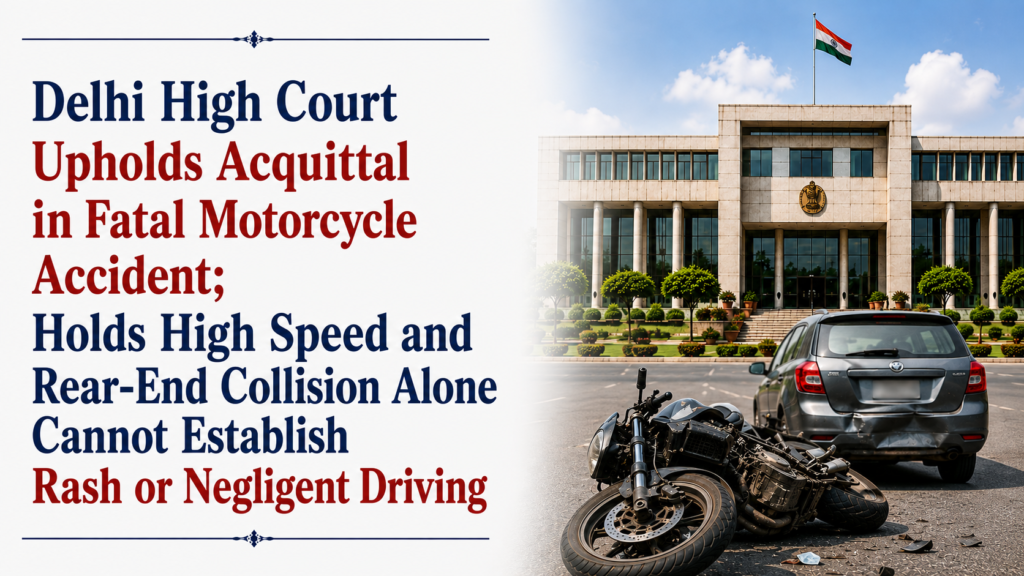
Delhi High Court Upholds Acquittal in Fatal Motorcycle Accident; Holds High Speed and Rear-End Collision Alone Cannot Establish Rash or Negligent Driving

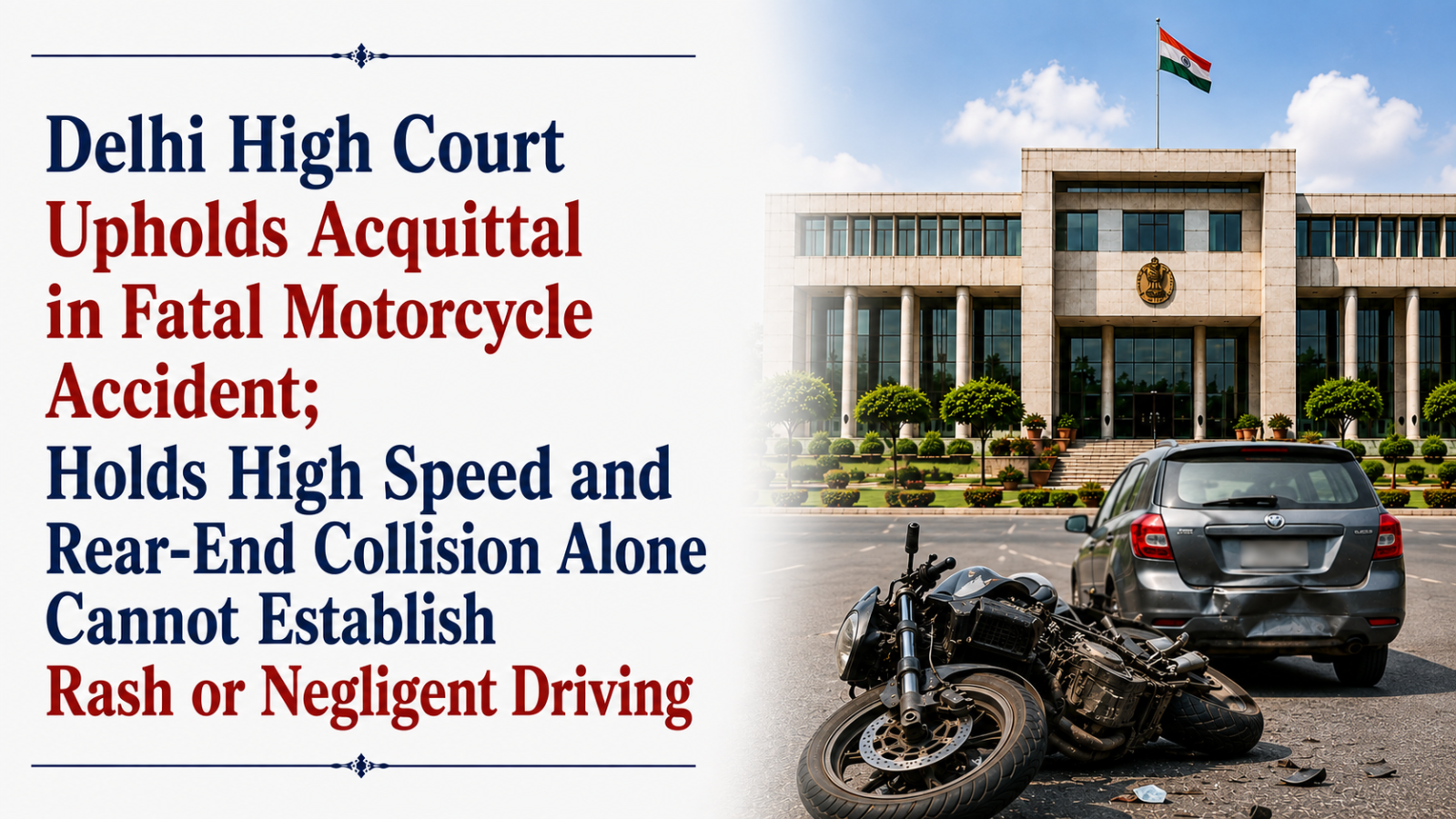
Delhi High Court Dismisses State Appeal Against Motorcyclist’s Acquittal; Finds No Infirmity in Trial Court’s Assessment of Rashness and Negligence
Facts
The appeal arose from a road accident that occurred at about 7:30 p.m. on 4 March 2012 near Jamia Nagar, New Delhi.
The prosecution alleged that Taufiq, the deceased, was walking with his friend PW3 from Sarai Julena Chowk towards Jamaat-e-Islami Hind Masjid when a motorcycle bearing registration No. DL3SBW9340, allegedly ridden by the accused Mohd Asif, came from behind and struck him.
Taufiq suffered grievous injuries and subsequently died. The accused was prosecuted under Sections 279 and 304A IPC.
The trial court acquitted the accused by judgment dated 9 February 2016.
The State filed an appeal under Section 378(1) CrPC challenging the acquittal.
The accused consistently denied that he was riding the motorcycle and claimed false implication.
Issues
The principal question before the Delhi High Court was whether the acquittal suffered from any infirmity warranting interference.
More specifically, the Court examined:
- Whether the prosecution proved that the accused was driving in a rash or negligent manner.
- Whether the eyewitness testimony of PW3 established the essential ingredients of Sections 279 and 304A IPC.
- Whether the site plan could be relied upon to prove the precise manner of the accident.
- Whether the deceased’s FIR statement could be treated as a dying declaration.
- If admissible as a dying declaration, whether it proved rashness or negligence beyond reasonable doubt.
Petitioner’s Arguments
The State contended that the trial court had failed to properly appreciate the ocular and documentary evidence.
It relied primarily on PW3, who claimed to have witnessed the accident and identified the accused as the rider.
According to PW3, the motorcycle was being driven at high speed, had not sounded a horn and struck the deceased from behind. He also stated that the deceased’s leg became entangled in the motorcycle’s shock absorber and that he was dragged for approximately ten metres.
The State therefore argued that the evidence sufficiently established rash and negligent driving.
Respondent’s Arguments
The accused supported the trial court judgment and contended that the prosecution had failed to establish any specific act amounting to criminal rashness or negligence.
The defence maintained that mere occurrence of an accident or evidence that a vehicle was being driven at high speed cannot automatically satisfy Sections 279 and 304A IPC.
It therefore sought dismissal of the State’s appeal.
Analysis of the Law
The High Court reiterated that, for an offence under Section 279 IPC, the prosecution must prove that the accused drove a vehicle on a public way in a manner so rash or negligent as to endanger human life or likely cause injury.
For Section 304A IPC, the prosecution must establish:
- the death of a person;
- that the accused caused the death; and
- that the act causing death was rash or negligent, though not amounting to culpable homicide.
The Court emphasised that criminal negligence requires more than ordinary carelessness. There must be gross and culpable neglect or a failure to exercise the degree of care that a reasonable and prudent person was duty-bound to exercise.
Similarly, rashness involves consciously taking an unjustifiable risk with recklessness or indifference to consequences.
Precedent Analysis
Naresh Giri v. State of Madhya Pradesh
The Court relied on Naresh Giri v. State of Madhya Pradesh, (2008) 1 SCC 791, which explains that Section 304A applies where there is neither intention to cause death nor knowledge that death would probably result, but the death is directly attributable to a rash or negligent act.
Alister Anthony Pareira v. State of Maharashtra
The Court also relied upon Alister Anthony Pareira v. State of Maharashtra, (2012) 2 SCC 648 for the distinction between rashness and criminal negligence.
Criminal negligence requires gross culpability and failure to exercise necessary care and precaution.
Tori Singh v. State of U.P. and Jagdish Narain v. State of U.P.
On the site plan, the Court relied upon Tori Singh v. State of U.P. and Jagdish Narain v. State of U.P.
A site plan is admissible only insofar as it depicts what the investigating officer personally observed. Markings based merely upon statements made by witnesses during investigation are hit by Section 162 CrPC and cannot independently prove disputed facts.
Damodar Prasad v. State of U.P. and Lalita v. Vishwanath
On the deceased’s statement, the Court referred to Damodar Prasad v. State of U.P. and Lalita v. Vishwanath, holding that a statement made by an injured person regarding the circumstances leading to death can later be treated as a dying declaration under Section 32(1) of the Evidence Act.
Court’s Reasoning
The Court found that PW3’s testimony did not establish any specific act constituting rashness or negligence.
Although PW3 stated that the motorcycle was travelling at 80–90 kmph, he also admitted that he and the deceased were walking on the road rather than on a footpath.
He further stated that they were walking on a kaccha strip adjoining the main road and that, if two people walked side by side there, one would necessarily be on the main carriageway.
The High Court therefore held that mere speed, without evidence about the actual manner of driving, lane deviation, unsafe manoeuvring, failure to control the vehicle or some other concrete negligent act, was insufficient.
The Court expressly observed that PW3’s testimony did not establish the requisite act of rashness or negligence.
The site plan also did not assist the prosecution. It failed to depict the alleged kaccha road referred to by PW3 and did not establish the respective positions of the deceased and motorcycle in a manner capable of proving negligence.
The deceased’s FIR statement was held admissible as a dying declaration because he later succumbed to the injuries sustained in the accident.
However, the statement merely recorded that the motorcycle came at high speed and struck him from behind. It contained no description of any specific dangerous manoeuvre, lane deviation or other conduct showing rashness or negligence.
Thus, the dying declaration proved the occurrence of the accident but not the essential criminal element required for conviction.
Conclusion
The Delhi High Court held that the prosecution had failed to prove beyond reasonable doubt that the accused drove the motorcycle in a rash or negligent manner.
The fact that the motorcycle struck the deceased from behind and was allegedly moving at high speed was insufficient, by itself, to establish criminal rashness or negligence.
The eyewitness testimony, site plan and dying declaration established the accident but did not establish the precise negligent act required under Sections 279 and 304A IPC.
The Court therefore found no infirmity in the trial court’s acquittal and dismissed the State’s appeal.
Case Details
Case: State NCT of Delhi v. Mohd Asif
Court: High Court of Delhi at New Delhi
Case Number: Criminal Appeal No. 1072 of 2019; CNR No. DLHC010382032019
Judge: Justice Chandrasekharan Sudha
Date: 18 August 2026; reserved on 13 August 2026
Result: State appeal dismissed; acquittal under Sections 279 and 304A IPC upheld because rash or negligent driving was not proved beyond reasonable doubt.