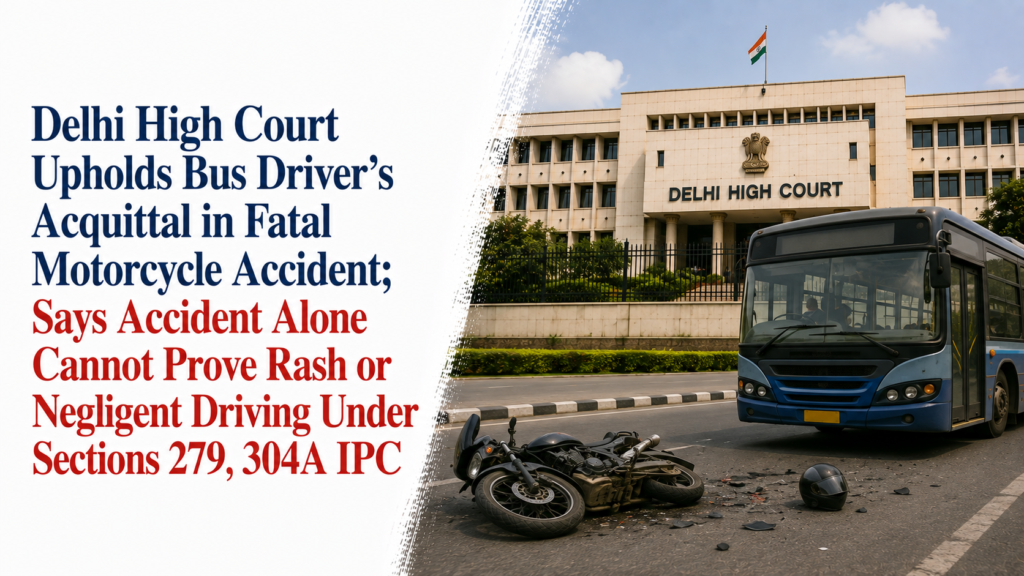
Delhi High Court Upholds Bus Driver’s Acquittal in Fatal Motorcycle Accident; Says Accident Alone Cannot Prove Rash or Negligent Driving Under Sections 279, 304A IPC

Delhi High Court Upholds Acquittal in Fatal Road Accident; Says Criminal Negligence Cannot Be Inferred Without Evidence Showing How the Accused Drove the Vehicle
Facts
The Delhi High Court dealt with two connected appeals under Section 378 Cr.P.C.—one filed by the State (NCT of Delhi) and the other by Ramphal Duggal, father of the deceased—challenging the Trial Court’s judgment dated 8 December 2017 acquitting Jagdish of offences under Sections 279 and 304A IPC.
The prosecution case arose from a fatal road accident on 7 July 2003 at approximately 6:15 PM.
Ravinder Duggal was riding motorcycle No. DL 8ST 6334 towards Punjabi Bagh near the Ring Road flyover. When he reached in front of Rajdhani College, a Blue Line bus bearing registration No. DL 1PA 7837 allegedly approached from behind and struck his motorcycle.
The impact threw Ravinder onto the road, after which the bus ran over him, causing his death. The prosecution alleged that Jagdish was driving the bus rashly and negligently.
FIR No. 504/2003 was registered at Rajouri Garden Police Station for offences under Sections 279 and 304A IPC.
During trial, the prosecution examined 11 witnesses. After the prosecution evidence was concluded, Jagdish denied the incriminating circumstances under Section 313 Cr.P.C., maintained his innocence and claimed that he was not driving the offending bus. He did not lead defence evidence.
The Trial Court acquitted him on 8 December 2017.
Both the State and the deceased’s father challenged the acquittal before the Delhi High Court.
Issues
The principal issues before the High Court were:
- Whether the prosecution proved beyond reasonable doubt that Jagdish was driving the offending bus;
- Whether the evidence established that the bus was driven in a rash or negligent manner as required under Section 279 IPC;
- Whether Ravinder Duggal’s death was directly caused by a rash or negligent act attributable to the accused so as to constitute an offence under Section 304A IPC;
- Whether the sole eyewitness’s testimony sufficiently established the manner in which the bus was being driven;
- Whether the site plan could be relied upon to infer rashness or negligence;
- Whether portions of the site plan based upon statements made to the Investigating Officer were inadmissible under Section 162 Cr.P.C.; and
- Whether the Trial Court’s acquittal disclosed any infirmity warranting interference in appeal.
Appellants’ Arguments
The State argued that the Trial Court’s acquittal was contrary to the evidence available on record.
According to the prosecution, the Trial Court failed to properly appreciate the ocular and medical evidence and also failed to apply the evidentiary principle of res ipsa loquitur.
Particular reliance was placed upon PW10, the sole eyewitness, whose testimony, according to the State, remained consistent on material particulars and was sufficient to establish the prosecution case.
PW10 stated that while on patrol duty he saw the motorcycle and Blue Line bus proceeding towards Punjabi Bagh. According to him, the bus struck the motorcycle from behind, throwing the motorcyclist onto the road, following which the bus ran over him.
PW10 also identified Jagdish in Court as the driver of the offending bus.
There was no representation for the deceased’s father when his connected appeal was heard. Relying upon Bani Singh & Ors. v. State of U.P., the High Court nevertheless considered that appeal on merits from the record.
Respondent’s Arguments
The accused supported the Trial Court’s acquittal and argued that there was no legal or factual infirmity warranting interference.
His counsel contended that the prosecution evidence failed to establish the essential ingredients of Sections 279 and 304A IPC.
Specifically, the evidence did not conclusively establish rashness or negligence on the part of the accused.
Reliance was placed upon:
- Abdul Subhan v. State (NCT of Delhi), 2006 SCC OnLine Del 1132; and
- Kishore Chand Joshi v. State, 2018 SCC OnLine Del 12337.
The respondent therefore contended that the acquittal should be maintained.
Analysis of the Law
Ingredients of Sections 279 and 304A IPC
The High Court explained that conviction under Section 279 IPC requires proof that the accused drove a vehicle on a public way in a manner so rash or negligent as to endanger human life or be likely to cause hurt or injury.
For Section 304A IPC, the prosecution must establish:
- death of the person concerned;
- that the accused caused the death; and
- that the act causing death was rash or negligent but did not amount to culpable homicide.
Thus, the mere occurrence of an accident and consequent death is not by itself sufficient.
The prosecution must establish the necessary degree of criminal rashness or negligence attributable to the accused.
Meaning of Criminal Rashness and Negligence
Relying upon Naresh Giri v. State of Madhya Pradesh, (2008) 1 SCC 791, the Court noted that Section 304A applies where there is neither an intention to cause death nor knowledge that the act would probably cause death.
Rashness and negligence must nevertheless be the direct cause of death.
The Court also relied upon Alister Anthony Pareira v. State of Maharashtra, (2012) 2 SCC 648.
Criminal rashness involves taking a risk with recklessness or indifference to its consequences, while criminal negligence involves gross and culpable neglect or failure to exercise the care and precaution required in the circumstances.
Sole Eyewitness Failed to Establish Manner of Driving
The High Court considered PW10 to be the prosecution’s principal witness.
However, his testimony merely established that the bus struck the motorcycle from behind and subsequently ran over the deceased.
Crucially, PW10 gave no evidence explaining how the bus was being driven in a rash or negligent manner.
The Court identified several important omissions. PW10 did not state:
- the speed at which the bus was travelling;
- whether it was travelling at excessive speed;
- whether there was heavy traffic;
- whether the bus deviated from its lane;
- whether the accused adopted any unusual or dangerous manner of driving; or
- whether any applicable speed limit had been violated.
The Court therefore found that the eyewitness evidence failed to establish the central ingredient of the offences.
Accident Itself Was Not Enough
The High Court recognised that an eyewitness cannot be expected to describe every minute detail with mathematical precision.
Nevertheless, for offences under Sections 279 and 304A IPC, the prosecution must establish more than the occurrence of an accident.
It must prove that the accident was the direct consequence of the accused’s rash or negligent driving.
PW10’s testimony contained no material from which such an inference could reasonably be drawn.
This distinction formed the central basis for upholding the acquittal.
Section 133 Motor Vehicles Act Reply
The prosecution also relied upon the owner of the offending bus and the reply furnished to a notice issued under Section 133 of the Motor Vehicles Act.
The Court held that the reply given by PW7 during investigation constituted a statement to the Investigating Officer and was therefore inadmissible because of the embargo contained in Section 162 Cr.P.C.
However, PW7 independently admitted during his examination that the accused was the driver of the offending vehicle.
Thus, even assuming the accused’s identity as driver was established, the prosecution still had to separately prove rashness or negligence.
Evidentiary Value of the Site Plan
The Court separately examined the site plan prepared by the Investigating Officer at PW10’s instance.
It held that a site plan is admissible to the extent that it records what the Investigating Officer personally observed at the scene.
However, markings depicting the location of the incident, victim or other facts based solely upon statements made by witnesses during investigation are hit by Section 162 Cr.P.C.
The Court relied upon:
- Tori Singh v. State of U.P., AIR 1962 SC 399; and
- Jagdish Narain v. State of U.P., (1996) 8 SCC 199.
Accordingly, the site plan could not be used as a substitute for substantive evidence regarding the manner in which the accident occurred.
Site Plan Did Not Establish Rashness Even If Considered
The Court went further and held that even assuming the site plan was admissible in its entirety, it did not establish rash or negligent driving.
The site plan merely showed the positions where:
- the bus was found abandoned;
- the deceased’s body was lying; and
- the motorcycle was lying.
It did not disclose:
- the point of impact;
- width of the road;
- respective traffic lanes;
- distance between the vehicles; or
- whether the bus had moved into the wrong lane.
Therefore, no inference of criminal rashness or negligence could safely be drawn from it.
Precedent Analysis
Naresh Giri v. State of Madhya Pradesh, (2008) 1 SCC 791
The Supreme Court explained that Section 304A operates outside the scope of culpable homicide under Sections 299 and 300 IPC.
For liability under Section 304A, the rash or negligent act must be directly responsible for causing the death.
Alister Anthony Pareira v. State of Maharashtra, (2012) 2 SCC 648
The judgment was relied upon to explain the standard of criminal rashness and negligence.
Criminal negligence requires gross and culpable failure to exercise reasonable care and precaution, while criminal rashness involves acting recklessly or with indifference to foreseeable consequences.
Tori Singh v. State of U.P., AIR 1962 SC 399
The Supreme Court authority was relied upon regarding the evidentiary limitations applicable to a site plan prepared by an Investigating Officer.
Facts incorporated into a site plan merely on the basis of witness statements cannot circumvent the prohibition contained in Section 162 Cr.P.C.
Jagdish Narain v. State of U.P., (1996) 8 SCC 199
This precedent reinforced the distinction between the Investigating Officer’s personal observations at the scene and information incorporated into a site plan on the basis of witness statements.
The latter cannot automatically be treated as substantive evidence.
Bani Singh & Ors. v. State of U.P., (1996) 4 SCC 720
The High Court relied upon Bani Singh to proceed with the deceased father’s appeal on merits despite the absence of representation on his behalf.
Abdul Subhan v. State (NCT of Delhi), 2006 SCC OnLine Del 1132 and Kishore Chand Joshi v. State, 2018 SCC OnLine Del 12337
These authorities were relied upon by the accused to contend that the prosecution evidence was insufficient to establish the essential element of rash or negligent driving required for conviction under Sections 279 and 304A IPC.
Court’s Reasoning
The High Court’s reasoning centred on the distinction between proof of an accident and proof of criminally rash or negligent driving.
There was no dispute that Ravinder Duggal died after being run over by the bus.
There was also evidence identifying Jagdish as the driver.
However, neither fact automatically established criminal liability under Sections 279 and 304A IPC.
The prosecution was required to prove how Jagdish drove the bus in a manner amounting to criminal rashness or negligence.
PW10, the only eyewitness, did not provide the necessary evidence concerning speed, traffic conditions, lane position, dangerous manoeuvring or any other feature demonstrating rashness or negligence.
The site plan could not cure this deficiency because portions derived from witness statements were inadmissible under Section 162 Cr.P.C. More importantly, even if considered, the site plan lacked the factual particulars necessary to reconstruct the accident and determine whether the accused had driven negligently.
The High Court therefore concluded that the Trial Court had correctly acquitted the accused.
Conclusion
The Delhi High Court dismissed both appeals filed against Jagdish’s acquittal.
The Court held that although the fatal accident was established, the prosecution had failed to prove the essential ingredient of rash or negligent driving beyond reasonable doubt.
The sole eyewitness did not explain the speed, lane position, traffic conditions or any dangerous manner of driving by the accused. The site plan also failed to establish these elements.
Consequently, the High Court found no infirmity in the Trial Court’s judgment dated 8 December 2017 and upheld Jagdish’s acquittal under Sections 279 and 304A IPC.
Case Details
Case: State (NCT of Delhi) v. Jagdish with Ramphal Duggal v. State & Anr.
Court: High Court of Delhi at New Delhi
Case Number: CRL.A. 1143/2019 & CRL.A. 1144/2019; CNR Nos. DLHC010400472019 & DLHC010400482019
Judge: Justice Chandrasekharan Sudha
Date: 12 August 2026
Result: Both appeals dismissed; acquittal of Jagdish for offences under Sections 279 and 304A IPC upheld.