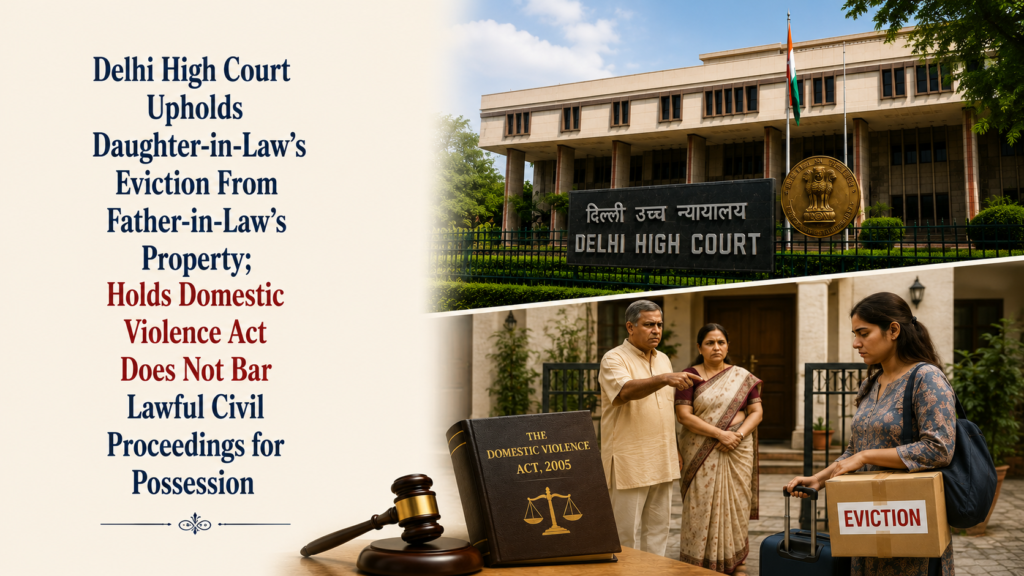
Delhi High Court Upholds Daughter-in-Law’s Eviction From Father-in-Law’s Property; Holds Domestic Violence Act Does Not Bar Lawful Civil Proceedings for Possession

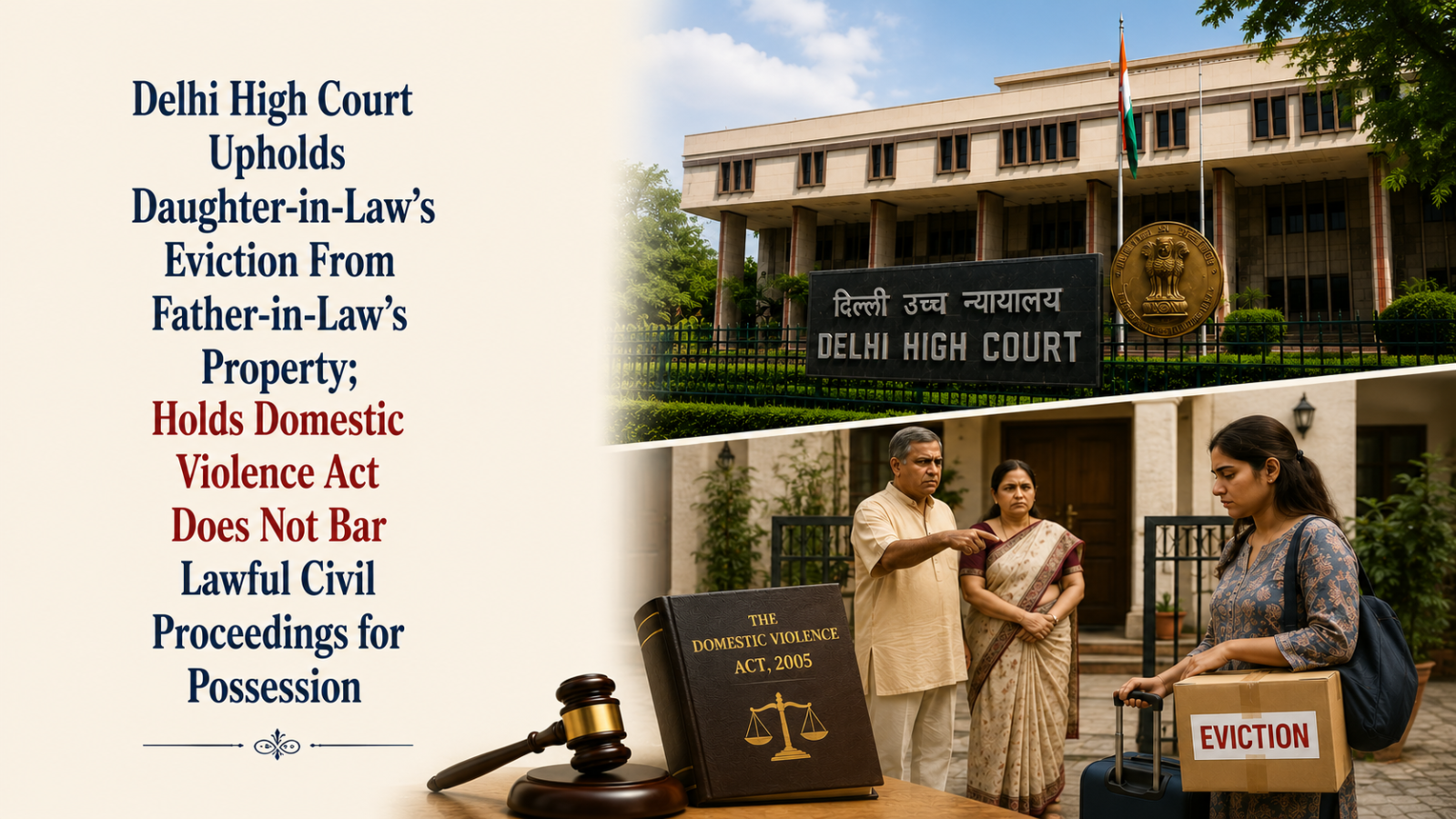
Father-in-Law Can Seek Daughter-in-Law’s Eviction Through Civil Court Despite Domestic Violence Proceedings, Delhi High Court Holds
Facts
The respondent-plaintiff, Safdar Raza, a retired schoolteacher, claimed ownership of a 50-square-yard property at D-265, Noor Ilahi, North Ghonda, Delhi, purchased in 2011 through documents including a GPA, Agreement to Sell, Will and Receipt and mutated in his name in municipal records. He resided on the ground floor, while his daughter-in-law, Ali Fatima, occupied part of the first floor.
The plaintiff’s elder son, Mohd. Raza, had first married Poonam Rani @ Sana and thereafter married Ali Fatima in 2009. According to the father-in-law, he had disowned his son and both wives and terminated Ali Fatima’s permission to occupy his property through a legal notice dated 22 February 2018.
The father-in-law claimed that because of continuing family disputes, he had purchased another house at Bhagirathi Vihar in Ali Fatima’s name so that she could shift there. She instead let that property to tenants and continued occupying his property. He therefore instituted a civil suit seeking possession and permanent injunction.
Ali Fatima resisted the suit on the ground that the property constituted her matrimonial home/shared household and that she had an independent statutory right of residence as a daughter-in-law. She disputed the father-in-law’s claim of exclusive ownership and alleged that the proceedings were collusive and intended to evict her after she initiated matrimonial proceedings.
The Trial Court held that the father-in-law had established his exclusive ownership and that Ali Fatima failed to prove that the property was ancestral or joint-family property. It consequently directed her to hand over possession. The First Appellate Court affirmed the decree on 6 January 2026.
Ali Fatima then approached the Delhi High Court in a Regular Second Appeal.
Issues
The principal issues were:
- Whether the daughter-in-law could resist eviction from the father-in-law’s separately acquired property by invoking her right to reside in a “shared household” under Sections 17 and 19 of the Protection of Women from Domestic Violence Act, 2005.
- Whether a civil suit for possession constituted “procedure established by law” for purposes of Section 17(2) of the DV Act.
- Whether the DV Act barred a property owner from instituting civil proceedings for eviction or possession.
- Whether the appellant could challenge the concurrent findings that the property was individually acquired by the father-in-law and not ancestral.
- Whether the appeal raised any substantial question of law warranting interference under Section 100 CPC.
Appellant’s Arguments
Ali Fatima argued that she had resided in the property since her marriage in 2009 and that it constituted her matrimonial home and “shared household” under Section 2(s) of the DV Act.
She invoked Section 17 to contend that she possessed an independent statutory right of residence and could not be evicted except through the procedure contemplated by the DV Act. According to her, a civil suit for possession could not be used to bypass the statutory protection afforded to an aggrieved woman.
She further argued that the father-in-law had failed to prove that the property was self-acquired. His claim was based on an unregistered GPA and allied documents, which, according to her, could not convey title in view of Suraj Lamp & Industries Pvt. Ltd. v. State of Haryana.
The appellant also alleged collusion between her husband and father-in-law, contending that the eviction proceedings were initiated as a counterblast to the matrimonial cases filed by her.
She disputed the finding regarding alternate accommodation and maintained that another property standing in her name did not extinguish her statutory right to reside in the shared household.
Respondent’s Case
The father-in-law’s case was that the property was his individually acquired property and that his son had no ownership or proprietary interest in it.
Ali Fatima’s occupation was permissive and arose solely because she was married to his son. Once permission to the son and his family was withdrawn, she had no independent proprietary right to continue occupying the premises.
It was also his case that another residential property had already been purchased in Ali Fatima’s name to resolve the family dispute and that she was earning rental income from it.
The respondent therefore maintained that the DV Act could not prevent him, as the property owner, from recovering possession through a competent civil court.
Analysis of the Law
The High Court emphasised that a Regular Second Appeal under Section 100 CPC is maintainable only where a substantial question of law arises. Concurrent findings of fact ordinarily cannot be reopened merely because the appellant seeks a different appreciation of the evidence.
The Court noted that both courts below had concurrently found that the suit property was individually acquired by the father-in-law and was not ancestral property.
It further held that Section 17(2) of the DV Act itself contemplates eviction or exclusion of an aggrieved woman from a shared household where it is undertaken in accordance with the procedure established by law.
The statutory scheme under Sections 19 and 26 of the DV Act also recognises alternate remedies, including provision of alternate accommodation or payment of rent, and does not expressly or impliedly prohibit civil proceedings before a competent court.
Accordingly, a right of residence under the DV Act cannot be equated with an absolute or indefeasible right to remain permanently in a particular property regardless of ownership rights and lawful judicial proceedings.
Precedent Analysis
The Court relied upon B.P. Achala Anand v. S. Appi Reddy, (2005) 3 SCC 313, observing that where a wife derives her residence through her husband, the loss of the husband’s lawful right to reside in the premises may correspondingly affect her entitlement to remain there.
The Court principally relied upon Satish Chander Ahuja v. Sneha Ahuja, (2021) 1 SCC 414. It noted that Section 17(2) protects an aggrieved woman against eviction otherwise than through due process, but does not create an absolute bar against eviction proceedings.
The Supreme Court had specifically recognised that proceedings before a competent civil court for eviction or exclusion are contemplated by the DV Act and that there is neither an express nor implied bar on civil proceedings. Section 26 additionally permits residence-related relief under Section 19 to be considered in civil, Family Court or criminal proceedings.
Thus, the High Court rejected the proposition that the pendency of DV Act proceedings automatically deprived the civil court of jurisdiction to adjudicate the father-in-law’s possession claim.
Court’s Reasoning
The Court found the appellant’s ownership argument internally inconsistent. On one hand, she challenged the father-in-law’s ownership on the basis that his documents did not confer valid title; on the other hand, she sought to assert a residence right precisely in the property claimed by him.
More importantly, the concurrent factual finding was that the husband had no independent right to continue occupying his father’s property. Once the father withdrew permission to his son and family, the appellant could not claim an unrestricted right to remain there merely by virtue of her status as daughter-in-law.
The Court also considered the availability of alternate accommodation. The First Appellate Court had found that another house stood in Ali Fatima’s own name and that she was receiving rental income from it. The evidence supporting the father-in-law’s assertion that he had purchased that property for her had remained materially unchallenged.
The High Court held that this property constituted alternate accommodation within the meaning of Section 19(1)(f) of the DV Act. Since the purpose of Sections 17 and 19 is to ensure that an aggrieved woman is not rendered shelterless or destitute, the appellant could not contend on these facts that eviction would leave her homeless.
Her residence rights against her husband remained capable of being pursued in the DV Act proceedings and maintenance proceedings already instituted by her. However, those rights did not justify continued occupation of the father-in-law’s property after lawful withdrawal of permission.
Finally, the High Court held that the grounds raised essentially sought reconsideration of factual findings and did not disclose any substantial question of law.
Conclusion
The Delhi High Court upheld the concurrent decrees directing Ali Fatima to vacate and hand over possession of the suit premises to her father-in-law.
The Court held that the DV Act does not impose an absolute prohibition on eviction of a woman from a shared household. Section 17(2) protects against eviction without due process, while civil proceedings before a competent court constitute a legally recognised mechanism for determining competing residence and property rights.
On the facts, the father-in-law had withdrawn permission to his son and family to reside in his separately acquired property, while the appellant had alternate accommodation standing in her own name.
Finding that the second appeal raised no substantial question of law, the Court dismissed it along with the pending applications.
Case Details
Case: Ali Fatima v. Safdar Raza & Ors.
Court: High Court of Delhi at New Delhi
Case Number: RSA No. 15/2026, CM Appl. 3771/2026 & CM Appl. 3774/2026
Judge: Hon’ble Ms. Justice Neena Bansal Krishna
Date: 11 August 2026
Result: Regular Second Appeal dismissed; decree directing the daughter-in-law to vacate and hand over possession of the father-in-law’s property upheld.