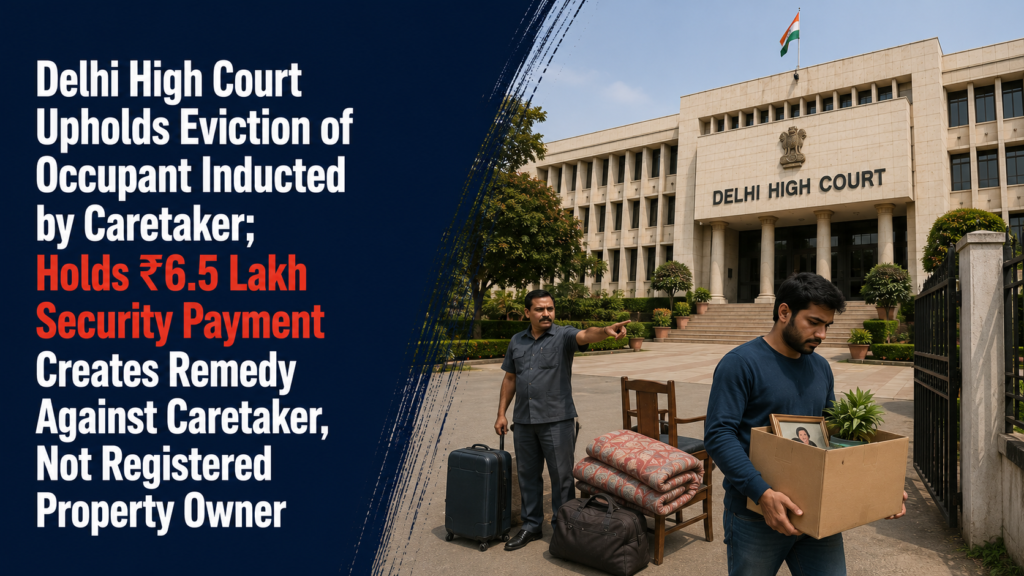
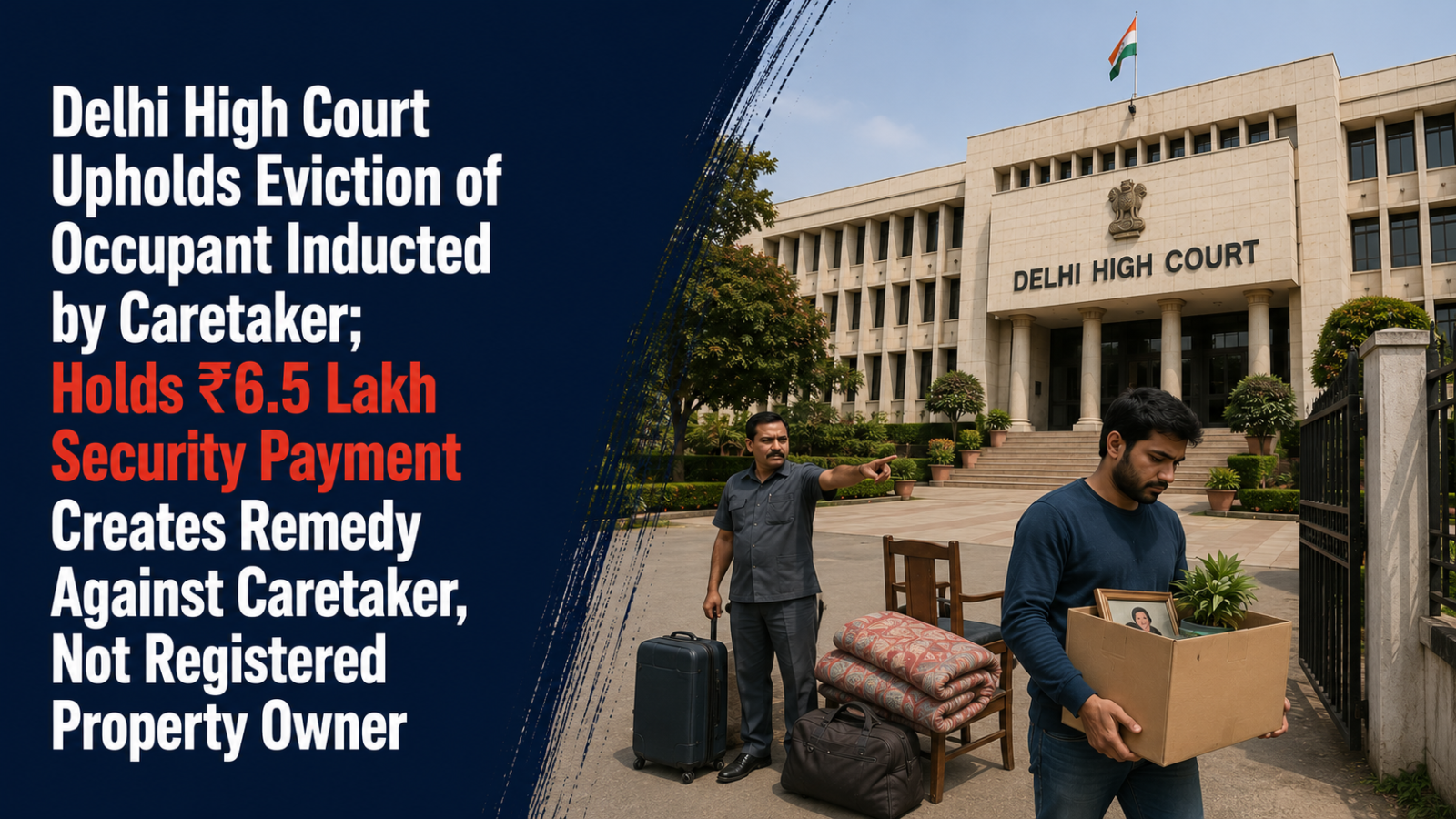
Delhi High Court Upholds Eviction of Occupant Inducted by Caretaker; Holds ₹6.5 Lakh Security Payment Creates Remedy Against Caretaker, Not Registered Property Owner

Delhi High Court Rejects Unauthorized Occupant’s Challenge to Ex-Parte Decree; Holds Failure to Pay Court-Ordered Costs Justified Striking Off Defence
Facts
The appeal arose from a decree dated 15 October 2025 granting possession, permanent injunction and mesne profits in favour of Shahnaz Parveen, the registered owner of a second-floor flat at West Jawahar Park, Laxmi Nagar, Delhi.
The Trial Court had awarded mesne profits/use and occupation charges of ₹15,000 per month with 9% interest from 1 January 2023 until vacation of the premises.
The respondent/plaintiff had purchased the property through a registered Sale Deed dated 24 July 2008. As she resided in Faridabad and was unable to manage the property personally, she appointed Mohd. Imran as caretaker in February 2020 and handed over the keys to him.
According to the plaintiff, because of the COVID-19 pandemic she could not visit the property for some time. When she visited in July 2021, she discovered Reshma, the appellant, occupying the premises.
Reshma informed her that Mohd. Imran had permitted her to stay there. The plaintiff initially gave Reshma time to vacate, ultimately extending it until 31 December 2022. When she failed to vacate, a legal notice dated 29 January 2024 was issued demanding possession and damages.
During the suit, Reshma failed to file her written statement within time and was proceeded ex parte. Her application to set aside the ex-parte order was later allowed subject to payment of ₹2,000 costs, but she did not pay the costs. Consequently, her written statement was taken off the record.
Her defence, although not formally on record, was that she had entered into a security-based occupancy arrangement through Mohd. Imran. She claimed that she had initially paid ₹5 lakh and subsequently paid further sums, totalling approximately ₹6.5 lakh, on the understanding that she could remain in possession until the security money was refunded.
The Trial Court accepted the plaintiff’s unrebutted ownership evidence and decreed possession, injunction and mesne profits.
Reshma challenged that decree in a Regular First Appeal under Section 96 CPC.
Issues
The Delhi High Court principally considered:
- Whether the Trial Court had wrongly proceeded ex parte or unfairly refused to consider the appellant’s written statement;
- Whether the appellant acquired any lawful right to occupy the property under the alleged security agreements executed with Mohd. Imran;
- Whether Mohd. Imran was a necessary or proper party to the possession suit;
- Whether payment of approximately ₹6.5 lakh to Mohd. Imran entitled the appellant to retain possession until refund;
- Whether the respondent had adequately proved ownership and entitlement to possession; and
- Whether the award of ₹15,000 per month as mesne profits/use and occupation charges was sustainable.
Appellant’s Arguments
The appellant argued that she had been denied a proper opportunity to defend the suit and that proceeding against her ex parte violated principles of natural justice.
She contended that her written statement was excluded merely because she failed to pay the imposed costs, which she described as an overly technical approach causing serious prejudice.
She further argued that Mohd. Imran was an indispensable party because he had allegedly negotiated the entire transaction, received payments and arranged her occupation of the premises.
According to the appellant, the arrangement was not a conventional tenancy but a security deposit-based arrangement under which she had paid ₹6.5 lakh and was entitled to remain in possession until that amount was refunded.
She also questioned the sufficiency of the plaintiff’s evidence of ownership and challenged the mesne profits award of ₹15,000 per month on the ground that no independent evidence of prevailing market rent had been produced.
Respondent’s Arguments
The respondent maintained that she was the registered owner and had never inducted the appellant as a tenant or licensee.
Mohd. Imran had been given possession of the keys only as a caretaker and had no authority to create any tenancy, security arrangement or proprietary interest in favour of a third party.
The respondent’s position was that any money paid by Reshma to Mohd. Imran was a matter exclusively between those two persons.
Her ownership was supported by the registered Sale Deed, electricity records and property tax receipts, all of which remained unrebutted because the appellant did not effectively contest her evidence.
Analysis of the Law
Failure to Pay Costs Justified Exclusion of Written Statement
The High Court rejected the appellant’s procedural grievance.
Although she had initially been proceeded ex parte, the Trial Court subsequently gave her an opportunity by allowing her application and permitting her written statement to come on record subject to payment of ₹2,000 costs.
The appellant admittedly neither paid the costs nor appeared on the relevant date.
The High Court therefore held that the Trial Court was justified in taking the written statement off the record and proceeding accordingly.
Registered Owner Established Her Title
The respondent proved ownership through:
- the registered Sale Deed dated 24 July 2008;
- property tax records from 2018 onward; and
- the electricity bill standing in her name.
Her oral testimony and documents remained unrebutted.
The High Court therefore accepted the finding that she was the lawful owner and had the superior right to possession.
Caretaker Could Not Confer a Better Right Than He Possessed
The key factual finding concerned Mohd. Imran’s role.
The Court examined the two alleged security agreements and found that Mohd. Imran had represented himself as the owner while entering into those arrangements.
The High Court held that he was merely a caretaker who had been entrusted with the keys and had misused that authority by handing over possession to the appellant for his own independent benefit.
Accordingly, whatever arrangement existed between Reshma and Mohd. Imran could not bind the actual registered owner.
Security Deposit Claim Lies Against Caretaker
Even assuming Mohd. Imran had received the entire ₹6.5 lakh claimed by the appellant, the Court held that the recovery claim was against Mohd. Imran, not against the plaintiff.
The money had never been shown to have been paid to or received by the registered owner.
Moreover, the security agreements themselves were only between the appellant and Mohd. Imran and described him as owner.
Therefore, the appellant could not assert a right to continue occupying the registered owner’s property merely because she had a monetary claim against the caretaker.
No Enforceable Occupancy Right Against Owner
The Court found that the appellant had failed to establish any tenancy, licence or other lawful right of occupancy vis-à-vis the registered owner.
The respondent had never let out the premises to her.
Accordingly, whatever civil or other remedies the appellant might possess against Mohd. Imran did not prevent the owner from recovering possession.
Mohd. Imran Was Not a Necessary Party
The appellant argued that the suit could not effectively proceed without impleading Mohd. Imran.
The High Court rejected this objection.
The possession suit was founded upon the plaintiff’s registered ownership and her claim against an occupant who could establish no right against her.
Mohd. Imran’s presence was therefore unnecessary for adjudicating the owner’s entitlement to recover possession.
Any separate claim between Reshma and Mohd. Imran could be independently pursued.
Mesne Profits of ₹15,000 Per Month Upheld
The appellant also challenged the amount of damages on the ground that the owner had not produced formal evidence of comparable rents.
The respondent had, however, stated in her evidence that the property could fetch approximately ₹15,000 per month, and that testimony remained completely unrebutted.
The Trial Court had additionally considered the locality and prevailing market conditions.
The High Court therefore found the assessment of ₹15,000 per month reasonable and upheld the mesne profits award.
Precedent Analysis
The judgment does not turn upon a detailed discussion of external precedents.
Its reasoning is primarily based on the evidentiary record and basic principles governing:
- registered ownership;
- entitlement of an owner to recover possession from an unauthorized occupant;
- the inability of a caretaker to create rights exceeding his own authority;
- procedural consequences of failure to comply with court-imposed conditions; and
- assessment of mesne profits on the basis of unrebutted evidence and surrounding circumstances.
The central principle emerging from the judgment is that a person who takes possession through a caretaker acting outside his authority cannot resist the registered owner’s possession suit by relying upon a private monetary arrangement with that caretaker.
Any claim arising from money paid under such an arrangement must be enforced against the person who actually received the money.
Court’s Reasoning
The High Court treated the case as involving two distinct relationships.
The first was between the registered owner and her caretaker, Mohd. Imran.
The second was between Mohd. Imran and the appellant, who entered into the alleged security arrangements.
There was no evidence connecting the respondent-owner to the appellant’s payments or showing that she had authorised Mohd. Imran to create tenancy or possession rights.
Indeed, the security agreements themselves demonstrated that Mohd. Imran had purported to act as owner.
The Court therefore concluded that the caretaker had exceeded and misused the limited authority entrusted to him.
Since the appellant could establish no independent right against the true owner, possession had to be returned.
At the same time, the Court preserved the appellant’s liberty to pursue any monetary or other remedy she may have against Mohd. Imran.
Conclusion
The Delhi High Court dismissed the Regular First Appeal and affirmed the Trial Court’s decree dated 15 October 2025.
It upheld:
- recovery of possession in favour of the registered owner;
- permanent injunction restraining creation of third-party rights; and
- mesne profits/use and occupation charges of ₹15,000 per month, together with the relief already granted by the Trial Court.
The Court held that Mohd. Imran, being only a caretaker, had misused his position by inducting the appellant into the premises and receiving money from her.
The appellant’s alleged payment of ₹6.5 lakh did not create any occupancy right against the plaintiff. Her remedy, if any, was against Mohd. Imran.
Finding no infirmity in the impugned judgment and decree, the High Court dismissed the appeal and disposed of the pending applications.
Case Details
Case: Ms. Reshma v. Ms. Shahnaz Parveen
Court: High Court of Delhi at New Delhi
Case Number: RFA 797/2026 & CM Application 52096/2026; CNR No. DLHC010362142026
Judge: Justice Neena Bansal Krishna
Date: 12 August 2026
Result: Appeal dismissed; possession decree, permanent injunction and mesne profits of ₹15,000 per month upheld; appellant left free to pursue her monetary remedies against the caretaker.