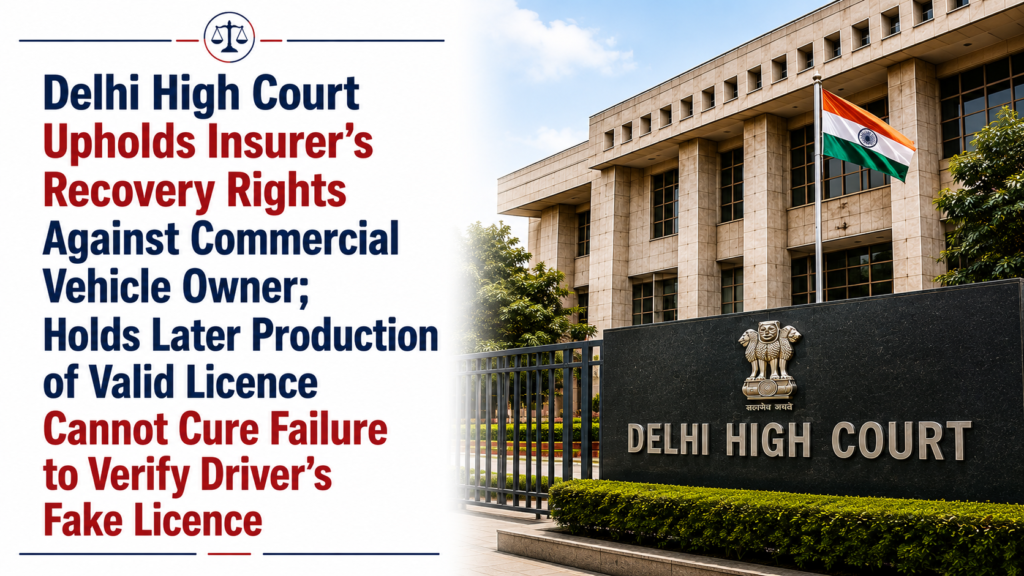
Delhi High Court Upholds Insurer’s Recovery Rights Against Commercial Vehicle Owner; Holds Later Production of Valid Licence Cannot Cure Failure to Verify Driver’s Fake Licence

Delhi High Court Upholds Insurer’s Recovery Rights; Commercial Vehicle Owner Failed to Prove Due Diligence After Driver’s Licence Was Found Fake
Facts
The appeal was filed by M/s Triveni Road Carriers Pvt. Ltd., owner of the offending goods carrier, challenging the recovery rights granted to United India Insurance Co. Ltd. by the Motor Accident Claims Tribunal in its award dated 24 July 2017.
The Tribunal had awarded the injured claimant ₹2,19,808 with 9% interest, while permitting the insurer to recover the amount from the vehicle owner because of breach of the insurance policy concerning the driver’s licence.
The accident occurred on 17 January 2012 when the injured claimant was riding his bicycle towards his home. Near J&K Bus Stop, Dilshad Garden, the appellant’s goods carrier truck bearing registration DL-1-GB-3815 struck him from behind, causing injuries to his right ear, head and upper back.
The licence seized from the driver immediately after the accident—referred to as Licence No. 1—was sent to the Mathura licensing authority for verification. The authority confirmed that it was fake and that no corresponding record existed. The police consequently added an offence under Section 471 IPC against the driver.
Subsequently, the driver produced another driving licence—Licence No. 2—issued by the Sant Kabir Nagar Licensing Authority, U.P. This licence was duly verified and was valid from 16 August 2011 to 15 August 2014, thus covering the date of the accident.
The central controversy was whether production of this second valid licence protected the commercial vehicle owner from the insurer’s recovery rights.
Issues
- Whether the insurer was entitled to recovery rights against the commercial vehicle owner when the licence seized from the driver after the accident was found to be fake.
- Whether subsequent production of another genuine and valid driving licence insulated the vehicle owner from liability.
- What level of due diligence is expected from a commercial transport operator while engaging drivers.
- Whether merely seeing the driver’s licence and conducting a driving test was sufficient for a commercial fleet operator.
- Whether the appellant had proved that it had actually seen, verified or relied upon the genuine Licence No. 2 when employing the driver.
Appellant’s Arguments
The appellant-owner argued that the driver possessed a genuine driving licence which was subsequently brought on record and verified by the licensing authority.
It submitted that Licence No. 2, issued by the Sant Kabir Nagar Licensing Authority, was valid from 16 August 2011 until 15 August 2014 and therefore valid on the date of the accident.
The owner asserted that this was the licence produced by the driver when he was employed and that the company had no knowledge of the earlier fake licence.
Accordingly, it argued that the MACT erred in ignoring the valid licence and granting recovery rights to the Insurance Company.
Respondent’s Arguments
United India Insurance argued that the driving licence produced at the time of the accident was fake and that the appellant had failed to demonstrate the requisite due diligence.
The insurer emphasised that a commercial transport carrier cannot be equated with an individual private vehicle owner when determining the standard of verification expected before employing a driver.
According to the insurer, commercial fleet operators have greater resources and administrative capacity and must therefore exercise a correspondingly higher degree of care in verifying the authenticity and credentials of their drivers.
Analysis of the Law
The High Court drew an important distinction between the standard of due diligence applicable to an ordinary private vehicle owner and that applicable to a commercial fleet operator.
The Court held that a commercial carrier bears a higher burden of due diligence because an entity operating a commercial fleet is expected to adopt stricter standards while verifying the persons entrusted with its vehicles.
The crucial inquiry was therefore not merely whether the driver happened to possess some other valid licence on the date of the accident. The appellant had to establish that, when engaging the driver, it had actually seen and verified the valid licence or otherwise undertaken adequate verification of his credentials.
The appellant failed to lead evidence before the MACT establishing that Licence No. 2 was the licence presented to it at the time of employment. Nor did it prove that the licence had been verified or that any other adequate verification process had been undertaken.
Thus, subsequent production of a genuine licence could not retrospectively establish the employer’s due diligence.
Precedent Analysis
United India Insurance Co. Ltd. v. Sarjo & Ors.
The High Court relied substantially upon its recent decision in United India Insurance Co. Ltd. v. Sarjo & Ors., 2026:DHC:5182.
That judgment distinguished private owners from public authorities and commercial fleet operators. While an individual vehicle owner may have limited ability to independently verify licences, commercial operators have significantly greater administrative resources.
Such entities must therefore undertake a complete verification process extending beyond merely conducting a driving test.
United India Insurance Co. Ltd. v. Lehru
The Court considered United India Insurance Co. Ltd. v. Lehru, (2003) 3 SCC 338, where the Supreme Court held that ordinarily an owner hiring a driver must check whether the driver possesses a licence and assess his competence to drive.
For ordinary owners, there is generally no requirement to independently approach the issuing RTO where the licence appears genuine. However, where breach is established, the insurer remains liable towards the innocent third-party claimant but may acquire recovery rights against the insured.
National Insurance Co. Ltd. v. Geeta Bhatt
The Court also relied upon National Insurance Co. Ltd. v. Geeta Bhatt, (2008) 12 SCC 426, which emphasised that a vehicle owner must make reasonable inquiry regarding whether the driver holds an effective and valid licence for the appropriate category of vehicle.
Reliance General Insurance Co. Ltd. v. Om Prakash
The High Court additionally referred to the Supreme Court’s recent decision in Reliance General Insurance Company Ltd. v. Om Prakash & Ors., 2026 INSC 767, delivered on 30 July 2026.
The Supreme Court reiterated the importance of a valid driving licence and applied the pay-and-recover principle, placing the ultimate burden upon the employer and driver where adequate precautions regarding the validity of the licence had not been established.
Court’s Reasoning
The Court found that the licence actually seized from the driver after the accident was Licence No. 1, which was subsequently verified as fake by the Mathura licensing authority.
The police investigation had also resulted in addition of an offence of forgery under Section 471 IPC against the driver.
Although Licence No. 2 was subsequently produced and verified as genuine, the appellant failed to prove that this was the licence it had seen when the driver was employed.
The owner had filed a written statement before the MACT but led no evidence demonstrating that it had visibility of Licence No. 2, verified it, conducted an appropriate driving test or undertaken any other process establishing due diligence.
Even the joint reply filed by the driver and owner to the Detailed Accident Report made no mention of the driver’s possession of the fake Licence No. 1. It merely asserted that the accident occurred due to the injured claimant’s negligence and that the driver had been appointed after a driving test and seeing his licence.
Given that the appellant was a commercial carrier, the Court applied the higher due-diligence standard recognised in Sarjo. It held that the mere subsequent production of another valid licence could not insulate the commercial carrier from liability where it had failed to establish what verification it undertook when employing the driver.
Conclusion
The Delhi High Court dismissed the appeal filed by M/s Triveni Road Carriers Pvt. Ltd.
It upheld the MACT’s grant of recovery rights in favour of United India Insurance Co. Ltd., holding that the commercial vehicle owner had failed to establish adequate due diligence in verifying the driver’s licence.
The Court made clear that the later production of another genuine licence did not cure the owner’s failure to establish that the licence had been seen or verified at the time of engaging the driver.
The statutory deposit, if any, was directed to be refunded to the appellant-owner, and pending applications were disposed of as infructuous.
Case Details
Case: M/s Triveni Road Carriers Pvt. Ltd. v. United India Insurance Co. Ltd. & Ors.
Court: Delhi High Court
Case Number: MAC.APP. 951/2018
Judge: Justice Anish Dayal
Date: 06 August 2026
Result: Appeal dismissed; insurer’s recovery rights against the commercial vehicle owner upheld; statutory deposit, if any, directed to be refunded to the appellant-owner.