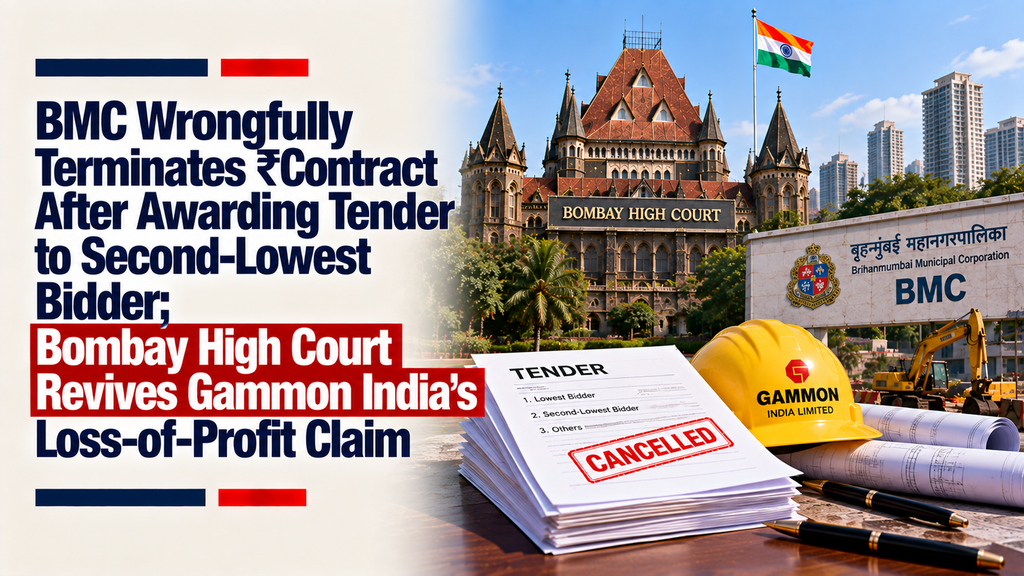
BMC Wrongfully Terminates ₹Contract After Awarding Tender to Second-Lowest Bidder; Bombay High Court Revives Gammon India’s Loss-of-Profit Claim

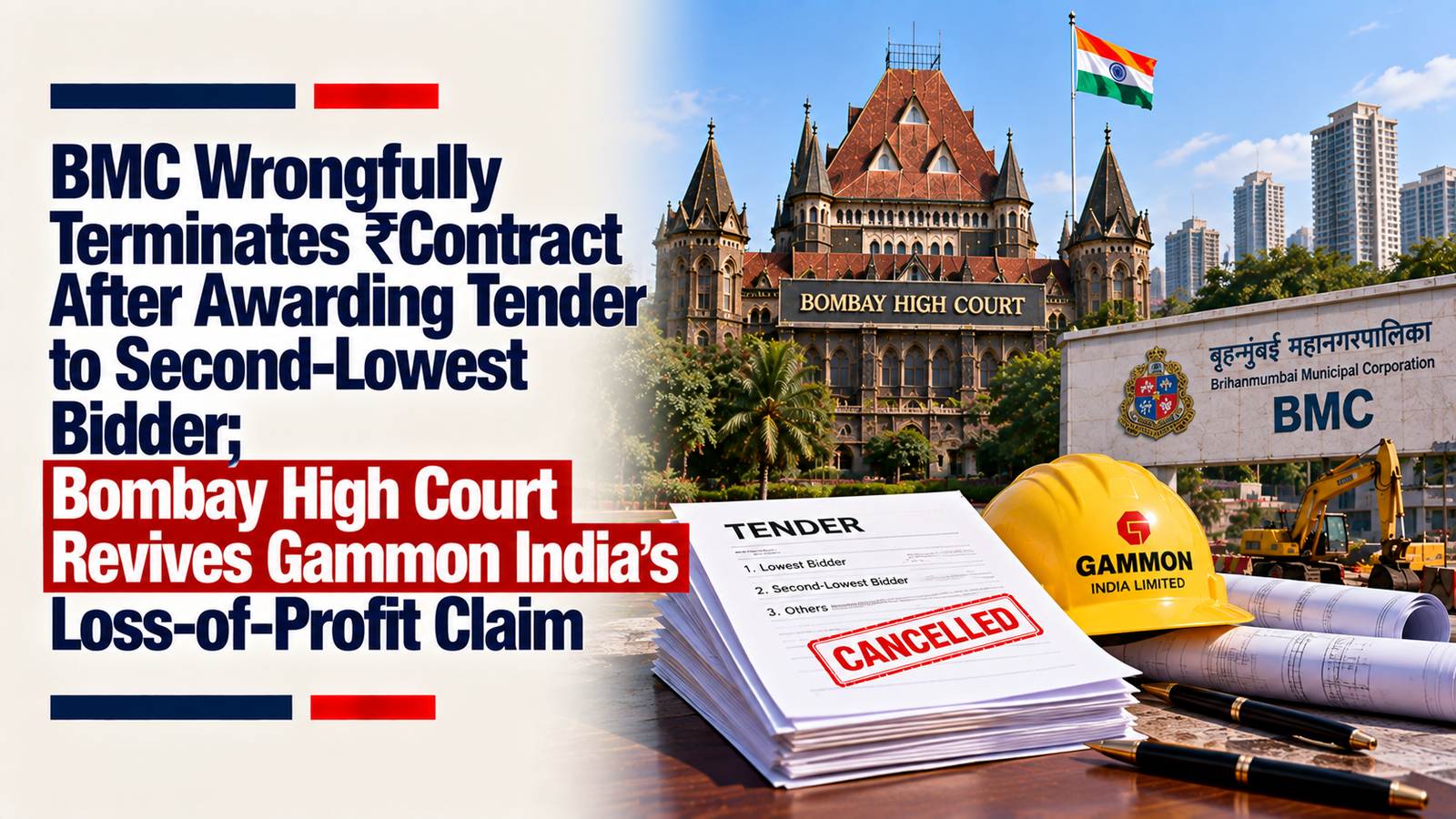
Gammon India’s BMC Contract Ends After Rival’s Successful Tender Challenge; Bombay High Court Revives Claim for Lost Profits
Facts
In January 1997, the Municipal Corporation of Greater Mumbai invited bids for the supply, erection and commissioning of 130 low-speed floating aerators at Bhandup and Ghatkopar lagoons.
M/s Hubert B.V. of the Netherlands was the lowest bidder, while Gammon India Limited was the second-lowest bidder. Significantly, Hubert’s bid was less than 50% of Gammon’s bid. Nevertheless, after scrutiny, BMC accepted Gammon’s bid by letter dated 11 June 1998.
Hubert challenged the decision before the Bombay High Court. During those proceedings, another consultant, Woodward Clyde of Australia, was appointed. The consultant found Hubert’s bid acceptable, following which BMC decided to award the contract to Hubert.
Gammon’s contract consequently came to an end and was formally terminated on 6 September 1999.
Gammon thereafter claimed compensation for losses suffered due to termination. When BMC repudiated the claims, the dispute went to arbitration.
The Arbitral Award
The Arbitrator found that:
- an enforceable contract existed between BMC and Gammon;
- BMC had wrongfully terminated it;
- BMC could not rely upon force majeure;
- BMC was responsible for initially awarding the contract to Gammon;
- there was no wrongdoing or mala fides attributable to Gammon.
However, most of Gammon’s monetary claims were rejected. The Arbitrator allowed only Claim No. 4 for ₹15,09,515 towards bank-guarantee costs and Claim No. 12 granting 9% interest on that amount.
Page 5 of the judgment contains a useful claim-wise table showing why each head was allowed or rejected.
Gammon India’s Challenge
Gammon challenged the rejection of Claims 1, 5, 6 and 8 under Section 34 of the Arbitration and Conciliation Act, 1996.
Claim No. 1 — Tender Costs
The Court upheld its rejection.
Clause 4 of the General Conditions of Contract required bidders to bear the costs of preparing and submitting their bids irrespective of the result. The Court held that the Arbitrator’s interpretation of the contractual clause was a permissible one and disclosed no patent illegality.
Claim No. 5 — Staff and Establishment Expenses
Gammon sought salary, travelling and conveyance expenses for its officers and staff.
The Arbitrator found that the personnel were already employed by Gammon on other projects. The High Court refused to reassess this factual finding under Section 34.
Claim No. 6 — American Design Consultant’s Fees
Gammon claimed fees allegedly payable to Smith and Loveless Incorporated, USA, for designing the aerators.
Since Gammon had not actually paid those fees and Smith and Loveless had not initiated any proceedings for recovery, the Court found no reason to interfere with the rejection.
Claim No. 8 — Loss of Profit
This became the decisive issue.
Gammon had claimed 25% of the contract value as loss of profit.
The Arbitrator rejected the claim because Gammon had not performed any substantial portion of the work, drawings had not yet been approved, no supporting evidence establishing the claimed loss of profit had been produced, and 25% was considered excessive.
The High Court, however, found a fundamental inconsistency in the award.
The Arbitrator had himself concluded that BMC was responsible for granting the contract and Gammon had not unlawfully influenced that decision. In those circumstances, the Court held that Gammon could not be made to suffer entirely because of BMC’s lapse.
Court Finds “Patent Illegality”
The High Court reasoned that once the Arbitrator held BMC responsible for granting and terminating the contract, while finding no blame on Gammon, it was logically impermissible to reject the loss-of-profit claim altogether.
Justice Arun R. Pedneker observed that the question of how much loss of profit Gammon was actually entitled to was a different issue and was not for the Section 34 Court to determine.
But the entire claim could not have been rejected in the face of the Arbitrator’s own findings.
Accordingly, the rejection of Claim No. 8 was held to suffer from patent illegality.
BMC’s Challenge to ₹15.09 Lakh Award
BMC separately challenged the award of ₹15,09,515 towards costs incurred for the two bank guarantees.
The guarantees related to performance security of approximately ₹2.70 crore and ₹1.32 crore, and the Arbitrator applied bank charges of 1% and 1.5%.
Although Gammon had not produced direct evidence showing actual payment of those precise percentages, the Arbitrator considered them normal and reasonable banking charges.
The High Court found no error in that approach and upheld the award.
Since Claim No. 4 survived, the Court also upheld 9% interest under Claim No. 12.
Analysis of the Law
The Court emphasised the restricted nature of Section 34 review.
An arbitrator’s reasonable construction of contractual provisions ordinarily cannot be interfered with merely because another interpretation is possible. However, under the pre-2015 regime applicable to this proceeding, an award could be interfered with where its conclusion suffered from patent illegality or perversity.
The Court relied upon Associate Builders v. Delhi Development Authority, particularly the principle that an award may become vulnerable where a finding is based on no evidence, irrelevant considerations are taken into account, vital evidence is ignored, or the contractual interpretation is one no fair-minded or reasonable person could adopt.
Precedent Analysis
The Court relied upon Gayatri Balasamy v. ISG Novasoft Technologies Limited for the proposition that a court’s power to set aside an arbitral award includes the power to partially set it aside, provided the valid and invalid portions are legally and practically severable.
It also referred to National Highways Authority of India v. Trichy Thanjavur Expressway Ltd., recognising that although multiple claims may arise from a single contract, individual claims can constitute separate and independently sustainable determinations where they rest on distinct rights, facts and obligations.
That principle enabled the Court to interfere only with Claim No. 8 without disturbing the remainder of the award.
Court’s Reasoning
The distinction drawn by the Court is important:
The Court did not award Gammon 25% loss of profit.
Nor did it determine what amount Gammon should receive.
Instead, it held only that the Arbitrator could not logically find BMC responsible for the contractual situation, absolve Gammon of wrongdoing, and nevertheless reject Gammon’s loss-of-profit claim in its entirety.
Thus, only the portion of the award rejecting Claim No. 8 was set aside, leaving Gammon to pursue whatever remedy is available in law regarding that claim.
Conclusion
BMC’s Arbitration Petition No. 463 of 2006 was dismissed, meaning the ₹15.09 lakh bank-guarantee award and 9% interest remained undisturbed.
Gammon’s Arbitration Petition No. 481 of 2006 was partly allowed only in relation to Claim No. 8. The rejection of its loss-of-profit claim was set aside for patent illegality, and Gammon was permitted to pursue remedies available in law regarding that claim.
BMC’s request for a stay of the judgment was also rejected.
Case Details
Case: Municipal Corporation of Greater Mumbai v. Gammon India Limited; connected with Gammon India Limited v. Municipal Corporation of Greater Mumbai
Court: Bombay High Court, Ordinary Original Civil Jurisdiction
Case Nos.: Arbitration Petition Nos. 463 of 2006 and 481 of 2006
Judge: Justice Arun R. Pedneker
Reserved: 27 August 2026
Pronounced: 21 September 2026
Citation: 2026:BHC-OS:20730
Result: BMC’s petition dismissed; Gammon’s petition partly allowed by setting aside rejection of Claim No. 8; loss-of-profit quantum not awarded or determined by the High Court.