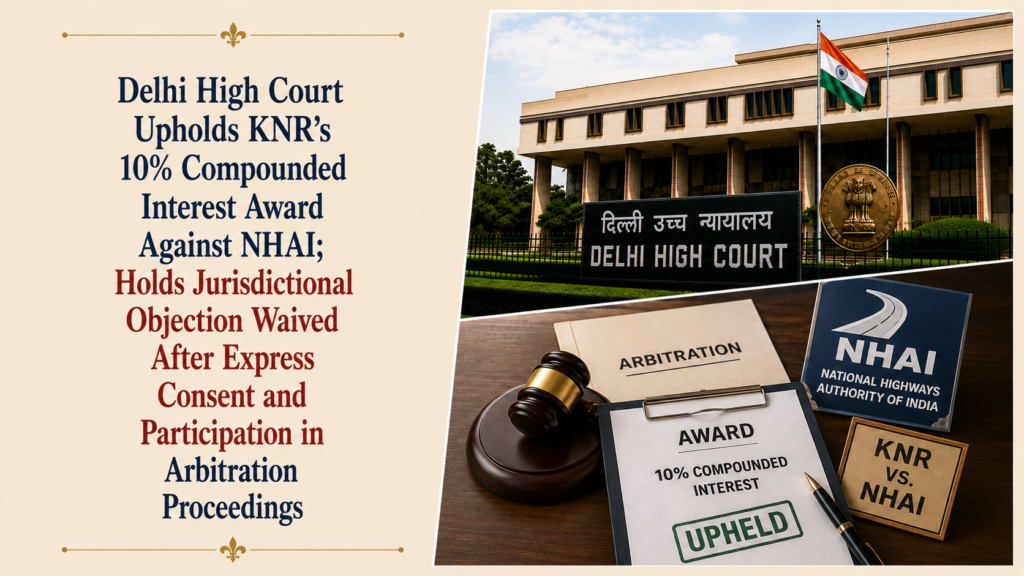
Delhi High Court Upholds KNR’s 10% Compounded Interest Award Against NHAI; Holds Jurisdictional Objection Waived After Express Consent and Participation in Arbitration Proceedings

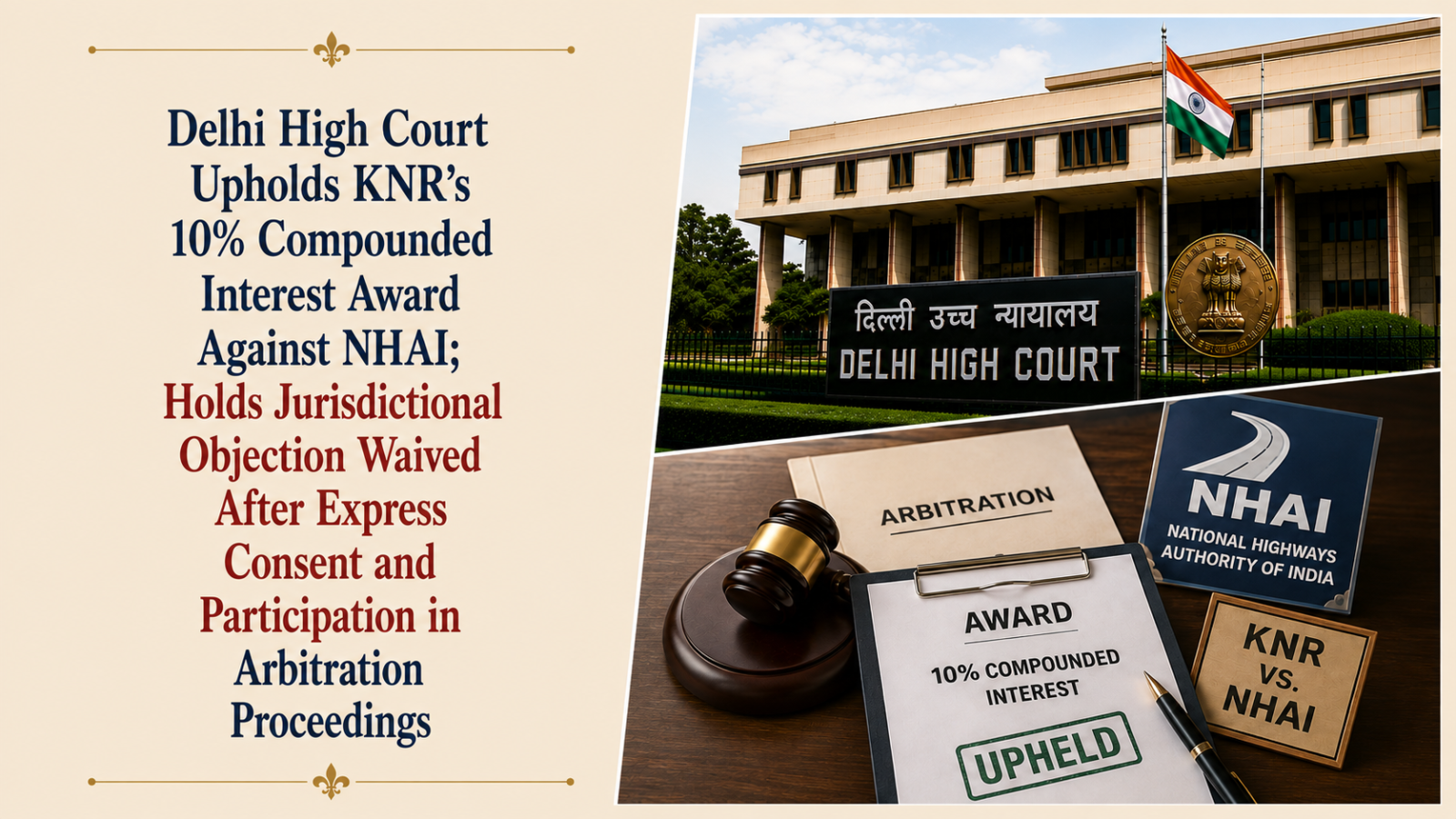
Delhi High Court Refuses to Set Aside KNR’s Compounded Interest Award; Finds No Fundamental Procedural Failure Despite Irregularities in Fresh Arbitration
Facts
The National Highways Authority of India (“NHAI”) filed a petition under Section 34 of the Arbitration and Conciliation Act, 1996, challenging an arbitral award dated 8 December 2021 in favour of KNR Constructions Ltd. (“KNR”). The dispute arose from a contract dated 22 October 2009 for balance works relating to widening and strengthening a stretch of NH-5 in Odisha.
This was the second round of arbitration between the parties. In the first arbitration, a majority award dated 29 April 2017 granted KNR approximately ₹35.39 crore towards price adjustment, along with interest. NHAI unsuccessfully challenged that award, including before the Supreme Court. KNR separately challenged the denial of pre-reference interest and the rate of interest awarded for subsequent periods. The Delhi High Court, by an order dated 3 May 2019, partially set aside the 2017 award on those limited aspects and permitted the parties to re-agitate their claims or counterclaims through appropriate proceedings.
KNR thereafter approached the earlier arbitral tribunal for re-agitation of its interest claim instead of formally invoking a fresh arbitration. One of the original arbitrators subsequently recused himself and was replaced.
The reconstituted Tribunal ultimately passed the impugned majority award dated 8 December 2021, holding that KNR was entitled under Clause 60.8 of the Conditions of Particular Application (“COPA”) to interest at 10% per annum compounded monthly, including for the pre-reference period, from the date the amount ought to have been paid until actual payment.
NHAI challenged this award on two principal grounds: lack of jurisdiction of the reconstituted Tribunal and errors on the merits of the interest award.
Issues
The principal questions before the High Court were:
- Whether the original Tribunal’s mandate had terminated upon making the 2017 award and whether the subsequent proceedings could legally continue before the reconstituted Tribunal.
- Whether NHAI, having participated in and expressly consented to those proceedings without raising a timely jurisdictional objection under Section 16, could subsequently challenge the Tribunal’s jurisdiction under Section 34.
- Whether the Tribunal’s interpretation of Clause 60.8 of COPA as entitling KNR to 10% interest compounded monthly on the awarded price-adjustment amounts amounted to rewriting the contract or patent illegality.
- Whether the award was liable to be set aside because the Tribunal did not itself finally quantify the interest amount.
Petitioner’s Arguments — NHAI
NHAI argued that the mandate of the first arbitral tribunal had terminated once the 2017 award was delivered. The case was neither one of correction or interpretation under Section 33 nor a remand under Section 34(4). KNR was therefore required to commence a fresh arbitration in accordance with Clause 67 of COPA read with Section 21 of the Arbitration Act.
According to NHAI, the Tribunal had wrongly proceeded on the footing that the second proceedings were merely a continuation of the earlier arbitration. Consent or acquiescence could not confer jurisdiction where the proceedings were inherently without jurisdiction.
NHAI relied upon Inder Sain Mittal v. Housing Board, Haryana; Srei Infrastructure Finance Ltd. v. Tuff Drilling Pvt. Ltd.; Lion Engineering Consultants v. State of Madhya Pradesh; Hindustan Zinc Ltd. v. Ajmer Vidyut Vitran Nigam Ltd.; and Sweta Construction in support of its jurisdictional objections.
It further argued that the fresh proceedings were procedurally defective because there had been no proper exchange of fresh pleadings, documents or evidence and no framing of issues.
NHAI also questioned the absence of fresh disclosures under Section 12 from two arbitrators who had continued from the earlier tribunal.
On merits, NHAI contended that Clause 60.8 did not apply to the disputed price-adjustment amounts because they had not been certified by the independent engineer. It argued that applying Clause 60.8 to all such dues effectively rewrote the parties’ contract.
NHAI also challenged the award on the ground that the Tribunal had not itself precisely quantified the amount of interest payable.
Respondent’s Arguments — KNR
KNR argued that NHAI had participated in the proceedings without raising any jurisdictional or procedural objection. More importantly, when the question regarding the Tribunal’s mandate was expressly raised during the arbitration, NHAI consented to continuation of the proceedings.
KNR therefore submitted that NHAI had waived any jurisdictional objection and could not resurrect it for the first time after receiving an adverse award under Section 34.
It relied upon M.P. Rural Road Development Authority v. L.G. Chaudhary Engineers & Contractors, Quippo Construction Equipment Ltd. v. Janardan Nirman Pvt. Ltd., M.P. Housing and Infrastructure Development Board v. K.P. Dwivedi, Sweta Construction and JMC Projects.
On merits, KNR argued that the Tribunal had adopted a plausible interpretation of Clause 60.8, and contractual interpretation lies primarily within the arbitral tribunal’s domain. A Section 34 court cannot substitute its preferred interpretation merely because another interpretation is possible.
KNR further submitted that the amounts and relevant dates were readily ascertainable from the 2017 award and documents before the Tribunal, meaning that the award was capable of mathematical computation even though the final figure was not expressly stated.
Analysis of the Law
The Court made an important distinction between whether the Tribunal was legally correct in treating the proceedings as a continuation of the old arbitration, and whether NHAI could nevertheless challenge the resulting award after expressly participating in those proceedings.
The Court agreed with NHAI on the first proposition: the original proceedings had legally terminated upon the making of the 2017 award. Neither Section 33 nor Section 34(4) had been invoked, and therefore the Tribunal was wrong in treating the later proceedings as a continuation of the original arbitration.
However, that finding did not invalidate the award.
The Court held that, as a matter of law, the subsequent proceedings could and should be construed as a fresh arbitration instituted with the consent of both parties before a tribunal constituted by their express consent.
The critical factor was NHAI’s conduct. It participated in the proceedings, filed its Statement of Defence, attended hearings and, even after the question of the Tribunal’s mandate was expressly raised, chose to proceed.
The Court held that allowing NHAI thereafter to challenge jurisdiction would permit a litigant to participate fully in arbitration and subsequently escape an adverse award through a belated jurisdictional objection. The Court specifically observed that NHAI’s objections might have deserved consideration had they been raised at the proper stage, but its conduct prevented it from raising them after the award.
The Court also relied upon Sections 18 and 19 of the Arbitration Act, noting that tribunals enjoy considerable procedural flexibility provided equality and natural justice are respected. There was no allegation that NHAI had been denied either.
Precedent Analysis
A significant part of the judgment concerns the relationship between Lion Engineering and L.G. Chaudhary on belated jurisdictional objections.
The Court relied upon the Supreme Court’s recent decision in Gayatri Project Ltd. v. Madhya Pradesh Road Development Corporation Ltd., 2025 SCC OnLine SC 1136, which reconciled these authorities.
The position emerging from Gayatri Project was that although a pure question of jurisdiction may theoretically be raised for the first time under Section 34, such an objection remains subject to the doctrine of waiver under Section 4. A party ordinarily cannot remain silent before the tribunal and later seek annulment of the award solely on that jurisdictional ground unless it establishes a strong and sufficient explanation for its earlier failure.
The Court also relied upon Sweta Construction, where the Supreme Court emphasised the consensual foundation of arbitration and held that a party which accepted the arbitration process could not subsequently approbate and reprobate.
On contractual interpretation, the Court reiterated the narrow limits of Section 34 review. Where an arbitral tribunal adopts a plausible interpretation of a contractual provision, the Court cannot replace that interpretation with its own merely because another construction is possible. Interference is warranted only in the narrow category of perversity or manifest arbitrariness.
Court’s Reasoning
Jurisdiction
The Court found that NHAI was fully aware of the possible jurisdictional issue. Indeed, one of the arbitrators had himself raised concerns about whether the earlier tribunal’s mandate could continue.
Despite this, NHAI expressly participated and ultimately requested the reconstituted Tribunal to proceed. It did not raise the objection in the manner contemplated under Section 16.
The Court therefore rejected NHAI’s jurisdictional challenge on the ground of consent, acquiescence and waiver.
Even the absence of fresh Section 12 declarations by the two continuing arbitrators was insufficient to invalidate the proceedings. Those arbitrators had furnished disclosures in the earlier proceedings, the replacement arbitrator made a fresh disclosure, and NHAI participated without protest.
Interest under Clause 60.8
Clause 60.8 expressly provided that where payment was not made within the prescribed period, the employer would pay the contractor interest compounded monthly at the rate stipulated in the Appendix to Bid.
The Tribunal interpreted this clause as covering the price-adjustment amounts subsequently found payable to KNR and awarded 10% per annum compounded monthly from the date the amounts became due until actual payment.
The High Court held that this was a permissible interpretation of the contract. Contractual interpretation principally belongs to the arbitrator, and the Section 34 court could not substitute its own interpretation absent perversity or manifest arbitrariness.
Non-Quantification of Interest
Although the High Court observed that the Tribunal ought ideally to have quantified the amount or at least specifically identified the documents necessary for computation, this deficiency did not justify setting aside the award.
The relevant amounts and dates were sufficiently ascertainable from the 2017 award and other materials placed before the Tribunal. Importantly, NHAI itself had subsequently filed an affidavit computing the amount payable under the award, demonstrating that the award was capable of implementation and calculation.
Conclusion
The Delhi High Court dismissed NHAI’s Section 34 petition and refused to interfere with the majority arbitral award dated 8 December 2021.
The Court held that although the Tribunal was technically incorrect in treating the second proceedings as a continuation of the earlier arbitration, the proceedings could legally be regarded as a fresh arbitration constituted by the parties’ consent.
NHAI, having knowingly participated and consented without timely objection, could not subsequently invoke jurisdictional defects to annul an unfavourable award.
The Tribunal’s interpretation of Clause 60.8 granting KNR 10% per annum interest compounded monthly from the date the amounts became payable until actual payment was a permissible contractual interpretation falling within the Tribunal’s domain.
The Court also rejected the challenge based on non-quantification because the amount was capable of calculation from the existing record.
Accordingly, both NHAI’s jurisdictional and merits challenges were rejected, the arbitral award was upheld, and the Section 34 petition was dismissed with no order as to costs.
Case Details
Case: National Highways Authority of India v. KNR Constructions Ltd.
Court: High Court of Delhi at New Delhi
Case Number: O.M.P. (COMM) 293/2022 & I.A. 10899/2022
CNR: DLHC010265822022
Judge: Hon’ble Mr. Justice Prateek Jalan
Reserved on: 13 July 2026
Date of Judgment: 11 August 2026
Result: Section 34 petition dismissed; majority arbitral award dated 8 December 2021 upheld; no order as to costs