

HEADNOTE
Sunil Kumar Tiwari & Ors. v. Government of NCT of Delhi & Ors.
Court: High Court of Delhi
Bench: Hon’ble Mr. Justice Anil Kshetarpal and Hon’ble Mr. Justice Amit Mahajan
Date of Judgment: January 20, 2026
Case Numbers: W.P.(C) 9163/2018, W.P.(C) 1696/2019, W.P.(C) 2446/2019
Laws Involved:
Articles 14 and 16, Constitution of India; All India Council for Technical Education Act, 1987; AICTE Regulations, 2010; AICTE Regulations, 2012; AICTE Clarification dated 04.01.2016
Keywords: AICTE regulations, Academic Grade Pay, Ph.D. qualification, Lecturers selection grade, service jurisprudence, Articles 14 and 16
Summary
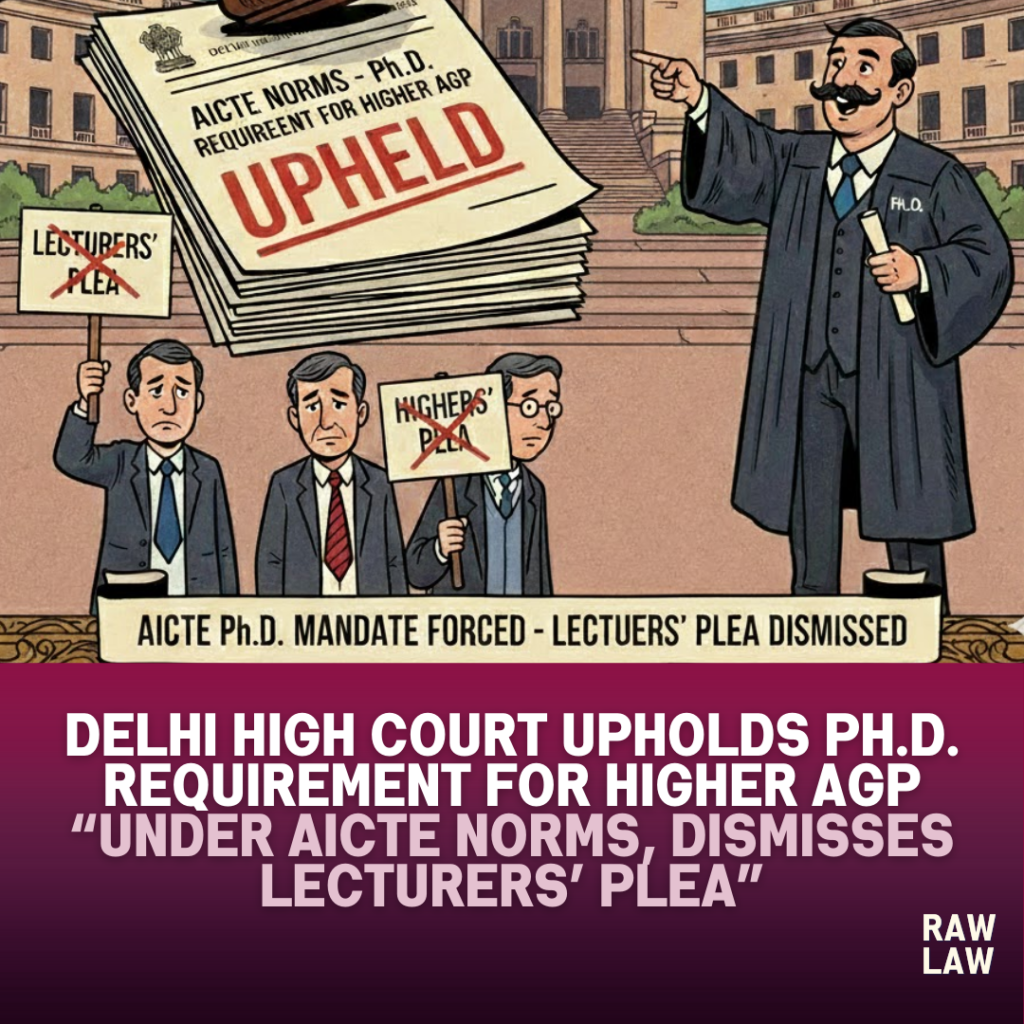
The Delhi High Court dismissed a batch of writ petitions filed by non-Ph.D. Lecturers working in Government Polytechnics under the GNCTD, who challenged the AICTE clarification requiring a Ph.D. qualification for grant of Academic Grade Pay (AGP) of ₹10,000. Upholding the decision of the Central Administrative Tribunal, the Court held that the prescription of a Ph.D. as an eligibility criterion for higher AGP is a policy decision taken by a statutory expert body and does not violate Articles 14 or 16 of the Constitution. The Court ruled that the classification between Ph.D. and non-Ph.D. Lecturers is rational, has a clear nexus with the objective of improving academic standards, and cannot be termed arbitrary or discriminatory. Judicial interference in such academic matters, the Court held, must remain minimal.
Court’s decision
The Delhi High Court dismissed all three writ petitions and upheld the orders passed by the Central Administrative Tribunal. The Court held that Clause 3.9 of the AICTE Clarification dated 04 January 2016, which restricts the grant of AGP ₹10,000 to Lecturers (Selection Grade) and Heads of Department possessing a Ph.D. qualification, is legally valid and constitutionally sound. No interference under Article 226 was warranted.
Facts
The petitioners were appointed as Lecturers in Government Polytechnics between 1989 and 1999 and had progressed to the post of Lecturer (Selection Grade), drawing AGP ₹9,000. They did not possess Ph.D. qualifications. Certain junior lecturers, who held Ph.D. degrees, were granted AGP ₹10,000 pursuant to AICTE norms. Aggrieved, the petitioners challenged the AICTE clarification and its implementation, contending that the requirement of a Ph.D. for higher AGP was arbitrary and discriminatory.
Issues
The core issue before the Court was whether the prescription of a Ph.D. qualification as an eligibility condition for grant of Academic Grade Pay of ₹10,000 to Lecturers (Selection Grade) was arbitrary, discriminatory, or violative of Articles 14 and 16 of the Constitution of India.
Petitioners’ arguments
The petitioners argued that under the AICTE Regulations of 2010 and the Career Advancement Scheme Regulations of 2012, there was no distinction between Ph.D. and non-Ph.D. Lecturers for grant of higher AGP. They contended that the 2016 Clarification introduced a new and arbitrary classification, adversely affecting vested rights. It was further argued that since a Ph.D. was not a mandatory qualification at the time of their appointment, its subsequent prescription for higher AGP amounted to discrimination and retrospective deprivation of benefits.
Respondents’ arguments
The respondents submitted that AICTE, as a statutory expert body, is empowered to prescribe qualifications, pay structures, and career advancement criteria. It was argued that the distinction based on possession of a Ph.D. qualification is rational and intended to promote higher academic standards in technical education. The respondents emphasized that courts should exercise restraint while reviewing policy decisions taken by expert bodies in academic matters.
Analysis of the law
The Court examined the statutory framework under the AICTE Act and the relevant Regulations of 2010, 2012, and the Clarification of 2016. It reiterated the settled principle that courts must be slow to interfere with decisions taken by expert statutory bodies relating to academic standards, qualifications, and pay structures. The Court held that classification based on higher academic qualification is a recognized and permissible basis under service jurisprudence.
Precedent analysis
The Bench relied on the Supreme Court decision in All India Shri Shivaji Memorial Society v. State of Maharashtra (2025) 6 SCC 605, which upheld the discretion of expert bodies to prescribe Ph.D. qualifications for career advancement. The Court also referred to AICTE v. Surender Kumar Dhawan (2009) 11 SCC 726, reiterating judicial restraint in academic policy matters. The earlier Delhi High Court decision in Ashok Kumar v. GNCTD was distinguished on facts.
Court’s reasoning
The Court held that the Ph.D. requirement introduced by the 2016 Clarification has a clear nexus with the objective of improving quality of technical education and encouraging higher academic attainment. The distinction between Ph.D. and non-Ph.D. Lecturers was found to be reasonable and non-arbitrary. The Court rejected the plea of vested rights, holding that the petitioners had no indefeasible right to AGP ₹10,000 without fulfilling the prescribed eligibility criteria.
Conclusion
The Delhi High Court concluded that Clause 3.9 of the AICTE Clarification dated 04.01.2016 is constitutionally valid and does not violate Articles 14 or 16. All writ petitions were dismissed.
Implications
This judgment reinforces judicial deference to expert statutory bodies in matters of academic policy and service conditions. It affirms that higher academic qualifications can be legitimately used as a basis for differential pay and career progression, and that such distinctions will not be interfered with unless shown to be manifestly arbitrary or irrational.
Case law references
- All India Shri Shivaji Memorial Society v. State of Maharashtra – Upheld Ph.D.-based classification for career advancement. Applied.
- AICTE v. Surender Kumar Dhawan – Courts must defer to expert bodies in academic matters. Relied upon.
- Ashok Kumar v. GNCTD – On vested rights and clarifications; distinguished.
FAQs
1. Is a Ph.D. mandatory for higher AGP under AICTE norms?
Yes, for grant of AGP ₹10,000 to Lecturers (Selection Grade), a Ph.D. is mandatory under the 2016 Clarification.
2. Did the Court find this requirement discriminatory?
No. The Court held the classification to be rational and constitutionally valid.
3. Can courts interfere with AICTE policy decisions?
Only in limited cases of arbitrariness or illegality; otherwise, courts must exercise restraint.
Also Read: Bombay High Court directs time-bound scrutiny and release of RTE reimbursement arrears


