

Court’s decision
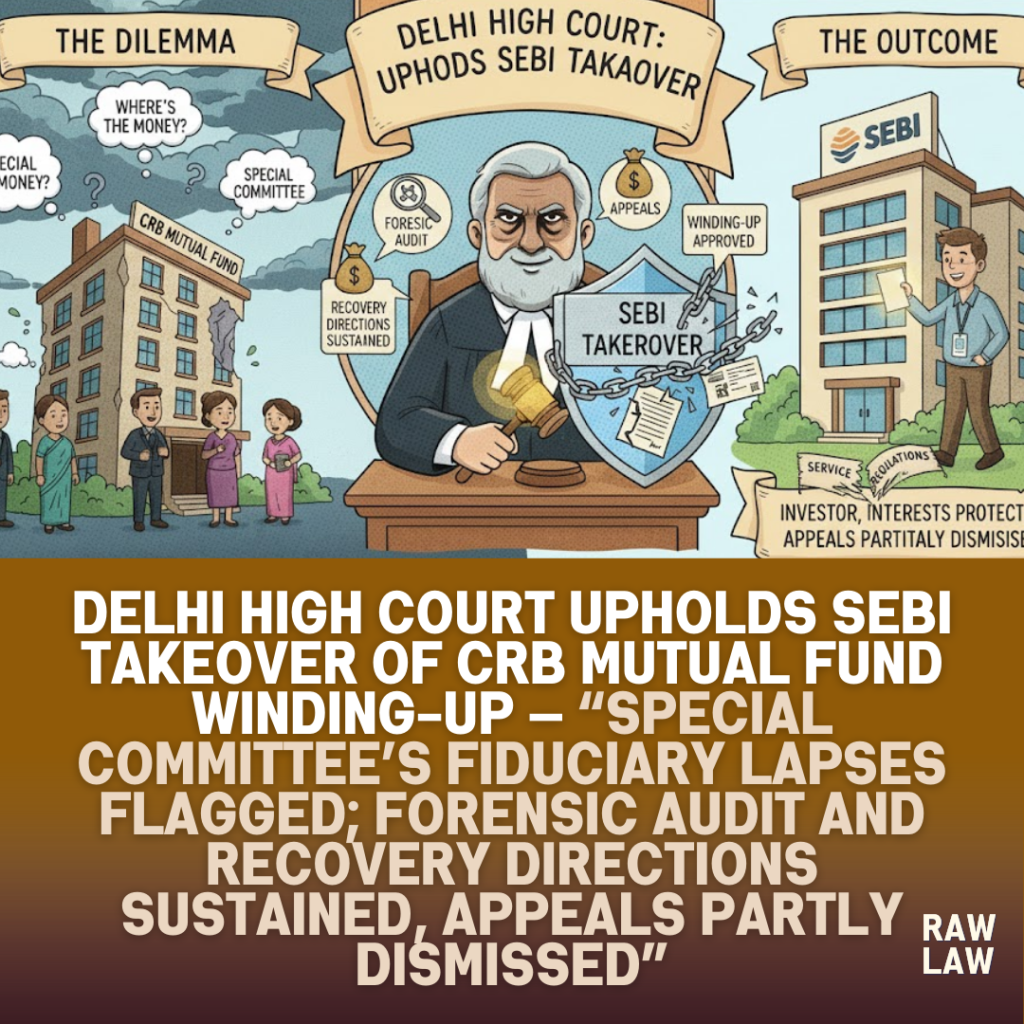
The Delhi High Court partly dismissed two connected company appeals arising from the decades-old CRB Mutual Fund winding-up proceedings, upholding the learned Single Judge’s directions transferring control from a court-appointed Special Committee to a Special Cell of SEBI, ordering a forensic audit, and restraining further payments to CRB Group entities. The Court held that once serious fiduciary lapses and prolonged non-compliance with judicial mandates are prima facie established, supervisory jurisdiction permits corrective intervention — “a trustee-like body functioning as an extension of the Court cannot proceed on assumptions or dilute investor-protection embargoes”.
Court’s decision
A Division Bench of Justice Anil Kshetarpal and Justice Harish Vaidyanathan Shankar affirmed that the Special Committee, constituted in 2013 to wind up the Arihant Mangal Scheme of CRB Mutual Fund, failed to complete its mandate for over a decade, lacked transparency in disbursements, and overlooked binding embargoes flowing from earlier Bombay High Court orders. While expunging any personal stigma beyond what was necessary for adjudication, the Court sustained the bulk of the Single Judge’s directions, including forensic audit under SEBI’s statutory powers and transfer of unclaimed amounts to the Investor Protection and Education Fund.
Facts
CRB Mutual Fund was established in 1993, with CRB Asset Management Company and CRB Trustees Limited managing its schemes. Following regulatory violations detected by SEBI, trustees resigned en masse, prompting court intervention. In 1997, winding-up proceedings commenced, and a Provisional Administrator was appointed.
By an interim order dated 25 January 1999, the Bombay High Court approved a premature repayment scheme for small investors but expressly excluded entities linked to the CRB Group and persons associated with the erstwhile management from receiving payments. This exclusion was foundational to investor protection.
After transfer of proceedings to the Delhi High Court, a Single Judge, by order dated 29 May 2013, constituted a three-member Special Committee to act as trustees and complete the winding-up within one year. Despite extensive powers, the Committee continued for over a decade, filed multiple interim reports lacking beneficiary-level disclosure, and disbursed substantial sums. Allegations later surfaced that more than ₹130 crore had been paid to CRB Group entities, triggering applications by SEBI and an objector company seeking scrutiny, audit, and recovery.
Issues
The core issues were whether the 1999 interim embargo excluding CRB Group entities continued to bind the Special Committee after the 2013 order, whether the doctrine of merger extinguished earlier directions, and whether the Single Judge could order a forensic audit, restrain payments, and transfer control to SEBI. A further issue concerned the locus of former Special Committee members to challenge adverse observations touching upon their conduct.
Appellants’ arguments
The former members of the Special Committee argued that the 2013 order authorised distribution to “all unit holders” and was passed with full knowledge of prior proceedings, thereby superseding the 1999 embargo under the doctrine of merger. It was contended that payments to CRB Group entities who were lawful unit holders were permissible and transparent, that statutory audits had been conducted, and that a forensic audit was disproportionate and reputationally damaging.
Separately, the CRB Group appellants argued that the Single Judge impermissibly reopened a consent order of 2013, unlawfully restrained payments, and vested trustee functions in SEBI contrary to the Mutual Fund Regulations. They also challenged directions transferring unclaimed redemption amounts to the Investor Protection and Education Fund.
Respondents’ arguments
SEBI and the objector contended that the Special Committee was a court-appointed fiduciary, bound by the 1999 embargo meant to prevent wrongdoers from benefitting. They argued that the Committee’s failure to disclose beneficiary-wise disbursements, operation from CRB-linked premises, and distribution of a majority of funds to CRB-related entities justified judicial intervention.
It was further submitted that the 2013 order never intended to dilute investor-protection measures and expressly permitted continued court supervision, clarification, and modification. SEBI defended the forensic audit and takeover as exercises of statutory power to safeguard investors.
Analysis of the law
The Court analysed the nature of court-appointed committees acting in trustee-like capacities, emphasising their fiduciary obligations of loyalty, transparency, and good faith. It reiterated settled principles that judicial orders must be read contextually and harmoniously, not as statutes, and that interim directions protecting investors do not automatically lapse unless expressly vacated.
On the doctrine of merger, the Court held that not all interim orders merge into final orders, particularly where the final order contemplates continuing supervision and does not advert to or resolve specific embargoes. The scope of the Companies Court’s inherent powers and SEBI’s statutory authority under the SEBI Act were also examined.
Precedent analysis
The Bench relied on Supreme Court authority on interpretation of judgments, including P.S. Sathappan and Goan Real Estate, to stress contextual reading. It also invoked fiduciary jurisprudence from Marcel Martins v. M. Printer to underline the heightened duties of trustees and court appointees. These precedents were applied to uphold supervisory intervention where fiduciary standards appeared compromised.
Court’s reasoning
The Court found that the 2013 order, though comprehensive, did not consciously override the 1999 embargo excluding CRB Group entities. Given the apparent tension between the two, the Special Committee ought to have sought clarification instead of proceeding on assumptions. Its prolonged tenure, incomplete winding-up, and opaque reporting justified loss of judicial confidence.
The Bench held that the Single Judge acted within supervisory jurisdiction in directing a forensic audit, restraining further payments to potentially ineligible entities, and entrusting completion of winding-up to SEBI’s Special Cell. However, the Court clarified that adverse observations were confined to assessing institutional functioning and did not amount to definitive findings of personal liability.
Conclusion
The Delhi High Court largely upheld the impugned judgment directing forensic audit, SEBI takeover, and protective measures for investors, while limiting the scope of adverse remarks against individual committee members. The appeals were accordingly disposed of, with investor protection reaffirmed as the overriding consideration in the long-pending CRB Mutual Fund winding-up.
Implications
This ruling reinforces strict fiduciary standards for court-appointed committees and underscores that investor-protection embargoes cannot be diluted by implication or inaction. It affirms SEBI’s central role in resolving legacy market failures and signals that prolonged non-compliance with judicial mandates can justify transfer of control, forensic scrutiny, and recovery measures — even years after initial orders.
Case law references
- P.S. Sathappan v. Andhra Bank: Judgments must be read contextually; applied to interpret 2013 order.
- Goan Real Estate v. Union of India: Orders not to be read as statutes; relied upon for construction of prior directions.
- Marcel Martins v. M. Printer: Fiduciary duties of trustees emphasised; applied to Special Committee’s role.
FAQs
1. Did the 2013 order allow payments to CRB Group entities?
No. The Court held that the earlier embargo excluding CRB Group entities was never expressly lifted.
2. Why was a forensic audit ordered?
Due to prolonged delay, lack of transparency, and large disbursements to related entities, warranting statutory scrutiny.
3. Can SEBI take over winding-up from a court committee?
Yes. Where investor protection is at stake, courts can entrust completion to SEBI under its statutory powers.


