Delhi High Court Upholds Taxi Driver’s Conviction for Raping Visually Challenged Girl; Reduces 20-Year Sentence to 14 Years as Trial Court Exceeded Sentencing Limits

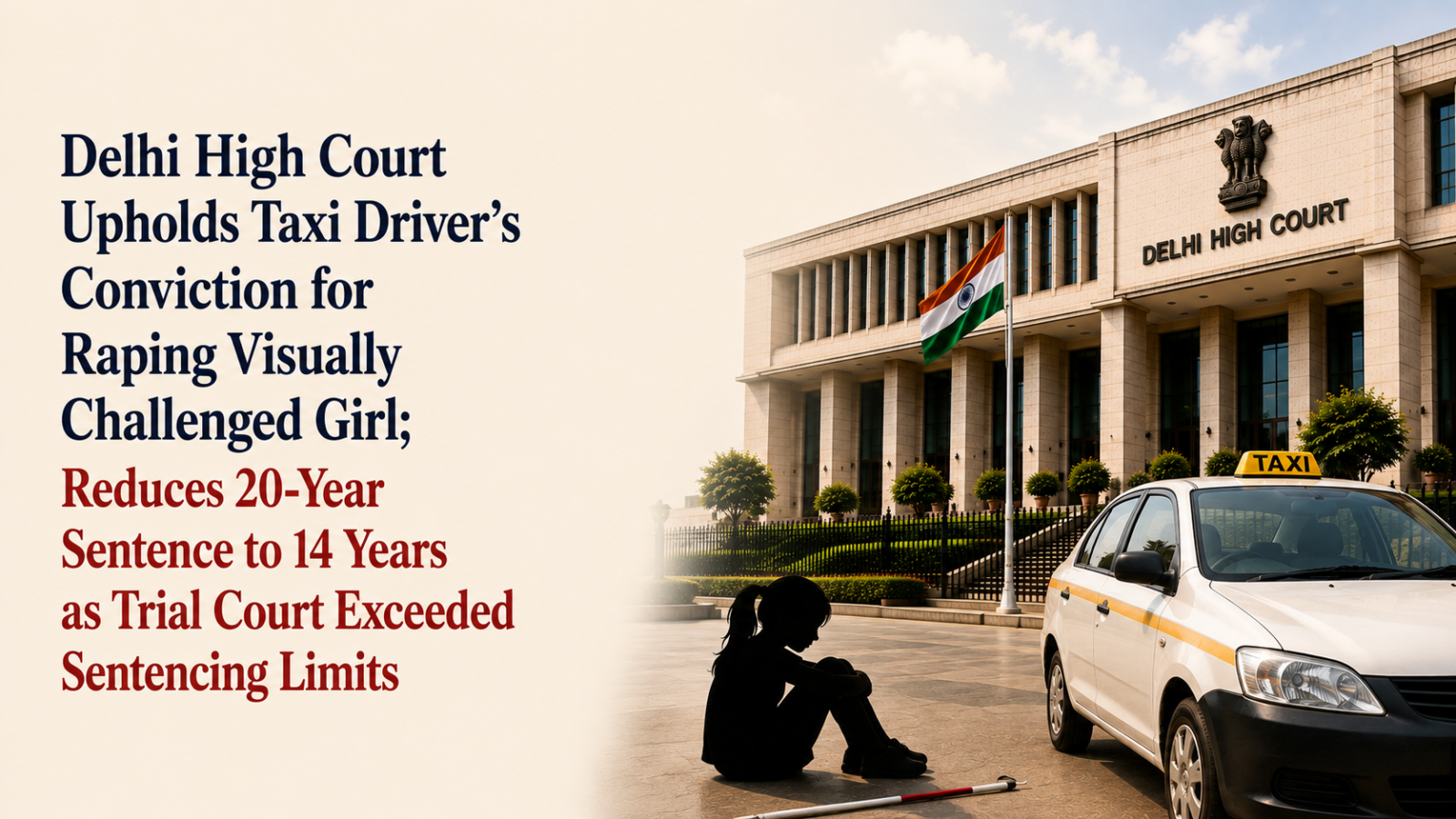
Delhi High Court Confirms Section 376(2)(l) Conviction for Raping Visually Challenged Girl; Holds Fresh Genital Injuries and Matching DNA Corroborated Victim’s Testimony
Facts
The Delhi High Court considered an appeal by Saleem @ Sanjay, challenging his conviction under Sections 376(2)(l) and 471 IPC and the sentence imposed by the Special Court at Saket. The judgment was pronounced on 14 August 2026.
The prosecution case was that on 12 September 2013 at about 8:30 PM, the appellant sexually assaulted PW1, a visually challenged girl, inside a Maruti Omni van near Humayun’s Tomb. The appellant was also alleged to have possessed and used a forged driving licence as genuine.
The victim had lost her eyesight at approximately three years of age. On the evening of the incident, she and her younger brother went out together. They encountered the appellant, a taxi driver, who offered to drop them home in his vehicle.
According to the victim, after she, her brother and other children entered the taxi, the appellant gagged them, tore her kurta, removed her clothes and penetrated her vagina with his penis. He threatened the children against disclosure and subsequently dropped them near Humayun’s Tomb.
PW2, the victim’s younger brother, materially corroborated her account. His Section 164 CrPC statement specifically recorded that the appellant removed his sister’s clothes and inserted his private part into hers, while threatening the children with a knife if they disclosed the incident.
The mother reported the matter to the police without delay.
Medical examination disclosed a fresh abrasion at the fourchette and fresh tear of the hymen.
The forensic evidence was particularly significant. DNA obtained from the appellant’s blood sample matched the male DNA obtained from the victim’s vaginal smear and a brown stain on her salwar.
The Trial Court convicted the appellant under Sections 376(2)(l) and 471 IPC and sentenced him to 20 years’ rigorous imprisonment with ₹30,000 fine for rape and one year’s rigorous imprisonment under Section 471 IPC, with both sentences running concurrently.
Issues
The principal issues before the High Court were:
- Whether the evidence proved beyond reasonable doubt that the appellant raped PW1.
- Whether the victim’s visual disability attracted the aggravated offence under Section 376(2)(l) IPC.
- Whether inconsistencies concerning whether PW1 knew the appellant before the incident affected the credibility of the prosecution case.
- Whether the alleged parking dispute between the appellant and the victim’s mother established a plausible case of false implication.
- Whether the medical and DNA evidence sufficiently corroborated the victim and her brother.
- Whether the prosecution established the ingredients of Section 471 IPC concerning use of a forged driving licence.
- Whether the Trial Court was legally competent to impose a fixed-term sentence of 20 years under Section 376(2)(l) IPC.
- Whether the sentence should be reduced considering the appellant’s period of incarceration and plea for leniency.
Appellant’s Arguments
The appellant principally argued that he was not a stranger to PW1.
According to him, he was already on friendly terms with the victim and her family. He claimed that the victim and her family knew him because he used to park his taxi near her mother’s shop.
The defence alleged that there had been a dispute between him and PW5, the victim’s mother, regarding parking of his cab in front of her stall.
It was contended that this dispute supplied the motive for false implication.
The appellant also sought a lenient and compassionate approach on sentence, arguing that he had already undergone a substantial period of imprisonment and that the 20-year sentence should be reduced.
Respondent’s Arguments
The State opposed the appeal and submitted that the Trial Court judgment suffered from no infirmity warranting appellate interference.
It argued that the prosecution evidence was sufficient to establish the appellant’s guilt.
The State relied upon the mutually corroborative testimony of:
- PW1, the victim;
- PW2, her younger brother; and
- PW5, their mother.
It was further supported by contemporaneous medical findings and DNA evidence directly linking the appellant to the sexual assault.
Analysis of the Law
Victim’s Evidence Was Cogent and Corroborated
The High Court found that PW1 had given a cogent description of the sexual assault.
Her brother PW2 also provided a materially consistent version of the incident.
Although PW2 had referred to a knife in his Section 164 statement but did not specifically mention the knife while testifying in court, the High Court held that this discrepancy was insufficient to discredit the prosecution case.
Immediate Reporting Supported Prosecution Case
The conduct of PW5, the victim’s mother, was considered significant.
After the children returned home and disclosed the occurrence, she reported the incident to the police without delay.
Her evidence substantially corresponded with the accounts given by PW1 and PW2.
Importantly, despite being given an opportunity, the defence never cross-examined PW5, leaving her material testimony unchallenged.
Medical Evidence Corroborated Penetration
The victim was medically examined shortly after the incident.
The examining doctor recorded:
- a fresh abrasion at the fourchette; and
- a fresh tear of the hymen.
The High Court held that these findings corroborated the prosecution’s allegation of recent penetrative sexual assault.
DNA Evidence Directly Linked Appellant to Assault
The forensic evidence provided additional independent corroboration.
DNA profiling established that the male DNA profile generated from the appellant’s blood sample matched the profile generated from:
- the victim’s vaginal smear; and
- the brown stain found on her salwar.
The High Court therefore found that the testimony of PW1, PW2 and PW5 was materially supported by both medical and scientific evidence.
Prior Acquaintance Did Not Undermine Rape Case
There was some inconsistency regarding precisely how PW1 and PW2 came to know the appellant’s name.
The High Court held that this did not go to the root of the prosecution case.
More importantly, the Court observed that even if the victim and appellant had been previously acquainted, such acquaintance could not justify the appellant’s conduct.
There was no case that the sexual act was consensual.
Thus, a dispute about whether the accused was previously known to the victim was immaterial to proof of the sexual assault.
Parking-Dispute Defence Rejected
The Court found no evidence supporting the appellant’s theory that he had been falsely implicated because of a parking dispute with the victim’s mother.
Apart from the appellant’s own statement under Section 313 CrPC, there was no material proving that such a dispute existed.
PW2 expressly denied the alleged dispute.
PW5 was never cross-examined on the issue.
The appellant also failed to raise the alleged dispute when the owner of the taxi was examined.
The false implication defence was therefore rejected.
Section 376(2)(l) IPC Established
For conviction under Section 376(2)(l) IPC, the prosecution was required to establish that the appellant committed rape upon a woman suffering from a physical disability.
PW1 was visually challenged, which was undisputed.
Her testimony regarding penetration was corroborated by PW2 and by the fresh genital injuries documented during medical examination.
The High Court therefore held that both essential elements were proved:
- penetration/sexual intercourse; and
- the victim’s physical disability.
Accordingly, Section 376(2)(l) IPC was attracted.
POCSO Charge Did Not Survive Due to Age Determination
An important aspect of the case was the victim’s age.
Although the prosecution initially proceeded on the basis that PW1 was 12 years old, an ossification test was subsequently conducted.
The report assessed her age as 17–19 years as on 16 May 2014.
Relying upon Shweta Gulati v. State (NCT of Delhi), the Trial Court concluded that the prosecutrix was more than 18 years old at the relevant time and therefore POCSO could not be invoked.
The conviction ultimately sustained was therefore under Section 376(2)(l) IPC rather than POCSO.
Forged Driving Licence Conviction Upheld
The appellant was also convicted under Section 471 IPC.
The High Court explained that Section 471 requires proof that:
- the document was forged;
- the accused used it as genuine;
- such use was voluntary; and
- the accused knew or had reason to believe that it was forged.
The Regional Transport Authority official produced the relevant records and testified that the driving licence allegedly issued to the appellant had not actually been issued by the authority.
The Court therefore held that the prosecution established that the licence was forged.
No substantive arguments were advanced in appeal challenging the Section 471 conviction or sentence.
Consequently, the High Court found no reason to interfere with that conviction.
20-Year Fixed Sentence Was Legally Impermissible
This was the decisive issue on which the appeal succeeded.
The appellant requested reduction of his 20-year sentence.
The High Court acknowledged the grave and aggravating circumstances surrounding the offence. The visually challenged victim had lost her eyesight during childhood, and the appellant had taken advantage of her vulnerability, taken her into his vehicle, restrained and threatened the accompanying children and raped her.
The Court found no substantial mitigating circumstances warranting leniency merely on compassionate grounds.
However, relying upon the Supreme Court’s decision in Ravinder Singh v. State Govt. of NCT of Delhi, (2024) 2 SCC 323, the High Court held that the Trial Court itself could not impose the particular 20-year fixed-term sentence it had awarded.
The statutory sentencing range permitted:
- minimum imprisonment of 10 years;
- imprisonment for life, meaning the remainder of the offender’s natural life; or
- where a fixed-term sentence was imposed by the Trial Court, a term not exceeding 14 years.
Accordingly, while the conviction was fully justified, the 20-year fixed-term sentence required correction.
The High Court reduced it to 14 years’ rigorous imprisonment considering the nature and gravity of the offence.
Precedent Analysis
Moidu K. v. State of Kerala
The Court noticed that the Trial Court had apparently failed to conduct the hearing contemplated under Section 232 CrPC after recording the accused’s Section 313 statement.
Relying upon Moidu K., it held that non-compliance with Section 232 does not automatically vitiate the trial. The accused must establish serious and substantial prejudice, which was not demonstrated here.
Shweta Gulati & Anr. v. State Govt. of NCT of Delhi
This precedent was relevant to determination of the prosecutrix’s age.
Based upon the ossification report and the principle applied in Shweta Gulati, the Trial Court treated the prosecutrix as above 18 years and consequently held that the POCSO Act was inapplicable.
Ravinder Singh v. State Govt. of NCT of Delhi
This was the crucial precedent on sentencing.
The High Court relied upon Ravinder Singh, (2024) 2 SCC 323, to hold that although the offence was grave, the Trial Court could not impose the 20-year fixed sentence in the manner it had done.
Consequently, the sentence was corrected to 14 years’ rigorous imprisonment while leaving the conviction intact.
Court’s Reasoning
The High Court found the prosecution case firmly established through multiple mutually corroborative evidentiary strands.
PW1 gave a clear account of penetration. Her younger brother witnessed the material events and corroborated her. Their mother’s evidence regarding the immediate disclosure and reporting remained substantially unchallenged.
The medical examination demonstrated fresh genital injuries, while DNA analysis scientifically connected the appellant with the vaginal smear and stain recovered from the victim’s salwar.
The inconsistencies concerning how the children came to know the appellant’s name were peripheral and did not affect the core prosecution case.
Similarly, the alleged parking dispute was unsupported by evidence and could not establish false implication.
The Court therefore found no infirmity whatsoever in the conviction under Section 376(2)(l) IPC.
The forged driving licence conviction under Section 471 IPC was also sustained.
The only legally sustainable interference concerned the quantum and structure of the sentence. Applying Ravinder Singh, the Trial Court’s 20-year fixed sentence could not stand and was reduced to 14 years.
Conclusion
The Delhi High Court partly allowed the appeal.
It confirmed the appellant’s convictions under Sections 376(2)(l) and 471 IPC.
However, it modified the substantive sentence for the rape conviction from 20 years’ rigorous imprisonment to 14 years’ rigorous imprisonment.
Thus, the appellant succeeded only on sentence and not on conviction.
Case Details
Case: Saleem @ Sanjay v. State
Court: Delhi High Court
Case Number: CRL.A. 535/2020; CNR No. DLHC010297992020
Judge: Justice Chandrasekharan Sudha
Date: 14 August 2026
Result: Appeal partly allowed; convictions under Sections 376(2)(l) and 471 IPC upheld, but 20-year sentence under Section 376(2)(l) reduced to 14 years’ rigorous imprisonment.