Delhi High Court: Wage arrears from 1997 upheld — “Arbitral tribunal within jurisdiction, limited scope of court interference reaffirmed”

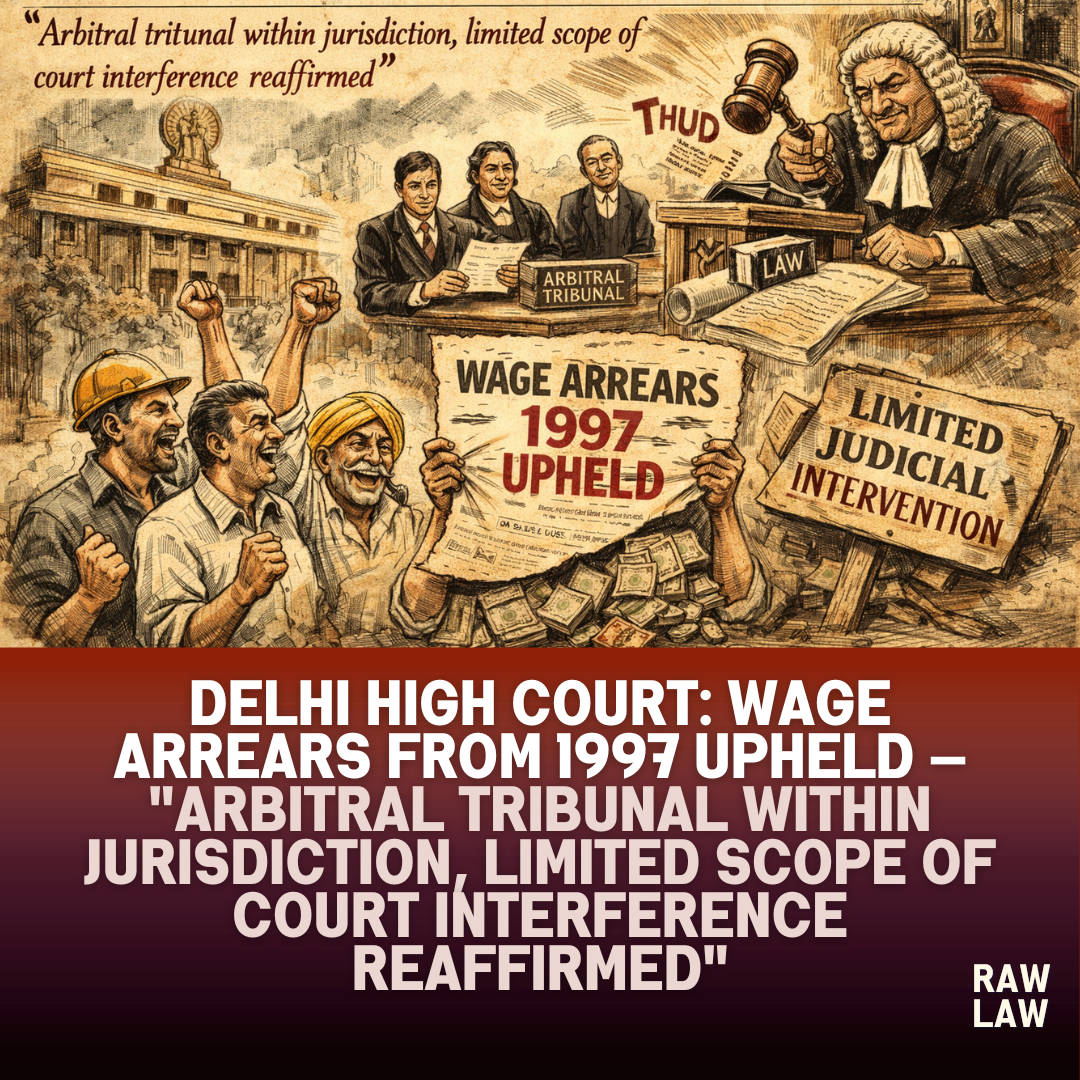
Court’s decision
The Delhi High Court dismissed appeals filed by a public sector aviation company and upheld arbitral awards directing payment of wage arrears to employee associations. The Court held that the arbitral tribunal acted within its mandate and did not exceed jurisdiction. It further reaffirmed that courts under Sections 34 and 37 of the Arbitration and Conciliation Act have a limited supervisory role and cannot reappreciate evidence or modify awards.
Facts
The dispute arose from wage revision claims of aircraft engineers and technicians employed in a public sector airline. Wage revision had fallen due from 01.01.1997 pursuant to Department of Public Enterprises (DPE) guidelines.
Presidential Directives (PDs) issued later permitted only notional fixation of wages from 1997 while allowing actual monetary benefits prospectively from later dates. Memoranda of Settlement entered into between the employer and employee associations reflected this approach but did not conclusively settle claims for arrears.
Employees consistently asserted entitlement to arrears from 1997, leading to conciliation proceedings and eventually intervention by the Supreme Court. The dispute was referred to arbitration to determine the quantum and heads of arrears.
The arbitral tribunal awarded substantial arrears with interest, holding that the employer could not deny arrears merely based on PDs. These awards were upheld by the Single Judge under Section 34, leading to appeals under Section 37.
Issues
The primary issue was whether the arbitral tribunal exceeded the scope of reference by examining the validity and effect of Presidential Directives while determining wage arrears.
Another issue was whether the awards were contrary to DPE guidelines, PDs, and contractual settlements governing wage revision.
The Court also examined whether the arbitral awards suffered from patent illegality or perversity warranting interference under Sections 34 and 37.
Additionally, the Court considered whether the award of interest, including post-award interest, was legally sustainable.
Petitioner’s arguments
The appellants argued that the arbitral tribunal exceeded its jurisdiction by effectively nullifying Presidential Directives, which they claimed had statutory force. They contended that the tribunal decided issues beyond the limited reference, which was confined to determining “admitted dues.”
It was further argued that the tribunal ignored binding contractual settlements and DPE guidelines that restricted payment of arrears to prospective periods. The appellants also challenged the quantification of arrears as unsupported by evidence.
On interest, they argued that the tribunal awarded excessive and penal interest, including impermissible “interest on interest,” and sought modification or severance of this component.
Respondent’s arguments
The respondents contended that the arbitral tribunal acted strictly within the scope of reference, which required determination of arrears payable for the relevant period. They argued that examination of PDs was incidental and necessary to adjudicate entitlement.
They emphasized that courts under Sections 34 and 37 cannot reappreciate evidence or substitute their views for that of the tribunal. The respondents also argued that the employer had effectively admitted liability through correspondence and conduct.
On interest, they relied on settled law permitting inclusion of pre-award interest in the “sum” for calculating post-award interest.
Analysis of the law
The Court reiterated that judicial interference in arbitral awards is extremely limited. Under Section 34, courts can only set aside awards on narrow grounds such as patent illegality, jurisdictional error, or violation of natural justice.
Under Section 37, the scope is even narrower, as appellate courts merely examine whether the Section 34 court acted within its jurisdiction.
The Court emphasized that arbitral tribunals are the final adjudicators of facts and contractual interpretation. Courts cannot revisit factual findings or re-evaluate evidence merely because another view is possible.
It also clarified that administrative instructions like PDs do not automatically override contractual or accrued rights unless supported by statutory authority.
Precedent analysis
The Court relied on MMTC Ltd. v. Vedanta Ltd., which held that appellate courts under Section 37 cannot reassess merits of arbitral awards.
In Associate Builders v. DDA, the Supreme Court clarified that interference is limited to cases of patent illegality or perversity.
In Ssangyong Engineering v. NHAI, it was held that tribunals cannot rewrite contracts but may interpret them within scope.
The Court also relied on Hyder Consulting v. State of Orissa and UHL Power v. State of Himachal Pradesh, which upheld the legality of awarding interest on the aggregate sum including pre-award interest.
These precedents collectively reinforced judicial restraint in arbitral matters.
Court’s reasoning
The Court held that the arbitral tribunal did not exceed its mandate. Since the employer relied on PDs to deny arrears, the tribunal was justified in examining their effect while determining entitlement.
It clarified that the tribunal did not strike down PDs but merely assessed their applicability within the dispute. This was necessary for adjudication and fell within the scope of reference.
The Court further held that PDs are administrative instructions and do not have overriding statutory force to defeat accrued wage rights. The tribunal’s finding that arrears were payable from 1997 was based on DPE guidelines, contractual context, and evidence on record.
On factual findings, the Court observed that the tribunal’s conclusions were supported by documentary evidence and admissions by the employer. Reappreciation of such evidence was impermissible.
Regarding interest, the Court upheld the award, holding that inclusion of pre-award interest in the principal for calculating post-award interest is legally permissible and well settled.
Conclusion
The Delhi High Court dismissed the appeals and upheld the arbitral awards granting wage arrears with interest. It reaffirmed that arbitral awards cannot be interfered with unless they suffer from patent illegality or jurisdictional error.
Implications
This judgment significantly strengthens the finality of arbitral awards in India, especially in labour and wage disputes involving public sector undertakings.
It clarifies that administrative directives cannot override accrued contractual or statutory rights unless explicitly authorized by law.
The ruling also reinforces the narrow scope of judicial review under Sections 34 and 37, discouraging attempts to re-litigate factual issues through appeals.
For employers and public sector entities, the judgment underscores the importance of clarity in wage settlements and adherence to fair labour practices.
Case law references
- MMTC Ltd. v. Vedanta Ltd. (2019)
Limited scope of appellate interference under Section 37. - Associate Builders v. DDA (2015)
Defined patent illegality and grounds for setting aside arbitral awards. - Ssangyong Engineering v. NHAI (2019)
Clarified limits of arbitral interpretation. - Hyder Consulting v. State of Orissa (2015)
Allowed post-award interest on aggregate sum. - UHL Power v. State of Himachal Pradesh (2022)
Reaffirmed principles governing interest in arbitral awards.
FAQs
1. Can courts re-evaluate evidence in arbitral awards?
No. Courts under Sections 34 and 37 cannot reappreciate evidence or substitute their own view unless the award is perverse or patently illegal.
2. Do administrative directives override arbitral findings?
Not necessarily. Administrative instructions cannot defeat accrued rights unless they have statutory backing.
3. Is “interest on interest” allowed in arbitration awards?
Yes. Courts have held that post-award interest can be calculated on the total sum, including pre-award interest.