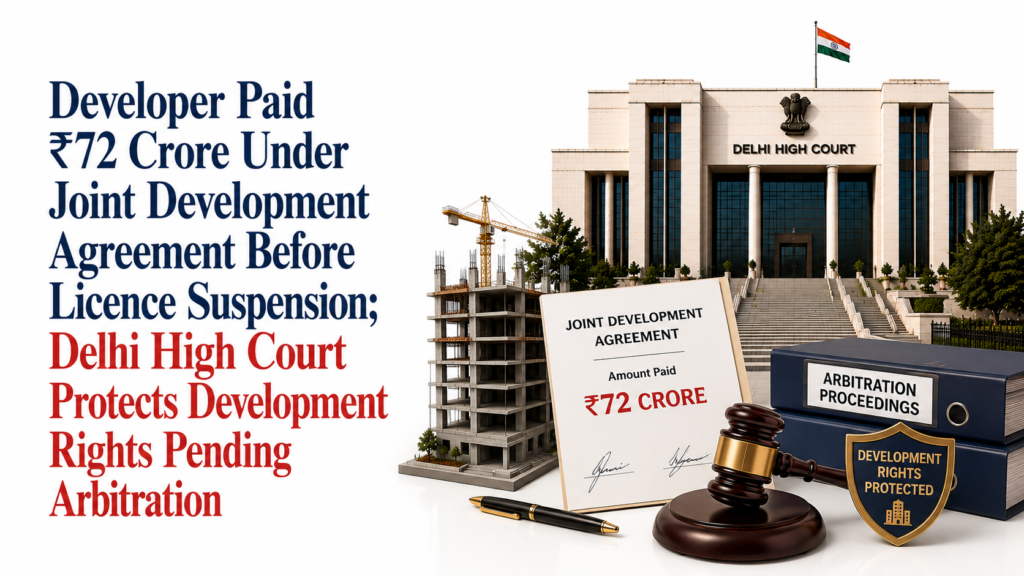
Developer Paid ₹72 Crore Under Joint Development Agreement Before Licence Suspension; Delhi High Court Protects Development Rights Pending Arbitration

Delhi High Court Protects Developer’s Rights After ₹72 Crore Investment Despite Landowner’s Attempt to Terminate Joint Development Agreement
Facts
M/s GCD Prime and DCM Limited entered into a Term Sheet dated 18 May 2022 followed by a Joint Development Agreement (JDA) dated 11 August 2022 for development of approximately 68.35 acres of land at Hisar, Haryana under the Deen Dayal Jan Awas Yojana (DDJAY). Under the arrangement, DCM contributed the land while GCD Prime undertook the responsibility of developing, constructing and marketing the project. GCD was entitled to 45% of the net sale revenue and claimed to have invested nearly ₹72 crore, including an advance payment of ₹50 crore, licence fees, external development charges, bank guarantees, RERA registration expenses and on-site development work.
Subsequently, on 18 April 2023, the Directorate of Town and Country Planning (DTCP), Haryana suspended the project licence after initiating proceedings concerning alleged illegal sale and misuse of the land by DCM. Thereafter, DCM issued a default notice on 22 September 2025, followed by a termination and forfeiture notice dated 31 October 2025, alleging that GCD had failed to maintain the validity of the development licence. GCD invoked Section 9 of the Arbitration and Conciliation Act seeking interim protection against termination pending arbitration. During the proceedings, arbitration was invoked and a Sole Arbitrator was appointed.
Issues
- Whether the petitioner established a prima facie case for interim protection under Section 9 of the Arbitration and Conciliation Act, 1996.
- Whether the Joint Development Agreement was determinable within the meaning of Section 14(d) of the Specific Relief Act.
- Whether interim protection would amount to granting specific performance of the contract.
- Whether termination based upon suspension of the development licence could prima facie be attributed to the petitioner.
Petitioner’s Arguments
GCD Prime contended that it had fully performed all contractual obligations under the JDA, including procuring the development licence and investing approximately ₹72 crore towards the project. It argued that the licence was suspended because of allegations concerning DCM’s title and prior transactions relating to the land, none of which were attributable to GCD. Consequently, no contractual “event of default” had occurred entitling DCM to terminate the agreement.
The petitioner further argued that the JDA was not a determinable contract, since termination was permissible only upon specified defaults after granting notice and an opportunity to cure. It maintained that the termination notice unlawfully deprived it of valuable contractual development rights and that failure to grant interim protection would render the arbitration proceedings meaningless by allowing DCM to deal with the property or create third-party rights before adjudication.
Respondent’s Arguments
DCM contended that under the Term Sheet and the JDA, GCD had undertaken responsibility not only for obtaining but also maintaining all necessary statutory approvals and licences. Since the development licence had been suspended, GCD had committed an event of default entitling DCM to invoke the contractual termination clause.
It was further argued that the JDA was essentially a development contract granting only contractual development rights and revenue sharing, without conferring any proprietary interest in the land. According to DCM, the agreement was determinable in nature, damages constituted an adequate remedy, and any order staying termination would effectively amount to granting specific performance, which is impermissible in proceedings under Section 9 of the Arbitration Act.
Analysis of the Law
The Court analysed the scope of Section 9 of the Arbitration and Conciliation Act, reiterating that interim measures are intended to preserve the subject matter of arbitration by applying the well-established tests of prima facie case, balance of convenience and irreparable injury. The Court emphasised that although Section 9 does not permit final adjudication or grant of specific performance, it does empower courts to grant such protective measures as are necessary to ensure that arbitral proceedings do not become infructuous.
The Court also examined Sections 14(d) and 41(e) of the Specific Relief Act concerning determinable contracts. Referring to recent Supreme Court jurisprudence, it held that a contract terminable only for cause after notice and opportunity to cure does not become determinable merely because it contains a termination clause. Applying those principles, the Court concluded that the JDA fell within the category of contracts terminable only upon occurrence of specified defaults after affording a cure period, and therefore was prima facie non-determinable in nature. However, that finding by itself did not automatically entitle the petitioner to interim relief, which still depended upon satisfaction of the traditional equitable tests.
Precedent Analysis
- ArcelorMittal Nippon Steel (India) Ltd. v. Essar Bulk Terminal Ltd. (2022) 1 SCC 712 – Relied upon for the principles governing grant of interim protection under Section 9, including prima facie case, balance of convenience and irreparable injury.
- Adhunik Steels Ltd. v. Orissa Manganese & Minerals (P) Ltd. – Reaffirmed that Section 9 is intended to preserve the subject matter of arbitration rather than grant final contractual relief.
- K.S. Manjunath v. Moorasavirappa Muttanna Chennappa Batil (2025 SCC OnLine SC 2378) – Relied upon to distinguish determinable contracts from contracts terminable only for cause after notice and opportunity to cure.
- A. Murugan v. Rainbow Foundation Ltd. – Adopted for classifying contracts into categories based upon their determinability and enforceability.
- Innovative Facility Solutions Pvt. Ltd. v. Affordable Infrastructure & Housing Projects Pvt. Ltd. – Cited regarding continuation of contractual obligations during pendency of disputes and interpretation of non-determinable contracts.
Court’s Reasoning
The Court first held that although the petitioner sought stay of the termination notice, the relief could not automatically be characterised as impermissible specific performance. The real question was whether interim protection was necessary to preserve the subject matter of arbitration. The Court observed that Section 9 empowers courts to grant interim measures wherever required to prevent frustration of arbitral proceedings, provided the applicant satisfies the established equitable principles.
On examining the contractual framework, the Court found that the JDA did not permit arbitrary or convenience-based termination. Termination was permissible only upon occurrence of specified defaults, followed by a thirty-day cure period and a further fifteen-day termination notice. Applying the principles laid down by the Supreme Court in K.S. Manjunath, the Court held that such a contract is non-determinable, as termination depends upon proof of contractual default rather than unilateral discretion.
The Court further noted that the suspension of the development licence arose from allegations relating to DCM’s title and land transactions, which prima facie required detailed factual examination in arbitration. Since GCD had invested nearly ₹72 crore and acquired valuable contractual development rights, permitting DCM to freely terminate the agreement or create third-party interests during arbitration could irreversibly prejudice the arbitral process. The Court therefore concluded that interim protection was warranted to preserve the subject matter until the arbitral tribunal determined the parties’ rights.
Conclusion
The Delhi High Court held that although Section 9 cannot ordinarily be used to grant final specific performance, it may be invoked to preserve valuable contractual rights pending arbitration. The Court found that the Joint Development Agreement was prima facie non-determinable, the petitioner had established a strong prima facie case based on substantial investment and disputed responsibility for the licence suspension, and interim protection was necessary to ensure that the arbitral proceedings remained effective and meaningful.
Case Details
- Case: M/s GCD Prime v. DCM Limited
- Court: High Court of Delhi
- Case Number: O.M.P.(I) (COMM.) 472/2025
- Judge: Justice Jasmeet Singh
- Date: 28 July 2026
- Result: Petition partly allowed; Court granted interim protection preserving the subject matter pending arbitration while applying the principles governing Section 9 of the Arbitration and Conciliation Act.