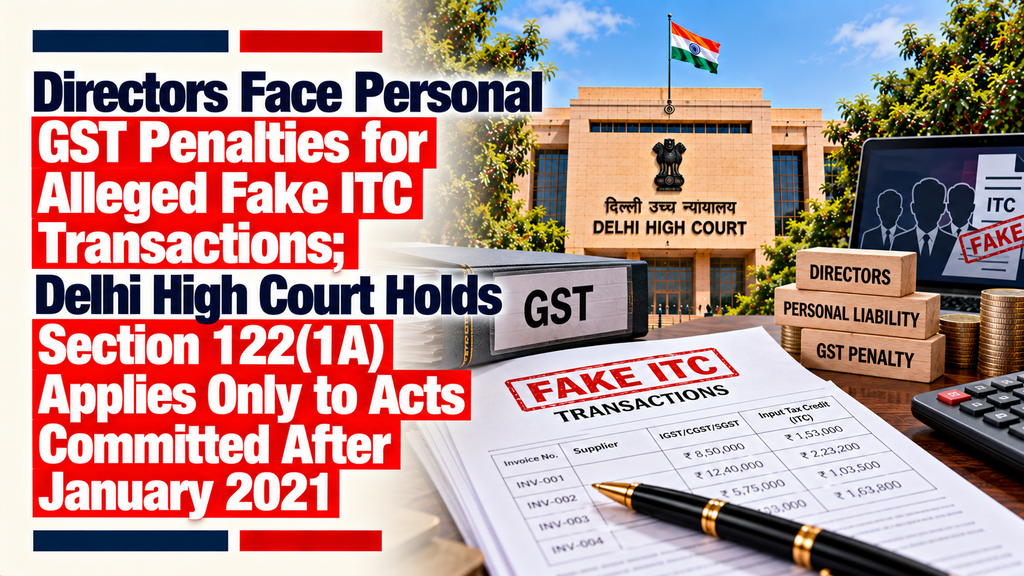
Directors Face Personal GST Penalties for Alleged Fake ITC Transactions; Delhi High Court Holds Section 122(1A) Applies Only to Acts Committed After January 2021

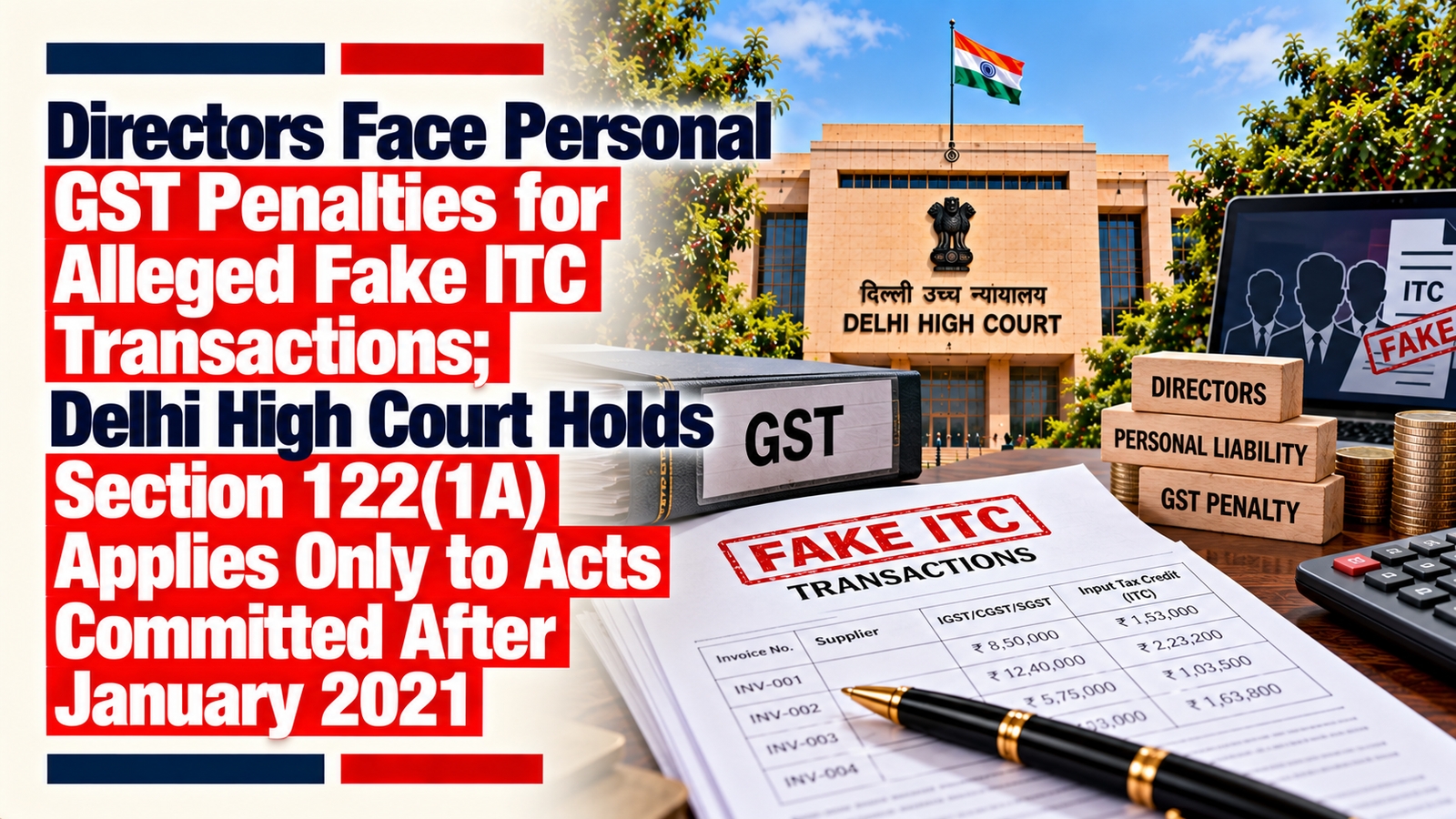
Can Company Directors Face GST Penalty for Transactions Before Section 122(1A) Existed? Delhi High Court Says No, Provision Operates Prospectively
Facts
This batch of writ petitions before the Delhi High Court challenged various Show Cause Notices and consequential Orders-in-Original imposing personal penalties under Section 122(1A) of the CGST Act, 2017. Although an appellate remedy under Section 107 existed, the Court entertained the petitions because they raised substantial questions of law concerning the scope and temporal operation of Section 122(1A). PARAG GARG
The lead controversy arose from a common SCN dated 27 July 2023 and an Order-in-Original dated 22 January 2025 concerning M/s Worlds Window Impex India Pvt. Ltd.
The Department alleged that the company engaged in circular trading and irregularly availed Input Tax Credit of ₹24,99,88,069 through invoices allegedly issued without actual supply of goods. PARAG GARG
Apart from imposing liability upon the company, the adjudicating authority imposed separate personal penalties of ₹24,99,88,069 each upon three petitioners under Section 122(1A), together with ₹25,000 each under Section 125, because they had served as directors at different points in time. PARAG GARG
Issues
The Delhi High Court framed two principal questions:
- Can Section 122(1A) be invoked against a person who is not himself a “taxable person” under the CGST Act?
- Can Section 122(1A), which came into force on 1 January 2021, be applied to transactions committed before that date merely because the SCN was issued later? PARAG GARG
Petitioners’ Arguments
The petitioners argued that neither the SCNs nor the Orders-in-Original attributed any specific fraudulent act, omission or role to them individually. According to them, liability had effectively been imposed merely because they happened to be directors. PARAG GARG
They emphasised that Section 122(1A) was introduced by the Finance Act, 2020 with effect from 1 January 2021 and was intended to penalise the actual beneficiaries or masterminds behind fraudulent ITC transactions.
The Legislature had expressly made certain other Finance Act amendments retrospective from 1 July 2017 but had not done so with Section 122(1A). This, according to the petitioners, demonstrated an intention to make the provision prospective. PARAG GARG
The alleged transactions in the lead cases related principally to the period 1 July 2017 to 31 March 2019, or at the highest up to 30 August 2020, with no alleged availment continuing after 1 January 2021. PARAG GARG
They further argued that Section 122(1A) contains two mandatory requirements:
- the person must have retained the benefit of the transaction; and
- the transaction must have been conducted at that person’s instance.
Neither condition, they submitted, could be presumed merely from directorship. PARAG GARG
Respondents’ Arguments
The Department primarily contended that the petitioners had an effective statutory appellate remedy under Section 107 and therefore should not be permitted to bypass the statutory hierarchy through Article 226. PARAG GARG
On retrospectivity, the Department argued that Section 122(1A) did not create the underlying GST contraventions; fraudulent availment or passing of ITC was already prohibited.
Accordingly, Section 122(1A) merely prescribed an additional fiscal consequence against the persons responsible for conduct already prohibited by law. PARAG GARG
The Department also argued that Article 20(1) did not apply because the penalty was civil/fiscal rather than punishment for a criminal offence. PARAG GARG
Analysis of the Law
1. “Any Person” Is Broader Than “Taxable Person”
The Court rejected the proposition that Section 122(1A) applies only to a taxable or GST-registered person.
It noticed that Parliament deliberately used different expressions within Section 122:
Section 122(1): “taxable person”
Section 122(1A): “any person”
Section 122(2): “registered person”
Section 122(3): “any person” PARAG GARG
The Court held that this variation was deliberate. Reading “any person” as merely another expression for “taxable person” would effectively insert words Parliament consciously omitted. PARAG GARG
This interpretation was reinforced by the statutory definition of “person,” which includes individuals, companies, firms, LLPs, HUFs, associations, trusts, governments and artificial juridical persons. PARAG GARG
2. Provision Is Intended to Reach the Real Beneficiary Behind GST Fraud
The Court gave a practical explanation for the broader interpretation.
Fraudulent ITC transactions may be routed through fictitious or shell entities registered in the names of persons having little connection with the actual business—including employees or persons whose identity documents have been misused.
If Section 122(1A) were restricted to the registered taxable entity, the person actually orchestrating the transaction and retaining its financial benefit could escape liability. PARAG GARG
The Court noted that Section 122(1A) was introduced pursuant to the 38th GST Council Meeting of 18 December 2019 specifically to address fake invoicing and impose liability upon the real beneficiaries of fraudulent transactions. PARAG GARG
3. Two Conditions Must Be Cumulatively Proved
The judgment importantly limits this broad expression.
Merely being a director, employee, shareholder or person associated with the taxable entity does not automatically establish Section 122(1A) liability.
The Court held that two conditions are cumulative:
- the person must have retained the benefit of a transaction falling within Section 122(1)(i), (ii), (vii) or (ix); and
- that transaction must have been conducted at that person’s instance. PARAG GARG
Both must be independently established before personal liability can arise. PARAG GARG
This is therefore not a provision creating automatic vicarious liability merely because an individual is a director.
4. Section 122(1A) Is Prospective From 1 January 2021
On the second issue, the Court held categorically that Section 122(1A) operates prospectively.
The decisive date is the date of the underlying transaction or act, not the date on which the Department happens to issue the SCN.
Accordingly:
Only transactions or acts committed on or after 1 January 2021 can attract Section 122(1A).
The Department cannot revive pre-2021 transactions for Section 122(1A) merely by issuing an SCN after the provision came into force.
5. SCN Date Cannot Determine Penal Liability
The Court rejected the contrary approach because it would produce arbitrary consequences.
Two identical transactions occurring before January 2021 could otherwise be treated differently merely because the Department issued an SCN earlier in one case and later in another.
The temporal reach of a penal provision cannot depend upon a subsequent administrative act of the Department.
The Court therefore held that the date of the underlying act or transaction determines applicability.
Precedent Analysis
Bharat Parihar v. State of Maharashtra
The Bombay High Court had held that “any person” under Section 122(1A) is broader than “taxable person” and can therefore include a non-taxable person.
The Delhi High Court expressly agreed with this approach. PARAG GARG
Shantanu Sanjay Hundekari v. Union of India
The Bombay High Court had taken a narrower approach and emphasised that employees could not be held liable without evidence of personal benefit and involvement.
The Delhi High Court disagreed insofar as that decision restricted “any person” to the taxable-person framework, though it accepted the importance of establishing the statutory requirements of benefit and personal involvement. PARAG GARG
Amit Manilal Haria v. Joint Commissioner, CGST
This decision became particularly important on retrospectivity.
The Bombay High Court had held that Section 122(1A), introduced from 1 January 2021, could not retrospectively penalise earlier conduct.
The Delhi High Court agreed with Amit Manilal Haria on this temporal issue, although it disagreed with its narrower interpretation of “any person.” PARAG GARG
Gurudas Mallik Thakur v. Commissioner of GST
The Delhi High Court had previously adopted the wider construction of “any person”, recognising that corporate entities operate through natural persons and that Section 122(1A) may extend to those who actually retain the benefit.
The present Bench approved that interpretation. PARAG GARG
Bhupender Kumar
This Delhi High Court decision had treated the date of SCN as relevant and regarded fraudulent ITC availment as potentially continuing conduct. PARAG GARG
The present Bench declined to adopt that reasoning as a general rule. Instead, it held that the relevant date is the date of the underlying transaction.
Mayank Bansal v. Union of India
The Gauhati High Court had adopted the broader interpretation of “any person” and also held that Section 122(1A) could operate where the SCN was issued after the provision came into force. PARAG GARG
The Delhi High Court agreed with the broader meaning of “any person” but disagreed with the SCN-date approach to temporal applicability.
Court’s Reasoning
The judgment draws a clear distinction between who may be penalised and for what period they may be penalised.
On the first question, Parliament intentionally used “any person” so that actual masterminds and beneficiaries operating behind corporate entities could not avoid liability simply because they were not registered taxpayers.
But that widened personal reach does not eliminate the statutory safeguards.
The Department must establish both that the individual retained the benefit and that the relevant transaction occurred at his or her instance.
On the second question, Section 122(1A) created a new penal consequence from 1 January 2021. The Department therefore cannot attach that consequence to conduct completed before the provision came into force.
Conclusion
The Delhi High Court held:
First, Section 122(1A) is not restricted to taxable persons. A director, employee, promoter, mastermind or other person may potentially fall within it even without being GST-registered.
Second, mere designation or association with a company is insufficient. The Department must prove both retention of benefit and that the transaction occurred at that person’s instance.
Third, Section 122(1A) operates prospectively from 1 January 2021. Transactions completed before that date cannot attract the penalty merely because an SCN was subsequently issued.
Importantly, the Court did not itself quash every individual penalty on the facts. It confined its judgment to these questions of law and left factual issues—whether each petitioner retained a benefit, caused the transaction, and whether the relevant conduct occurred after 1 January 2021—to the statutory appellate authority.
The petitioners were given liberty to file appeals under Section 107 CGST Act. Appeals filed within four weeks of the judgment were directed not to be rejected on limitation.
Case Details
Case: Parag Garg v. Commissioner, Adjudication, CGST Delhi West & Anr. and connected matters
Court: High Court of Delhi at New Delhi PARAG GARG
Lead Case: W.P.(C) 13883/2026 & connected matters PARAG GARG
CNR No.: DLHC010450702026 PARAG GARG
Judges: Justice Anil Kshetrapal and Justice Bharat Parashar PARAG GARG
Reserved: 21 September 2026
Pronounced: 29 September 2026 PARAG GARG
Result: Questions of law decided by holding that Section 122(1A) covers “any person,” including a non-taxable person satisfying its twin conditions, but operates only prospectively for acts or transactions occurring on or after 1 January 2021. The writ petitions were disposed of with liberty to pursue statutory appeals under Section 107