Domestic Help Lives in Owner’s Property for Decades and Claims Oral Gift and Adverse Possession; Delhi High Court Orders Her to Vacate

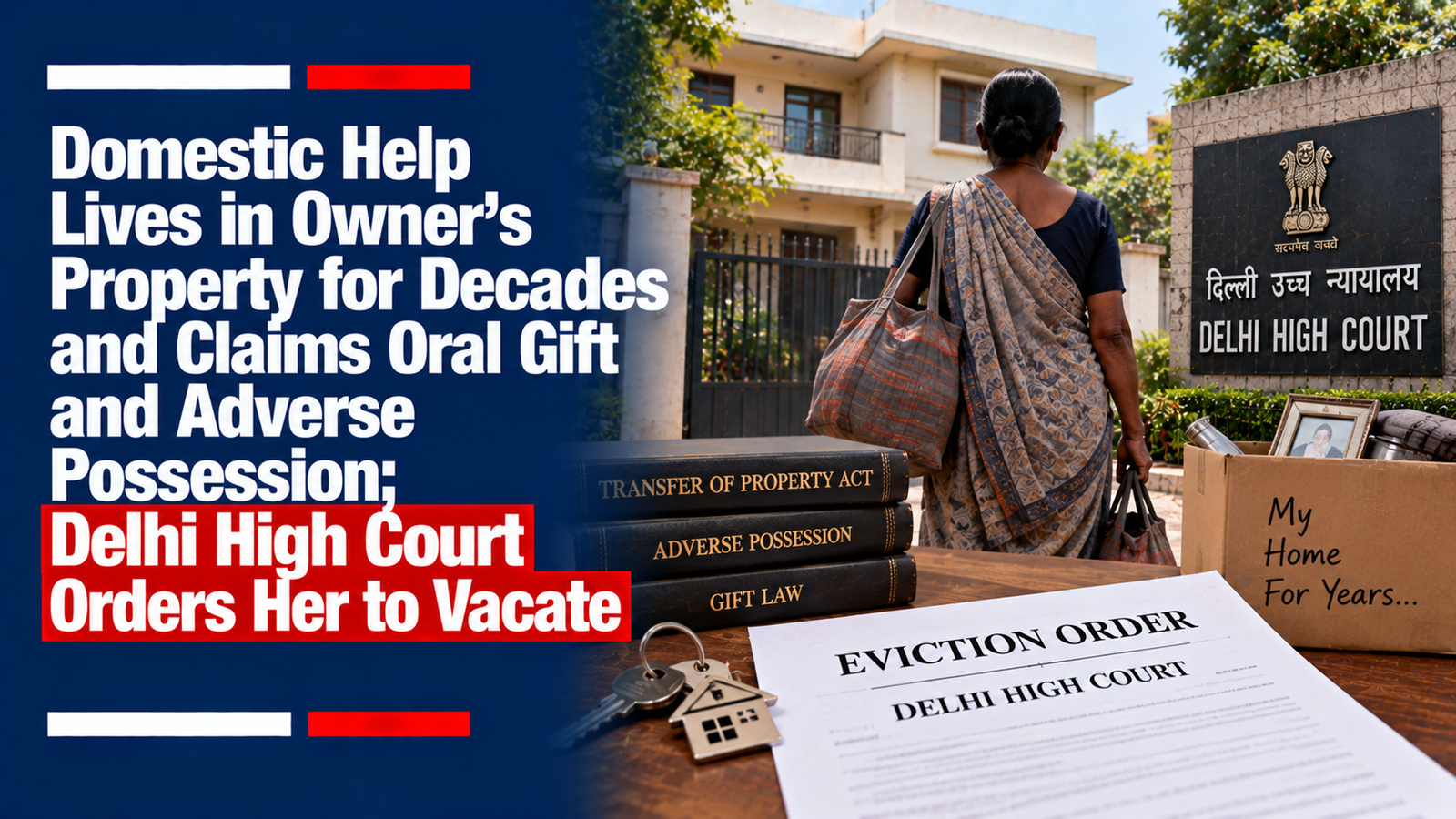
Woman Lives in House for Decades as Caretaker, Later Claims Adverse Possession; Delhi High Court Says Permissive Possession Never Became Hostile
Facts
Smt. Rajinder Kaur claimed ownership of a property at 1/2494, Moti Ram Marg, Mukherjee Marg, G.T. Road, Shahdara, Delhi, on the strength of a Receipt, General Power of Attorney and Agreement to Sell dated 18 July 1988.
The husband of the defendant, Smt. Chandrawati Shah, had initially joined the plaintiff as a domestic help. Chandrawati subsequently also assisted the plaintiff’s family in domestic work. When the plaintiff went to Canada after her husband’s death, Chandrawati and her husband were permitted to reside in the property without rent on the understanding that they would look after it and return possession when required.
In January 2018, the plaintiff returned to India and sought possession for reconstruction. The defendant refused to vacate, following which a legal notice was issued and a suit for possession and damages was instituted.
The defendant set up a substantially different case. She claimed that about 35 years earlier, the plaintiff and her husband had orally gifted the property to her and her husband out of love and affection because they had cared for the family and because her husband had allegedly saved the plaintiff’s family during the 1984 Sikh riots.
She also challenged the plaintiff’s title on the ground that the GPA, Agreement to Sell and Receipt were unregistered documents which could not confer ownership under Suraj Lamp.
The Trial Court rejected the oral-gift and adverse-possession defences, decreed possession in favour of the plaintiff and awarded ₹1 lakh as damages/mesne profits with 6% future interest. The defendant appealed.
Issues
The Delhi High Court framed four central questions:
- Whether the defendant established ownership through the alleged oral gift;
- whether several decades of possession created proprietary rights;
- whether the defendant had acquired title by adverse possession; and
- whether ₹1 lakh awarded as damages/mesne profits was sustainable.
Appellant’s Arguments
The defendant argued that she and her family had remained in peaceful, continuous and uninterrupted possession for around 40 years, openly and with the plaintiff’s knowledge. She therefore asserted that her possession had matured into adverse possession.
She relied upon her family’s maintenance of the property and payment of electricity charges. She also maintained that the house had been orally gifted to her husband after he saved the plaintiff’s family during the 1984 riots.
A separate challenge was made to the plaintiff’s own title. The defendant argued that the GPA, Agreement to Sell and Receipt dated 18 July 1988 did not constitute registered conveyance documents and therefore could not themselves confer title.
Respondent’s Arguments
The plaintiff emphasized that the defendant herself claimed title through an alleged gift made by the plaintiff and her husband. Therefore, the burden was upon the defendant to prove that gift.
In cross-examination, however, the defendant admitted that she possessed no documentary proof of ownership, no written document evidencing the alleged gift, and no registered gift deed. She also admitted that the property continued to stand in the plaintiff’s name.
The plaintiff relied upon Section 123 of the Transfer of Property Act, 1882, contending that an alleged oral gift could not transfer title in immovable property.
Analysis of the Law
1. Suraj Lamp Did Not Help the Defendant
The Court accepted that Suraj Lamp & Industries Pvt. Ltd. v. State of Haryana prevents an Agreement to Sell/GPA/Receipt transaction from being treated as a substitute for a registered conveyance conferring absolute ownership.
But the Court made an important distinction: such documents are not void or devoid of all evidentiary significance. They may still be considered when determining the origin and comparative rights asserted by the parties.
More importantly, the defendant’s own case undermined her challenge. She claimed that the plaintiff and her husband had gifted the property to her. That plea itself proceeded on the footing that the plaintiff had rights capable of being transferred.
The Court therefore found the plaintiff had established a better right to the property vis-à-vis the defendant.
2. Oral Gift of Immovable Property Was Invalid
The Court relied upon Section 123 of the Transfer of Property Act, 1882, which requires a gift of immovable property to be effected through a registered instrument signed by or on behalf of the donor and attested by at least two witnesses.
The Court relied upon:
- Gomtibai v. Mattulal, (1996) 11 SCC 681; and
- R.N. Dawar v. Ganga Ram Saran Dhama, 1992 SCC OnLine Del 446.
It held that mere delivery of possession cannot substitute the statutory requirement of a registered gift instrument.
Here, there was no gift deed, mutation, contemporaneous document or independent evidence showing when or how the alleged gift had taken place.
Accordingly, the oral-gift defence failed.
Precedent Analysis
Maria Margarida Sequeria Fernandes v. Erasmo Jack de Sequeria
This was central to the Court’s treatment of long-term occupation.
The Supreme Court had held that a person allowed to occupy premises gratuitously, including a caretaker, servant, friend or relative, does not acquire ownership merely because the occupation continues for years or decades.
A caretaker holds the property on behalf of the principal and must return possession when demanded.
Karnataka Board of Wakf v. Government of India
A party claiming adverse possession must specifically establish when possession commenced, its character, whether it was known to the owner and that it remained open and hostile for the statutory period.
Konda Lakshmana Bapuji v. Government of A.P.
Mere long possession is insufficient. Where possession was not hostile at inception, limitation for adverse possession begins only when the occupier demonstrates the requisite animus possidendi and a hostile assertion against the true owner.
Bhag Singh v. Basant Kaur, 2026 INSC 983
The Court relied on this recent Supreme Court decision for the proposition that where possession begins lawfully or permissively, the mere passage of time cannot transform it into adverse possession. There must be clear evidence identifying when permissive possession became hostile.
Narasamma v. A. Krishnappa
A person cannot simultaneously claim that she became owner through a transfer on a particular date and also claim adverse possession against that very owner from the same date.
If the asserted title fails, the occupier must independently establish a subsequent point when possession became hostile.
Court’s Reasoning
Decades of Possession Did Not Create Ownership
The Court found that the defendant’s possession was permissive in origin.
She and her husband had entered the property because of their association with and assistance to the plaintiff’s family. Their occupation was therefore that of caretakers rather than persons possessing under an independent proprietary right.
The Court consequently held:
Long possession, even extending over several decades, does not convert permissive occupation into ownership.
The defendant’s payment of electricity or other consumption charges also did not help her. Such payments were merely incidents of occupation and did not establish ownership.
Adverse Possession Was Not Even Properly Pleaded
The adverse-possession defence suffered from a fundamental defect: it had not been pleaded in the written statement at all. It was raised only during final arguments.
There was no pleading specifying:
- when permissive possession allegedly became hostile;
- what act constituted denial of the plaintiff’s title;
- when the plaintiff became aware of that hostile assertion; or
- how such hostility continued uninterrupted for 12 years.
The Court therefore held that mere occupation for 40 years could not establish adverse possession.
Oral Gift and Adverse Possession Were Also Inconsistent
The defendant’s substantive case was that the plaintiff had voluntarily gifted the property to her family.
Having claimed ownership through the plaintiff, she could not simultaneously say that her possession from the same point was hostile to the plaintiff’s ownership.
No subsequent date on which her possession allegedly became hostile was pleaded or proved.
Damages / Mesne Profits
The Trial Court had awarded a lump sum of ₹1 lakh despite there being no evidence of the prevailing rental value.
During the appeal, however, the plaintiff expressly informed the High Court that she was not interested in recovering the damages/mesne profits from the defendant and therefore gave up that monetary relief.
Conclusion
The Delhi High Court held that the defendant could establish neither a valid oral gift nor adverse possession.
Her occupation originated permissively as a caretaker. Even decades of continued possession could not create title without a clear, hostile and unequivocal assertion against the owner maintained for the statutory period.
The Court also clarified that an alleged oral gift of immovable property governed by Section 123 of the Transfer of Property Act cannot transfer title without a registered instrument.
Possession of the property had already been restored to the plaintiff on 26 November 2024 during execution proceedings. The High Court dismissed the appeal, while recording that the plaintiff had given up recovery of ₹1 lakh damages/mesne profits and interest.
Case Details
Case: Smt. Chandrawati Shah v. Smt. Rajinder Kaur
Court: Delhi High Court
Case No.: RFA 453/2025
CNR: DLHC010319592025
Judge: Justice Neena Bansal Krishna
Reserved: 31 August 2026
Pronounced: 22 September 2026
Result: Appeal dismissed; decree for possession sustained; plaintiff gave up recovery of damages/mesne profits.