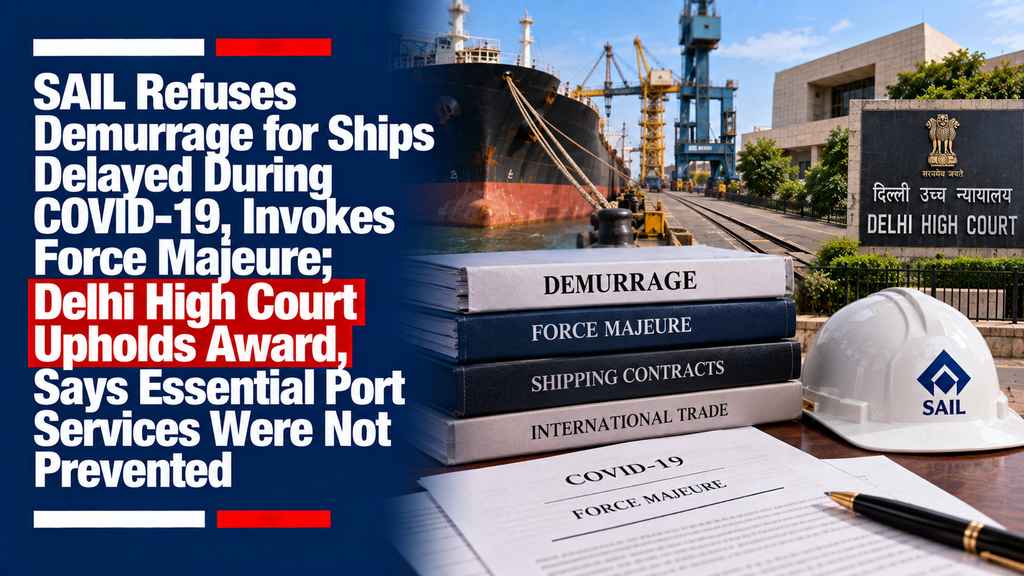
SAIL Refuses Demurrage for Ships Delayed During COVID-19, Invokes Force Majeure; Delhi High Court Upholds Award, Says Essential Port Services Were Not Prevented

Government Declared Cargo Loading and Unloading Essential During COVID-19; Delhi High Court Rejects SAIL’s Force Majeure Challenge to Demurrage Award
Facts
Steel Authority of India Limited (“SAIL”) entered into a Contract of Affreightment dated 5 April 2019 with Canadian company Norvic Shipping North America Inc. for transportation of 16,00,000 metric tonnes of limestone from the United Arab Emirates to India through multiple voyages.
Disputes arose regarding calculation of laytime, freight and demurrage at different discharge ports. Arbitration was invoked on 11 June 2020.
The dispute eventually concerned seven vessels—MV Pegasus, MV Esperia, MV Cas Avanca, MV Vishva Ekta, MV Jay, MV Blue Ripple and MV Sparrow.
The three-member arbitral tribunal awarded Norvic freight and demurrage in respect of the vessels, along with interest at LIBOR + 3 percentage points or 12% per annum, whichever was lower, and ₹10 lakh towards costs.
SAIL challenged the award under Section 34 of the Arbitration and Conciliation Act, 1996.
Issues
The principal questions before the Delhi High Court were whether:
- the arbitral tribunal had incorrectly calculated laytime and demurrage;
- COVID-19 constituted force majeure under Clauses 55 and 56 of the contract for the relevant vessels;
- governmental COVID-19 circulars prevented levy of demurrage;
- SAIL’s status as a “State” under Article 12 gave it any additional protection in a commercial contract;
- the award was inadequately reasoned or “non-speaking”; and
- such objections could justify interference with an international commercial arbitration award under Section 34.
Petitioner’s Arguments
For MV Pegasus, SAIL argued that the Notice of Readiness (“NOR”) tendered at Haldia on 10 May 2019 was premature because the vessel subsequently suffered a generator problem and could not berth when called on 17 May 2019. According to SAIL, laytime should therefore have commenced later.
For MV Esperia, SAIL argued that although the NOR was issued on 10 July 2019, a dispute between the vessel owner and Norvic prevented discharge and the vessel eventually re-berthed on 31 July 2019. Laytime, it argued, should therefore have commenced only from that later date.
For Cas Avanca, Vishva Ekta, Jay, Blue Ripple and Sparrow, SAIL principally relied upon the COVID-19 pandemic and Clauses 55 and 56 of the contract. It argued that force majeure had been triggered and that governmental and port circulars required the affected period to be excluded from calculation of demurrage.
SAIL further contended that the tribunal failed to consider voluminous documentary evidence, rendered a non-speaking award and failed to properly deal with its submissions, thereby offending natural justice and Indian public policy.
Respondent’s Arguments
Norvic argued that under Clause 36, NOR could be tendered when the vessel reached the limits of the discharge port and was ready to discharge; actual berth availability was not decisive.
A subsequent period of equipment inefficiency merely had to be excluded from laytime under Clause 41—it did not invalidate an earlier valid NOR.
On COVID-19, Norvic argued that cargo transportation, loading, unloading and related activities had been declared essential services, and SAIL had failed to prove that performance was actually “prevented” as required by the force majeure clause.
It also emphasized the extremely restricted scope of judicial review because this was an international commercial arbitration.
Analysis of the Law
The Court first held that this was an international commercial arbitration because Norvic was incorporated in Canada.
Since Delhi was the contractual seat of arbitration, Part I of the Arbitration Act applied.
Crucially, the Court held that after the 2015 amendment, “patent illegality” under Section 34(2A) is unavailable for challenging an award arising from international commercial arbitration, even where the arbitration is seated in India.
Accordingly, SAIL could not convert the Section 34 proceedings into an appeal on the tribunal’s interpretation of the contract, appreciation of evidence or factual conclusions.
Precedent Analysis
Patel Engineering Ltd. v. North Eastern Electric Power Corporation Ltd.
The Court relied on the Supreme Court’s explanation that the “patent illegality” ground introduced under Section 34(2A) applies to domestic awards but not to international commercial arbitration awards.
Ssangyong Engineering & Construction Co. Ltd. v. NHAI
The judgment reinforced the proposition that after the statutory amendment, patent illegality cannot be invoked to set aside an award arising from an international commercial arbitration.
Parsa Kente Collieries Ltd. v. Rajasthan Rajya Vidyut Utpadan Nigam Ltd.
The Court relied upon the principle that an arbitrator is the master of the quantity and quality of evidence. A court applying Section 34 does not sit as an appellate court merely because it might have reached a different factual conclusion.
Dyna Technologies Pvt. Ltd. v. Crompton Greaves Ltd.
The Court reiterated that Section 31(3) requires reasons that are intelligible and adequate, but an arbitral tribunal is not expected to write an elaborate judgment comparable to that of a judicial court.
Court’s Reasoning
COVID-19 Did Not Automatically Trigger Force Majeure
Clauses 55 and 56 expressly referred to epidemics and circumstances beyond the charterer’s control. However, Clause 56 operated where contractual obligations were prevented by the specified event.
The critical issue, therefore, was not merely whether COVID-19 existed, but whether it actually prevented the discharge operations covered by the contract.
The tribunal found that SAIL failed to establish this factual nexus.
Government orders instead showed that transportation of goods by water and related loading, unloading, transportation and storage activities had been declared essential services.
Accordingly, the tribunal’s rejection of force majeure could not be faulted.
Article 12 Status Does Not Alter a Commercial Contract
The Court rejected SAIL’s argument that its status as a “State” under Article 12 should assist its force majeure case.
It held that when an Article 12 entity enters into a commercial contract with a private party, the parties’ relationship is governed by the contractual terms; no special commercial status follows merely from the entity being an instrumentality of the State.
Government Circulars Did Not Eliminate Private Demurrage Liability
The Court distinguished between statutory/port charges and contractual demurrage.
Section 53 of the Major Port Trusts Act empowered the Port Board to exempt or remit charges levied by it. That provision did not regulate the independent contractual liability between SAIL and Norvic.
Thus, port-related COVID concessions could not automatically extinguish contractual demurrage.
Pegasus: Later Generator Failure Did Not Invalidate Earlier NOR
The tribunal found that MV Pegasus was ready when its NOR was issued on 10 May 2019.
Its generator problem arose subsequently.
Clause 41 merely excluded the period during which equipment breakdown rendered the vessel inefficient; nothing in the contract stated that a later breakdown retrospectively invalidated a previously valid NOR.
The High Court therefore upheld the tribunal’s calculation.
Tribunal Was Not Required to Discuss Every Document
The Court rejected SAIL’s argument that the award became defective because several COVID-related circulars were not expressly discussed.
The tribunal had addressed the substantive force majeure issue and reached its conclusion on the evidence.
The Court stressed that it is the quality, not the volume, of evidence that matters, and assessment of that evidence lies primarily within the tribunal’s domain.
Award Was Not Non-Speaking
The Court found that the tribunal had dealt separately with the vessels, examined the contractual clauses, recorded factual findings and explained the basis of its conclusions.
An arbitral award need not resemble a detailed judicial judgment. What Section 31(3) requires is intelligible and adequate reasoning.
Accordingly, the challenge that the award was non-speaking failed.
Interest Was Certain and Enforceable
SAIL also attacked the interest formula as open-ended.
The Court disagreed. The award clearly provided for LIBOR + 3 percentage points or 12% per annum, whichever was lower. There was therefore no uncertainty as to how the applicable rate was to be determined.
Conclusion
The Delhi High Court found no ground under Section 34(2) to interfere with the arbitral award and dismissed SAIL’s petition.
The judgment is particularly significant on three propositions: a COVID-19 event does not by itself establish contractual force majeure without proof of its actual impact on performance; a public-sector entity receives no special protection from ordinary commercial contractual obligations merely because it is “State” under Article 12; and the patent-illegality ground under Section 34(2A) is unavailable against an international commercial arbitration award.
Case Details
Case: Steel Authority of India v. Norvic Shipping North America Inc.
Court: Delhi High Court
Case No.: O.M.P. (COMM) 260/2023
CNR: DLHC010277772023
Judge: Justice Avneesh Jhingan
Reserved: 1 September 2026
Pronounced: 22 September 2026
Result: Section 34 petition dismissed; arbitral award upheld.