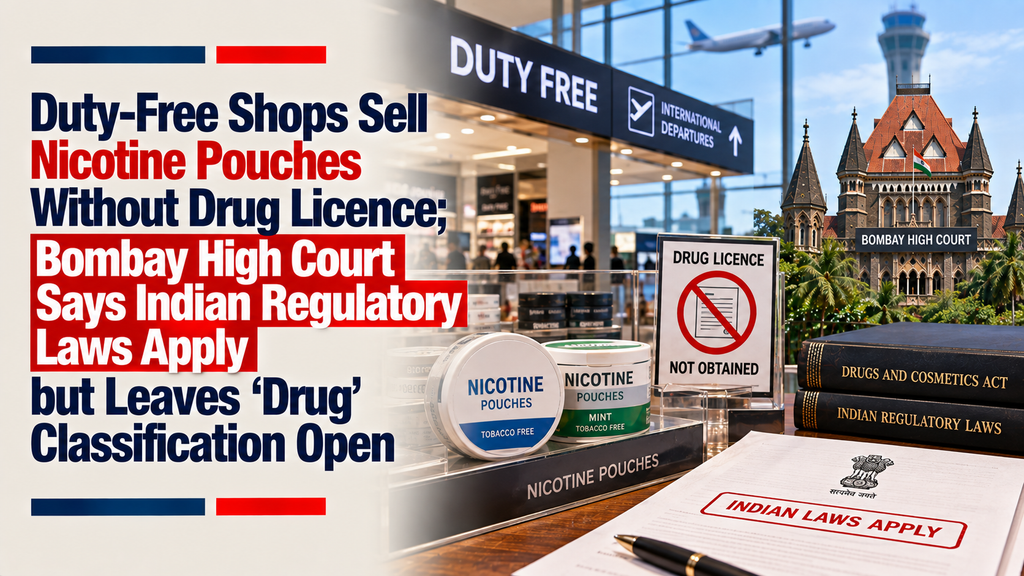
Duty-Free Shops Sell Nicotine Pouches Without Drug Licence; Bombay High Court Says Indian Regulatory Laws Apply but Leaves ‘Drug’ Classification Open

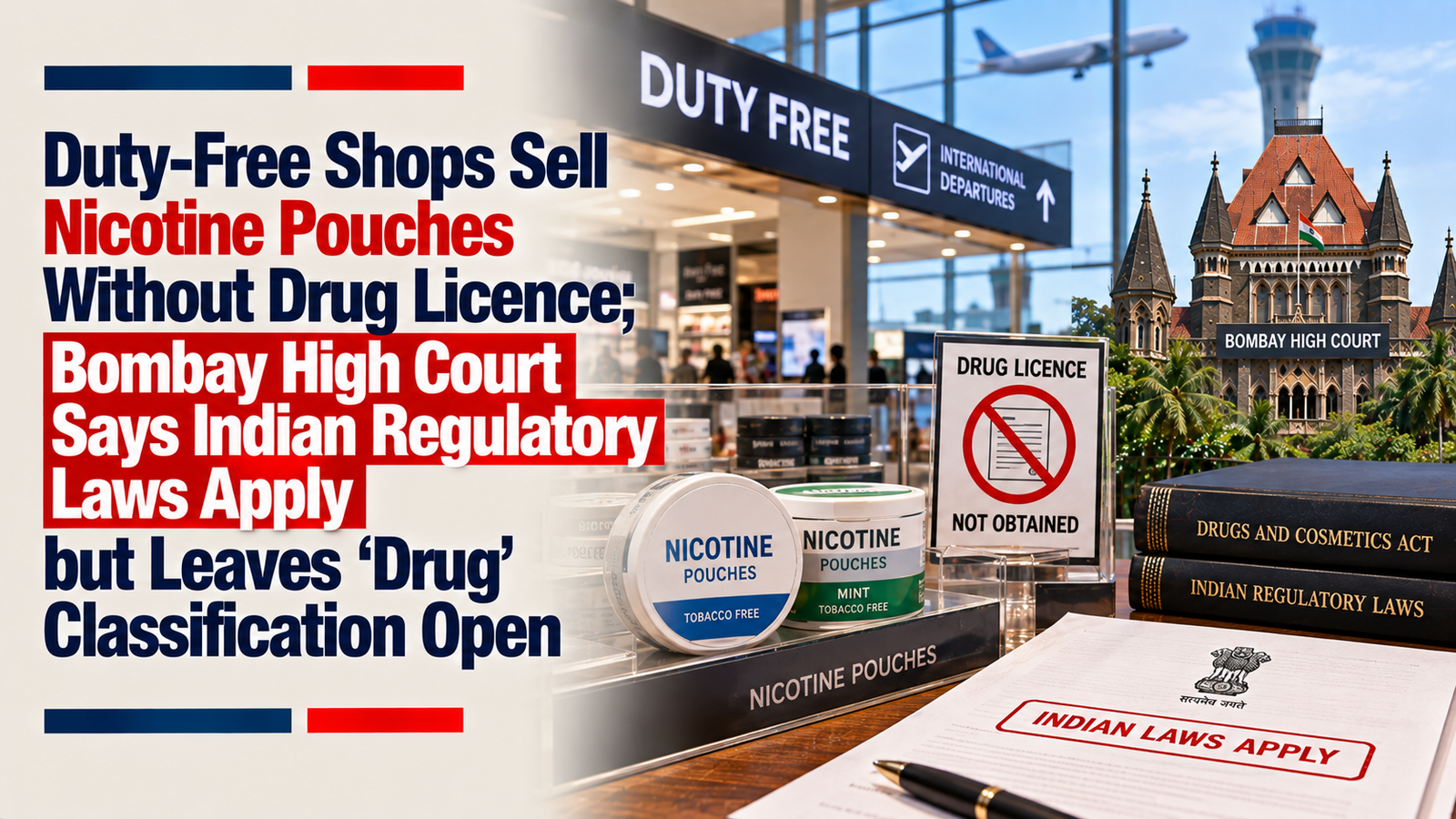
Are Nicotine Pouches ‘Drugs’ Requiring Import Licence? Bombay High Court Says Classification Depends on Composition and Intended Use
Facts
Mumbai Travel Retail Limited and Flemingo Dutyfree Shop Private Limited operate Duty-Free Shops at the international departure terminals of Mumbai Airport. They were selling imported tobacco-free nicotine pouches under the brands “ZYN” and “FOX.”
The retailers admittedly did not possess an import licence or Registration Certificate under the Drugs and Cosmetics Act, 1940. Their case was that the pouches were imported from foreign suppliers, stored in a customs-licensed special warehouse and sold only to outbound international passengers. According to them, the transaction was effectively one of re-export and did not attract the domestic drug-licensing regime.
The controversy began after a complaint by Mothers Against Vaping on 3 October 2025 raising health concerns regarding nicotine pouches. Customs sought details concerning the legality of their sale. The retailers maintained that because their Duty-Free Shops were situated within the customs frontier, domestic regulatory requirements did not apply.
Following an inspection on 5 March 2026, the Assistant Drugs Controller issued a communication dated 2 April 2026, treating nicotine pouches as “drugs” under Section 3(b) of the Drugs and Cosmetics Act and seeking stoppage of their sale. Customs subsequently informed the retailer that a Registration Certificate and import licence were mandatory and that sales should stop pending compliance.
The two retailers consequently approached the Bombay High Court. The principal petition was Writ Petition No. 3079 of 2026, Mumbai Travel Retail Limited v. Union of India & Ors.
Issues
The Division Bench identified two central questions:
First, whether transactions conducted in a Duty-Free Shop beyond the customs barrier enjoy complete immunity from India’s domestic regulatory regime, or whether the exemption is confined essentially to fiscal levies such as customs duty and indirect taxes.
Second, whether a “Nicotine Pouch” is a “drug” under Section 3(b) of the Drugs and Cosmetics Act, 1940, thereby requiring an import licence and registration even when sold within the customs barrier of an international departure terminal.
Petitioners’ Arguments
The retailers relied heavily upon the legal character of Duty-Free Shops. They argued that goods stored within customs warehouses and sold beyond the customs barrier do not merge with the “mass of goods” in India.
Accordingly, they contended that until the goods crossed the customs barrier, Indian regulatory authorities could neither insist upon a drug licence nor prevent their sale. They relied upon decisions including Hotel Ashoka and Garden Silk Mills.
They further contended that nicotine pouches had not been demonstrated to fall within the statutory definition of a “drug.” The product was not prohibited under the DGFT regime and “Nicotine” for oral application under ITC (HS) 24049100 had a “free” import status.
Respondents’ Arguments
The Union of India argued that a Duty-Free Shop does not become territory outside India merely because it lies beyond the customs barrier.
According to the authorities, transactions occurring on Indian soil remain subject to India’s regulatory laws. The customs concept of goods being beyond the customs frontier principally concerns taxation and cannot create immunity from legislation intended to protect public health.
The respondents further argued that nicotine is an Active Pharmaceutical Ingredient, bringing the product within Section 3(b) of the Drugs and Cosmetics Act and consequently requiring the necessary licence.
Analysis of the Law
1. Duty-Free Shop Is Not Outside Indian Regulatory Jurisdiction
The High Court rejected the proposition that goods sold in a Duty-Free Shop enjoy complete immunity from Indian law.
Following Glamstone Cosmetics Pvt. Ltd. v. Union of India, the Court held that “import” occurs when goods enter the territorial waters of India. Goods therefore become imported goods even though they have not yet been cleared for home consumption.
The Court consequently held:
Import for warehousing or re-export does not confer immunity from domestic laws.
The special treatment available to Duty-Free Shops is essentially limited to fiscal consequences such as customs duty, tax and MVAT. If goods are restricted or prohibited under another law in force, India’s regulatory regime continues to apply even when the transaction occurs beyond the customs barrier.
This answered the first issue against the Duty-Free Shop operators.
2. Is Every Nicotine Pouch a “Drug”? — No Automatic Classification
On the second issue, however, the Court did not accept that the presence of nicotine automatically makes every nicotine pouch a drug.
Section 3(b)(i) requires the substance to be intended for diagnosis, treatment, mitigation or prevention of disease or disorder.
Accordingly, nicotine used in Nicotine Replacement Therapy or smoking-cessation products has a much stronger basis for classification as a drug. But a nicotine pouch marketed purely as a recreational nicotine product without therapeutic or cessation claims may not automatically fall within Section 3(b)(i) merely because nicotine has physiological effects.
The Court expressly observed that whether a particular nicotine pouch is a drug depends upon its composition, formulation and intended use.
3. Authorities Had Not Adequately Established the Jurisdictional Fact
The Assistant Drugs Controller had stated that because certain nicotine-containing products such as nicotine patches, gums and lozenges are regulated as drugs, the nicotine pouches in question also constituted drugs.
The High Court found a significant gap in this reasoning.
Section 3(b) contains four separate statutory categories. The authority had not identified under which particular clause the ZYN or FOX nicotine pouches fell.
For clauses (ii) and (iv), the Court noted that there was admittedly no Central Government Gazette notification specifically covering nicotine pouches. For clause (iii), there was no finding that the pouch was intended to be used as a component of a drug.
The Court therefore held that the jurisdictional facts necessary for the Drug Controller to exercise regulatory power must first be established.
4. High Court Refused to Decide Scientific Classification Itself
At the same time, the retailers themselves had not supplied complete product specifications to the authorities.
The record did not adequately establish the precise composition, nicotine content, formulation, intended use or applicability of the statutory exemptions.
The Court therefore declined to undertake a scientific and factual inquiry under Article 226 into whether these particular products actually constituted “drugs.”
Whether a particular formulation has therapeutic use or falls within Schedule D/Schedule K exemptions requires factual and technical examination by the competent regulatory authority, not determination by the writ court.
Precedent Analysis
A particularly important precedent was Glamstone Cosmetics Pvt. Ltd. v. Union of India, 2026 SCC OnLine Bom 1861.
The Court held that Glamstone had already considered Garden Silk Mills and established that goods entering India’s territorial waters are imported goods even when intended for warehousing or subsequent re-export.
The Bench expressly stated that Glamstone had attained finality and constituted a binding precedent, and therefore declined to take a different view.
The Court also considered the Supreme Court decisions in Chimanlal Jagjivandas Sheth v. State of Maharashtra and State of Andhra Pradesh v. Linde India Ltd. for the scope of “drug.” These authorities establish that substances other than conventional medicines can qualify as drugs, but the necessary connection with diagnosis, treatment, mitigation or prevention must exist.
Court’s Reasoning
The judgment draws an important distinction between two propositions:
First: being inside a Duty-Free Shop does not create a legal enclave outside Indian regulatory legislation.
Second: the existence of regulatory jurisdiction does not automatically mean that every nicotine-containing product is a regulated “drug.”
Thus, the retailers failed on their broad proposition that Indian drug laws could never apply to products sold beyond the customs barrier. But the authorities also could not conclusively classify these particular nicotine pouches merely from the fact that they contained nicotine.
The actual regulatory status must be determined product-by-product on the basis of composition, intended use, statutory classification and applicable exemptions.
Conclusion
The Bombay High Court kept open the question whether ZYN and FOX nicotine pouches actually constitute “drugs” under Section 3(b).
Instead, the Court permitted the petitioners to make fresh representations before the appropriate authority, including the CDSCO, supported by technical material showing that their products either:
- do not constitute “drugs” under Section 3(b); or
- fall within the Schedule D and/or Schedule K exemptions.
If such representations are filed within four weeks from uploading of the judgment, the authorities must consider them on their own merits, pass a reasoned order, and, if necessary, provide a personal hearing. The entire exercise must be completed within 30 days of receipt of the representation. The writ petitions were accordingly disposed of without costs.
Case Details
Case: Mumbai Travel Retail Limited v. Union of India & Ors., with Flemingo Dutyfree Shop Private Limited v. Union of India & Ors.
Court: Bombay High Court, Ordinary Original Civil Jurisdiction
Case Nos.: Writ Petition No. 3079 of 2026 with Writ Petition (L) No. 20740 of 2026
Citation: 2026:BHC-OS:20816-DB
Coram: Justice Suman Shyam & Justice Advait M. Sethna
Reserved: 7 August 2026
Pronounced: 22 September 2026
Result: Duty-Free Shops held subject to Indian regulatory laws; classification of the particular nicotine pouches as “drugs” left open for technical determination by the competent authority.