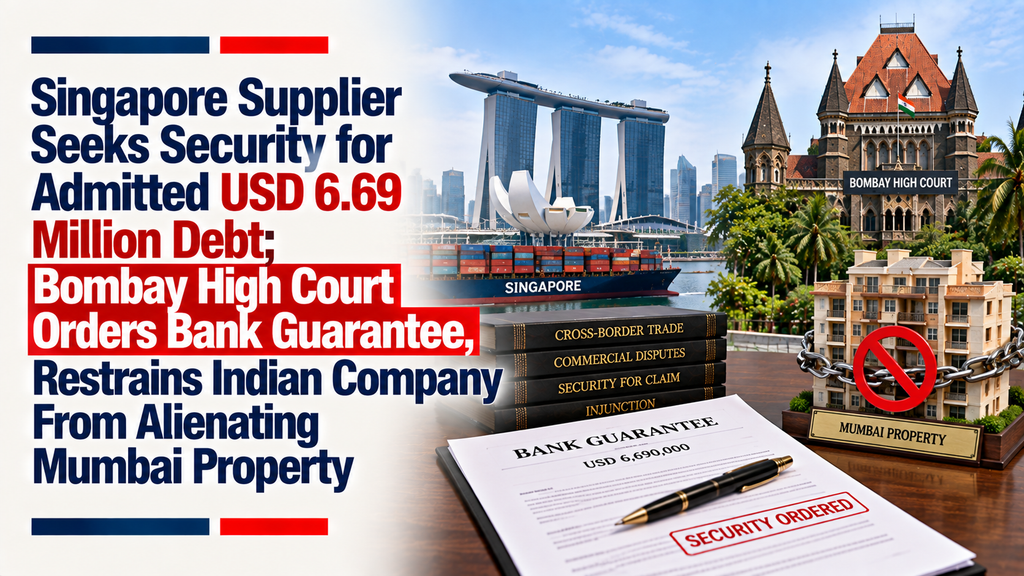
Singapore Supplier Seeks Security for Admitted USD 6.69 Million Debt; Bombay High Court Orders Bank Guarantee, Restrains Indian Company From Alienating Mumbai Property

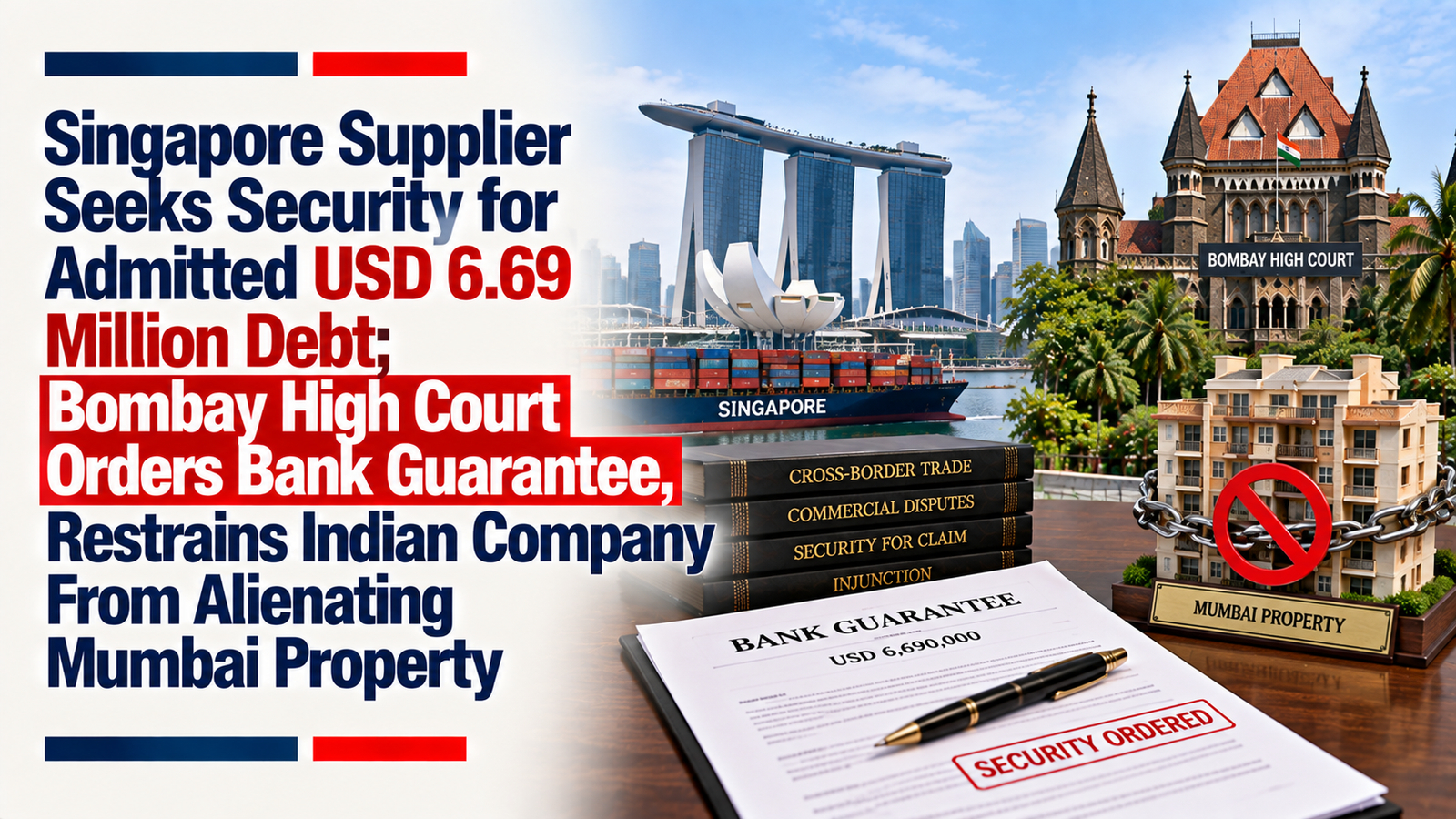
Debtor Admits USD 6.69 Million Dues but Refuses Payment; Bombay High Court Says Arbitration Cannot Be Allowed to Become a Paper Award
Facts
The appeal arose from a commercial dispute between Sunfield Global Pte Limited, a Singapore company engaged in supply-chain services and trading, and Liberty Investments Private Limited, an Indian company engaged in the purchase and sale of vegetable and seed oils. The appeal was filed under Section 37 of the Arbitration and Conciliation Act, 1996 against the dismissal of Sunfield’s Section 9 petition.
Between 1 October 2024 and 19 February 2025, Liberty executed six contracts for supply of 11,500 metric tonnes of oil. Sunfield claimed that after procuring the material, Liberty admitted that a balance of USD 66,92,500 remained payable as of 3 October 2025 but failed to make payment.
Sunfield therefore approached the Bombay High Court under Section 9 seeking security for the amount, either through a bank guarantee or, alternatively, an injunction preventing Liberty from creating third-party rights over its identified 7,409.08 sq. metre Mumbai property and buildings.
While the Section 9 petition was pending, a three-member arbitral tribunal was constituted on 17 November 2025 under FOSFA Rules. The Single Judge subsequently rejected the Section 9 relief, resulting in the present appeal.
Issues
The principal issues were whether the Bombay High Court could continue to grant Section 9 protection after constitution of the foreign-seated arbitral tribunal; whether the remedies available before the FOSFA tribunal were efficacious for securing assets located in India; and whether the admitted monetary liability justified an order securing Sunfield’s claim.
Appellant’s Arguments
Sunfield argued that the Mumbai location of the asset sought to be protected gave the Bombay High Court jurisdiction to entertain the Section 9 petition.
It emphasised that Liberty had unequivocally admitted the outstanding amount in its communication dated 3 October 2025. According to Sunfield, without security the eventual arbitral award could become merely a paper award.
Sunfield further argued that neither the FOSFA Rules nor Section 38 of the English Arbitration Act provided an effective mechanism equivalent to the relief sought in India—namely, securing the admitted amount or restraining alienation of an Indian property that was not itself the subject matter of the underlying contractual dispute.
Most importantly, Sunfield had filed its Section 9 petition before the arbitral tribunal was constituted. It argued that it could not lose its entitlement to judicial protection merely because the Court did not hear the petition before the tribunal was subsequently constituted.
Respondent’s Arguments
Liberty contended that once the FOSFA tribunal had been constituted, Section 9(3) required the parties to approach the arbitral tribunal rather than the Court.
It argued that the object of Section 9(3) is to minimise judicial intervention once the tribunal exists, and that this principle should equally apply to a foreign-seated arbitration where the tribunal can grant effective interim protection.
Liberty also contended that Sunfield had failed to plead and establish that the remedy available under FOSFA and English arbitration law was ineffective. It submitted that the arbitration was already at an advanced stage and the Section 37 appellate jurisdiction was limited.
Analysis of the Law
The Division Bench examined Section 9 and stressed that the provision expressly empowers courts to order “securing the amount in dispute in the arbitration”, apart from granting injunctions and other appropriate interim measures.
The Court held that Sunfield was unquestionably entitled to institute the Section 9 proceeding when it did. The fact that the tribunal was subsequently constituted could not automatically prejudice Sunfield when the delay in hearing its petition was attributable to the Court rather than the claimant.
The Court then compared Section 9 relief with the powers available under Section 38 of the English Arbitration Act. It found that the English provision concerning property forming the subject matter of the proceedings was materially different from Sunfield’s request to secure its monetary claim against an independent asset belonging to Liberty.
The Court therefore rejected the contention that merely having a FOSFA tribunal available necessarily constituted an efficacious alternative remedy.
Precedent Analysis
The Court relied significantly upon Arcelor Mittal Nippon Steel India Ltd. v. Essar Bulk Terminal Ltd., noting that Section 9 applications are inherently urgent and intended to ensure that arbitration proceedings do not culminate in an award that exists only on paper.
It also relied upon Norvic Shipping Asia Pte Ltd. v. Zigma International, where interim protection had been granted despite London arbitration proceedings. The Court reaffirmed that Section 9 relief is not mechanically confined by the strict requirements governing attachment before judgment under Order XXXVIII Rule 5 CPC. A strong possibility of diminution of assets based on objective material can justify protection.
The judgment further reaffirmed that under Section 9(3), the crucial consideration is not merely whether another remedy exists, but whether that remedy is efficacious.
The Court distinguished Ashwani Minda, where the claimant had first unsuccessfully sought interim relief from the arbitral tribunal and then approached the Court for substantially the same relief. Here, Sunfield had approached the Bombay High Court before constitution of the tribunal.
Court’s Reasoning
The Division Bench placed substantial emphasis on the admitted nature of the debt. It observed that Liberty had procured the goods, admittedly owed USD 66,92,500, and had not paid despite assurances.
The Court found that the foreign arbitral mechanism did not provide an efficacious means of securing Liberty’s Indian assets. An interim foreign order could potentially require multiple proceedings before it became effective against assets situated in India, creating a serious possibility that the protection would become ineffective in the meantime.
The Court also made an important procedural point: a litigant cannot be deprived of Section 9 protection merely because the Court did not hear its already-filed petition before the tribunal was constituted.
It held that courts dealing with arbitration should not permit technical objections to enable a party to frustrate a claim. Interim jurisdiction exists precisely to ensure that the successful claimant is ultimately able to realise the fruits of an arbitral award.
Conclusion
The Bombay High Court allowed Sunfield’s appeal and set aside the Single Judge’s judgment.
Liberty Investments was directed to furnish, within two weeks, a bank guarantee from a nationalised bank or scheduled commercial bank securing USD 66,92,500 together with interest and costs, or its INR equivalent, to the satisfaction of the Prothonotary and Senior Master.
Until the security is furnished—or if Liberty is unable to furnish it—the company is restrained from alienating or creating third-party rights, title or interest in the identified Mumbai property until completion of the arbitration proceedings.
Case Details
Case: Sunfield Global Pte Limited v. Liberty Investments Private Limited
Court: Bombay High Court, Commercial Division
Case No.: Commercial Arbitration Appeal (L) No. 1634 of 2026 in Commercial Arbitration Petition (L) No. 34540 of 2026
Coram: Justice A. S. Gadkari and Justice Kamal Khata
Reserved: 13 August 2026
Pronounced: 22 September 2026
Citation: 2026:BHC-OS:20813-DB
Result: Appeal allowed; USD 66.925 lakh claim secured by bank guarantee, failing which restraint against alienation of the Mumbai property continues until completion of arbitration.