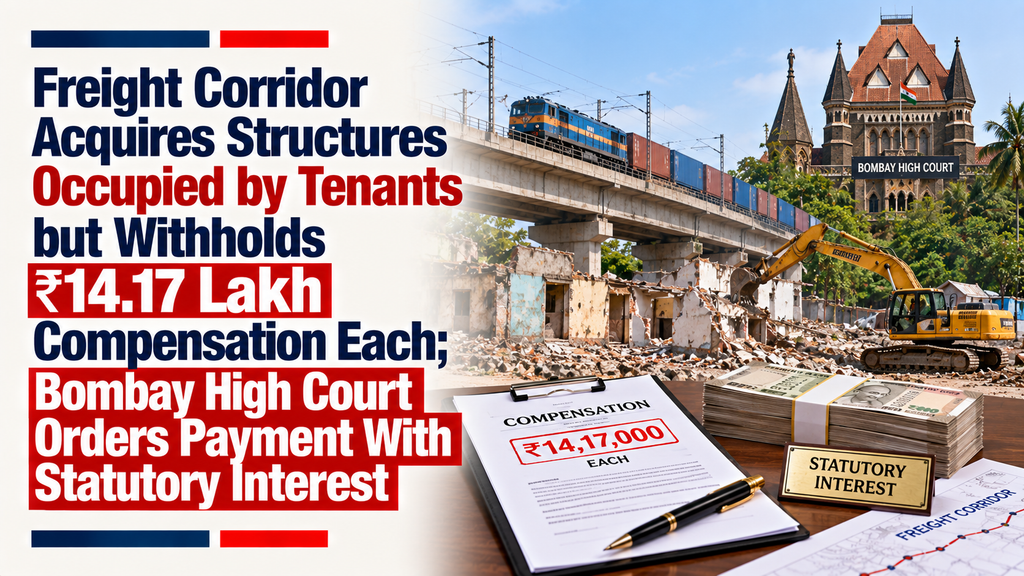
Freight Corridor Acquires Structures Occupied by Tenants but Withholds ₹14.17 Lakh Compensation Each; Bombay High Court Orders Payment With Statutory Interest

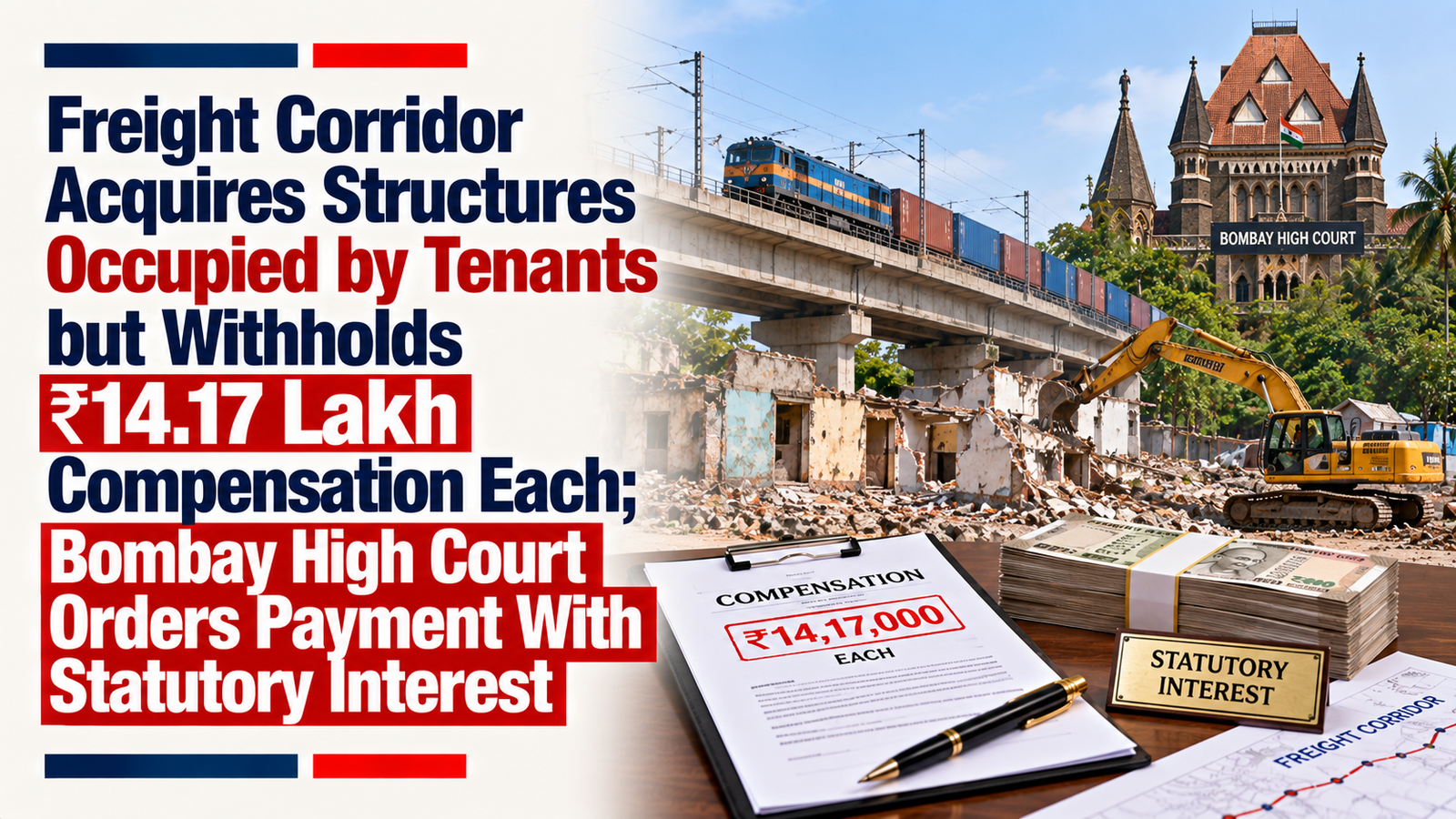
Compensation Approved but Suddenly Withheld After Freight Corridor Takes Structures; Bombay High Court Orders Payment With Interest
Facts
The batch of writ petitions was filed by tenants occupying structures acquired by the Dedicated Freight Corridor Corporation of India Limited (DFCCIL) for construction of the Dedicated Freight Corridor passing through Alibag, District Raigad.
The petitioners had approached the rehabilitation authorities in 2021 claiming status as project-affected persons. Possession of the structures was taken during 2021–2022. On 16 June 2022, the Deputy Commissioner (Rehabilitation), Konkan Division, allowed their appeals and held them eligible for compensation. DFCCIL’s review applications against those orders were subsequently rejected.
Thereafter, on 6 November 2025, the Deputy Collector (Rehabilitation) passed a reasoned order determining compensation of ₹14,17,000 for each petitioner. Instructions were even issued to the concerned bank to transfer a major portion—₹10 lakh each through RTGS.
However, on 24 November 2025, DFCCIL changed its position. Its Project Manager contended that because the petitioners were merely tenants, they were entitled only to three months’ written notice and ₹10,000 as shifting allowance, relying upon DFCCIL’s 2012 Rehabilitation and Resettlement Plan and the 2015 Entitlement Matrix.
Despite the State rehabilitation authority reiterating that the petitioners were eligible for the compensation already sanctioned, DFCCIL did not release the amount, resulting in the present writ petitions.
Issues
The principal questions before the Bombay High Court were whether tenants whose structures were acquired for the Dedicated Freight Corridor qualify as “affected families” under Section 3(c) of the Right to Fair Compensation and Transparency in Land Acquisition, Rehabilitation and Resettlement Act, 2013; whether DFCCIL could rely upon its administrative Entitlement Matrix to restrict their entitlement to ₹10,000; and whether the petitioners were entitled to interest for delayed payment.
Petitioners’ Arguments
The petitioners argued that DFCCIL’s refusal to release compensation already determined by the competent authority was arbitrary.
They relied particularly upon Sections 3(c)(ii) and 31 read with Schedule II of the 2013 Act, contending that tenants are expressly included within the definition of an “affected family.” Therefore, an administrative Entitlement Matrix based upon DFCCIL’s earlier rehabilitation policy could not override the statutory rights subsequently conferred by Parliament.
They further relied upon the Maharashtra Government Resolution dated 22 May 2018, which itself contemplated that where the 2013 Act provided higher compensation, the affected person would receive the higher statutory benefit.
Respondents’ Arguments
DFCCIL relied upon a 23 May 2015 Railway Board communication approving its Entitlement Matrix based upon its September 2012 Rehabilitation and Resettlement Plan.
It argued that under this framework tenants and lessees had limited entitlements and, since compensation had already been paid to the owners of the structures, the tenant-petitioners could not independently claim ₹14.17 lakh each.
DFCCIL also relied upon the Maharashtra Government Resolution of 22 May 2018, arguing that because the structures stood on Gaothan land, the relevant schedule contemplated compensation only for the structure owners.
The State rehabilitation authority, however, supported the petitioners’ entitlement and maintained that its 6 November 2025 determination was consistent with the 2013 Act.
Analysis of the Law
The Court focused on Section 3(c)(ii) of the 2013 Act, which expressly includes within an “affected family” persons who do not own land but are tenants, including any form of tenancy, subject to the statutory requirements.
Section 31 requires the Collector to pass Rehabilitation and Resettlement Awards for affected families in accordance with the entitlements contained in the Second Schedule.
The Court found it undisputed that the petitioners were tenants of the acquired structures. They therefore fell within the statutory framework and were entitled to compensation under the 2013 Act by applying Schedule II.
Importantly, their eligibility had already been determined in 2022, DFCCIL’s review proceedings had failed, and the competent authority had subsequently quantified the entitlement at ₹14.17 lakh each.
Precedent Analysis
The judgment principally turned upon the statutory scheme rather than an extensive analysis of earlier judicial precedents.
The significant legal principle applied by the Court was the hierarchy between statutory rights and executive/administrative instructions. The Court expressly held that the Railway Board’s 2015 instructions and DFCCIL’s Entitlement Matrix could not override the provisions of the 2013 Act.
The Court also relied upon the statutory principle reflected in Section 108 of the 2013 Act, permitting affected families to avail themselves of better compensation and rehabilitation benefits. Consequently, the Government Resolution could not be interpreted to deprive the petitioners of the higher statutory entitlement.
Court’s Reasoning
The Court found DFCCIL’s objection particularly untenable because its own Chief General Manager, jointly with the competent rehabilitation authority, had earlier instructed the bank to release ₹10 lakh each through RTGS.
Only thereafter did the Project Manager raise an objection based upon the older Entitlement Matrix. The Court characterised this objection as belated.
Since the petitioners were statutorily recognised affected families, their eligibility had attained finality and ₹14.17 lakh each had already been quantified, the Court found no legal impediment to disbursement.
The Court also considered DFCCIL’s subsequent refusal unreasonable enough to justify statutory interest. Under Section 80 of the 2013 Act, the Court held that interest would be payable at 9% per annum for the first year from the date possession was taken and 15% per annum from the second year onwards.
Conclusion
The Bombay High Court allowed all the writ petitions.
Each petitioner was directed to be paid ₹14,17,000 along with statutory interest. Since the principal compensation amounts had already been deposited by DFCCIL, the Court directed their disbursement within two weeks.
The competent authority was directed to calculate the interest within four weeks, communicate the calculation to DFCCIL, after which DFCCIL was required to deposit the interest and the authority was to disburse it to the petitioners.
Case Details
Case: Sanjay Baban Girhe v. Chief General Manager, Dedicated Freight Corridor Corporation & Ors., with connected petitions
Court: Bombay High Court, Civil Appellate Jurisdiction
Case No.: Writ Petition No. 5707 of 2026 with connected petitions
Coram: Justice Manish Pitale and Justice Shreeram V. Shirsat
Date: 21 September 2026
Citation: 2026:BHC-AS:38755-DB
Result: Writ petitions allowed; ₹14.17 lakh compensation to each petitioner with statutory interest under Section 80 of the 2013 Act.