Original Forged Building Plan Missing From Charge-Sheet, High Court Discharges Accused; Supreme Court Restores Trial, Says Forgery Can Be Proved Circumstantially

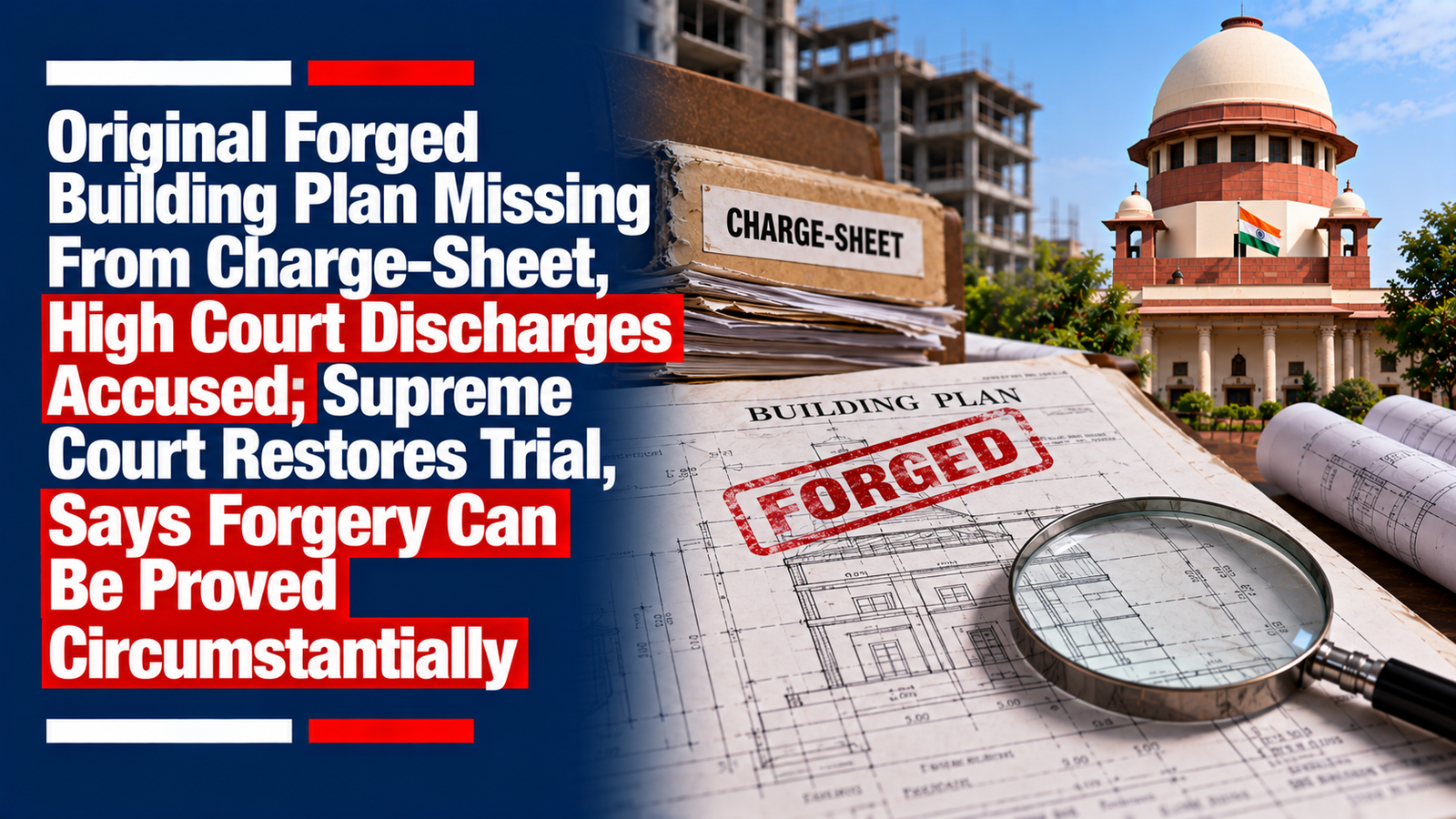
Photocopy of Allegedly Altered Building Plan Leads to Forgery Charges; Supreme Court Says Missing Original Is a Matter for Trial
Facts
The case arose between neighbours Antonetto J. D’Souza, the informant, and Aldila Braganza, the accused. The Supreme Court was considering the informant’s challenge to the accused’s discharge from offences under Sections 468, 471 and 420 IPC.
The accused and her father-in-law had undertaken construction pursuant to a municipal licence issued in 1971. The complainant alleged that their construction was illegal and that they had relied upon an interpolated and forged copy of the original approved building plan prepared by architect Agnelo Mascarenhas.
After a complaint before the Goa Coastal Zone Management Authority, the informant approached Calangute Police Station. FIR No. 152/2012 was registered on 18 July 2012 for offences under Sections 468, 471 and 420 read with Section 34 IPC.
After investigation, a final report was filed on 2 April 2016 alleging that the accused and her father-in-law had forged a copy of the original plan and presented it as genuine before the Goa Coastal Zone Management Authority.
The accused sought discharge principally because neither the original approved plan nor the allegedly forged plan had been recovered and produced.
The Magistrate rejected the contention and, on 21 December 2017, found sufficient prima facie material to frame charges. The Sessions Court subsequently upheld that order.
Issues
The Supreme Court considered three important questions:
- Whether an accused can be discharged from a forgery prosecution merely because the original allegedly forged document has not been recovered or filed with the charge-sheet.
- Whether the High Court, while examining an order framing charge, could undertake a detailed appreciation of evidence to determine whether the prosecution would ultimately secure conviction.
- Whether the accused could re-agitate the same missing-original-document contention in a second writ petition after an earlier Division Bench had already rejected that challenge.
Appellant’s Arguments
The informant argued that the High Court exceeded the permissible scope of its jurisdiction by effectively conducting a detailed examination of the prosecution evidence at the stage of framing charge.
Whether the plan was actually forged was a matter for trial.
The prosecution had collected statements, including that of the engineer who prepared the plan, and this material was sufficient at the preliminary stage to permit the trial to proceed.
It was also argued that the accused had previously challenged the FIR and charge-sheet on substantially the same ground, and that challenge had already failed.
Respondent’s Arguments
The accused, appearing in person, argued that the original plan had never been recovered, despite nearly fourteen years having elapsed since registration of the FIR.
According to her, without the original document there could be no proper comparison to establish that the document relied upon by her had actually been forged.
Requiring her to undergo a criminal trial despite the prosecution’s inability to produce the foundational document would therefore amount to an abuse of process.
Analysis of the Law
The Supreme Court rejected the proposition that non-production of the original document necessarily destroys a forgery prosecution.
The Court drew a distinction between:
the evidentiary burden required to ultimately convict an accused, and
the much lower threshold applicable when deciding whether charges should be framed and the matter should proceed to trial.
At the charge stage, the court is not supposed to conduct a mini-trial or determine whether the available evidence will inevitably result in conviction.
If the prosecution material raises the requisite grave suspicion, the trial should ordinarily proceed.
Precedent Analysis
Rama Shanker Lal v. State of U.P.
This was central to the Supreme Court’s reasoning.
In that case too, the document alleged to have been forged—the original sale deed—had not been produced.
The Supreme Court had nevertheless clarified that absence of the original document does not mean that forgery can never be proved. Where the original is unavailable, the prosecution may still establish the offence through other evidence, although such evidence must ultimately exclude reasonable doubt.
Applying that principle, the Court held that absence of the original plan was not, by itself, fatal to the prosecution. Other evidence could potentially establish forgery.
CBI v. R.S. Pai
The Court also reiterated that omission to file a relevant document along with the charge-sheet does not necessarily prevent its subsequent production.
There is no absolute statutory prohibition against the prosecution producing additional documents later with the court’s permission. Further investigation also remains permissible after filing of the charge-sheet.
K.H. Kamaladini v. State
At the stage of framing charge, the court cannot separate the “grain from the chaff” by conducting a detailed evaluation of the prosecution evidence.
Where the material creates grave suspicion against the accused, discharge is not warranted.
Piara Singh v. State of Punjab
The Court also discussed issue estoppel, explaining that an issue distinctly raised and determined in earlier proceedings cannot ordinarily be reopened between the same parties in subsequent proceedings.
The principle is concerned with preventing re-litigation of an issue of fact or law already judicially determined.
Court’s Reasoning
1. Missing Original Document Is Not Automatically Fatal
The Supreme Court held that the absence of the original allegedly forged plan “cannot sound the death knell of the prosecution case.”
The prosecution must be permitted to attempt to establish forgery through other evidence, including circumstantial evidence. Whether that evidence ultimately proves the offence beyond reasonable doubt is a question for trial.
2. High Court Went Too Far at the Charge Stage
The High Court had effectively assessed whether the available material was capable of ultimately proving the prosecution’s case.
The Supreme Court held that this was not the correct approach.
At the charge/discharge stage, the court asks whether sufficient material exists to proceed—not whether the prosecution has already established guilt beyond reasonable doubt.
3. Circumstantial Evidence Can Establish Forgery
The Court expressly held that the prosecution may attempt to establish forgery through circumstantial evidence even where the original document is unavailable.
The prosecution must, however, ultimately meet the criminal standard of proof at trial.
4. Same Ground Had Already Been Rejected
The accused had earlier filed Criminal Writ Petition No. 80 of 2023, specifically arguing that the original plan was absent and therefore the forgery charge could not survive.
A Division Bench rejected that contention on 31 October 2023, finding sufficient prima facie material for framing charges. That order was never challenged further and attained finality.
The Supreme Court held that the accused could not simply bring another writ petition and re-agitate substantially the same issue without challenging the earlier order.
5. Issue Estoppel Applied
The earlier Division Bench had considered the precise argument concerning absence of the original plan and declined to interfere.
The Supreme Court therefore held that issue estoppel provided an additional reason why the subsequent challenge could not be entertained on the same ground.
Conclusion
The Supreme Court set aside the Bombay High Court at Goa’s order discharging the accused.
It held that absence of the original allegedly forged document does not, by itself, justify quashing a forgery prosecution. The prosecution may attempt to prove the charge through circumstantial and other admissible evidence, and the sufficiency of that evidence must ultimately be tested at trial.
The Court restored Criminal Case No. 90/S/2016/F before the Magistrate and directed that the trial proceed in accordance with law. Since the complaint dates back to 2012, the proceedings were also expedited.
Importantly, the Supreme Court clarified that all contentions of both sides remain open and its observations should not prejudice the trial.
Case Details
Case: Antonetto J. D’Souza v. Aldila Braganza & Others
Court: Supreme Court of India
Case No.: Criminal Appeal No. 4092 of 2026
Citation: 2026 INSC 1032
Bench: Justice Ujjal Bhuyan & Justice Atul S. Chandurkar
Judgment by: Justice Atul S. Chandurkar
Date: 22 September 2026
Result: Appeal allowed; discharge set aside; criminal trial restored and expedited.