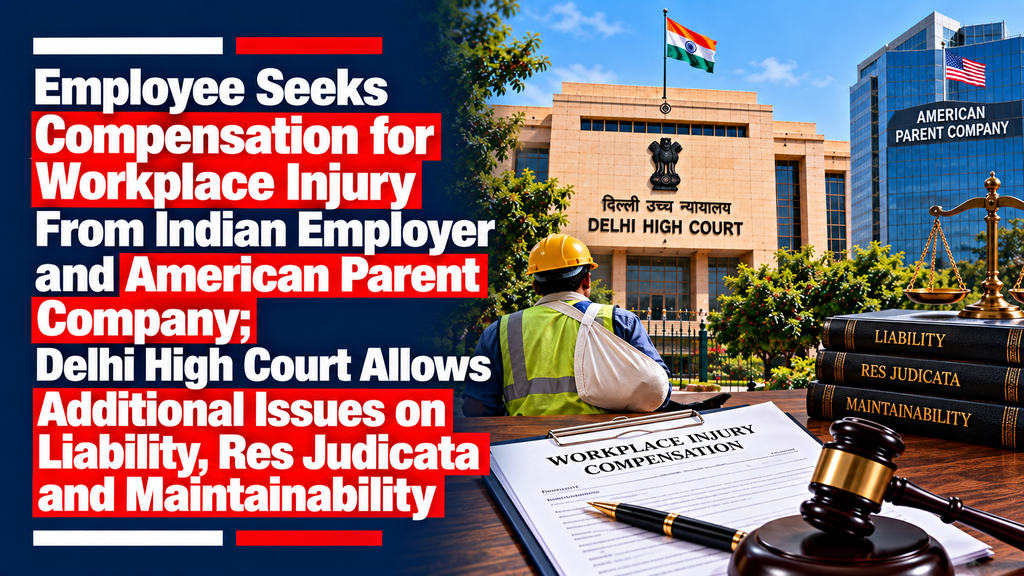
Employee Seeks Compensation for Workplace Injury From Indian Employer and American Parent Company; Delhi High Court Allows Additional Issues on Liability, Res Judicata and Maintainability

Can American Parent Company Be Liable for Injury Suffered by Indian Subsidiary’s Employee? Delhi High Court Says Question Requires Evidence and Trial
Facts
The suit was instituted by Malcolm John Campbell seeking compensation for injuries allegedly suffered during his employment with Robbins Tunnelling and Trenchless Technology (India) Pvt. Ltd., defendant no. 2. Defendant no. 1 was the American entity formerly known as The Robbins Co., subsequently described as Hall Street Company. MALCOLM MALCOLM
Initially, on 4 May 2018, the Delhi High Court held that the American company was not a necessary party and deleted it from the suit. Issues were thereafter framed, evidence was recorded and the matter reached the stage of final hearing. MALCOLM
Campbell later sought re-impleadment of the American company through its Receiver, who had been appointed by the Court of Common Pleas, Cuyahoga County, Ohio.
That request was again rejected on 13 August 2020 on the reasoning that the American and Indian companies were separate juristic entities and Campbell had been employed by the Indian company; therefore, his compensation claim would ordinarily lie against the Indian entity. MALCOLM
Division Bench Restored the American Parent Company
Campbell challenged those orders before the Division Bench of the Delhi High Court.
On 21 April 2022, the Division Bench relied upon Charan Lal Sahu v. Union of India and the English Court of Appeal decision in David Brian Chandler v. CAPE PLC.
It held that whether the American company could incur tortious liability was not a question that could be summarily determined merely by pointing to the separate corporate personality of the parent and subsidiary.
The issue required examination of the parties’ pleaded cases and the evidence. The Division Bench therefore restored The Robbins Co. as a defendant. MALCOLM
Importantly, re-impleadment did not mean that liability had been established.
The Division Bench specifically left both sides free to establish whether either or both corporate entities were liable and framed an additional issue:
“Whether The Robbins Co. is liable to pay any amount towards damages to the plaintiff?” MALCOLM
Supreme Court Proceedings
The American company challenged the Division Bench’s order before the Supreme Court.
On 4 December 2024, the Supreme Court declined to interfere with its re-impleadment but expressly granted the American company liberty to file an additional written statement.
Crucially, the Supreme Court allowed it to raise contentions including:
- that it was not a necessary or proper party;
- limitation; and
- other available defences.
The Supreme Court further directed the Trial Court to frame additional issues based upon that written statement and expressly clarified that whether the American company was a necessary or proper party remained open. MALCOLM
The present application under Order XIV Rule 5 CPC followed.
Additional Issues Sought by the American Company
Defendant no. 1 sought four additional issues.
First, whether it was a necessary or proper party and should remain in the suit.
Second, whether Campbell’s claim against it was maintainable in view of an order dated 7 October 2019 of the Ohio Court, which had appointed a Receiver and allegedly stayed creditors and claimants from commencing or continuing proceedings against the company.
Third, whether Campbell’s claim was barred by res judicata because his alleged claim had already been rejected and dismissed by the Ohio Court on 18 November 2020.
Fourth, if those objections failed, whether any claim could nevertheless continue against defendant no. 1 after the 1 February 2021 equity transfer, following which it claimed to have no interest, rights or liabilities in the Indian company. MALCOLM
Plaintiff’s Arguments
Campbell opposed the application.
His principal submission was that the additional issue already framed pursuant to the Division Bench’s 2022 judgment—whether The Robbins Co. was liable to pay damages—was broad enough to encompass the matters now sought to be separately framed.
Accordingly, separate additional issues were unnecessary. MALCOLM
Defendant No. 1’s Position
The American company relied upon the liberty expressly granted by the Supreme Court.
It maintained that its status as a necessary/proper party, the effect of the Ohio receivership proceedings, res judicata and the consequences of the subsequent equity transfer were distinct legal and factual defences that could not properly be subsumed within a generic issue concerning liability for damages.
Analysis of the Law
1. Supreme Court’s Direction Required a Separate Necessary-Party Issue
The Delhi High Court first addressed whether defendant no. 1 was a necessary or proper party.
This issue could not simply be treated as settled by its earlier re-impleadment.
The Supreme Court had expressly said that the question would “remain open.”
The High Court therefore held that the Supreme Court’s direction could only be meaningfully implemented by separately framing the proposed issue concerning whether defendant no. 1 was a necessary or proper party. MALCOLM
2. General Liability Issue Did Not Cover the Ohio Proceedings
The plaintiff’s central argument—that the existing issue concerning liability covered everything—was rejected.
The Court found that the existing issue did not adequately address the specific factual and legal consequences of the Ohio proceedings.
Whether an American receivership order prohibited continuation of claims against the company was conceptually different from the ultimate question of whether that company was tortiously liable for Campbell’s injuries.
Likewise, whether the Ohio proceedings had already adjudicated Campbell’s claim so as to attract res judicata required a distinct determination.
The Court therefore held that these additional issues were necessary for a just determination of the suit. MALCOLM
3. Effect of Equity Transfer Also Required Determination
The Court also permitted a separate issue concerning the 1 February 2021 equity transfer.
Defendant no. 1 maintained that after this transaction it held no interest, rights or liabilities in defendant no. 2.
The Court considered this issue consequential upon determination of the necessary-party, receivership and res judicata questions and therefore found it necessary to frame it separately. MALCOLM
4. Re-Impleadment Does Not Establish Parent Company Liability
An important feature of the proceedings is the distinction between being a party to the suit and ultimately being liable for damages.
The Division Bench had expressly clarified that restoring The Robbins Co. as a defendant did not amount to acceptance of Campbell’s claim against it.
Its tortious liability remained an evidentiary question requiring examination at trial. MALCOLM
The present order preserves that distinction.
The American company remains in the litigation, but it can still establish that:
- it is not a necessary/proper party;
- the claim cannot continue because of the Ohio receivership order;
- res judicata applies;
- the equity transfer defeats continuing liability; or
- it is not substantively liable for damages.
5. Parent and Subsidiary Being Separate Entities Is Not the End of the Inquiry
The litigation is significant because the original Single Judge orders had essentially proceeded on the proposition that the American parent and Indian subsidiary were separate juristic entities and that Campbell had no contractual relationship with the American company.
The Division Bench rejected treating that corporate distinction as conclusive at the threshold.
Relying upon Charan Lal Sahu and David Brian Chandler, it held that potential tortious liability of the parent company required consideration of the factual case and evidence, rather than automatic exclusion merely because the plaintiff was formally employed by the subsidiary. MALCOLM
The present order does not decide that liability; it structures the issues through which it will ultimately be adjudicated.
Issues Now Framed for Trial
The Delhi High Court ultimately consolidated the original and additional issues into 14 issues.
Among the principal substantive issues are:
- whether Campbell’s injury is attributable to the defendants;
- whether Campbell’s own negligence caused the injury;
- whether insurance coverage limits the defendants’ liability;
- whether Campbell suffered ₹6,18,83,976 in loss of earnings;
- whether he incurred ₹67,56,019 in care and nursing expenses;
- whether various expenses for aids, equipment, travel, clothing and treatment are recoverable;
- whether he is entitled to ₹95,42,400 for trauma, pain and suffering; and
- whether interest is payable. MALCOLM
The newly framed issues specifically require adjudication of whether defendant no. 1 is a necessary/proper party, the effect of the Ohio receivership order, res judicata, the effect of the 2021 equity transfer and, ultimately, whether The Robbins Co. is liable to Campbell and for what amount. MALCOLM
Precedent Analysis
Charan Lal Sahu v. Union of India, (1990) 1 SCC 613 — Relied upon by the Division Bench while reconsidering whether the American company could potentially face liability notwithstanding the separate corporate identity of its Indian subsidiary. MALCOLM
David Brian Chandler v. CAPE PLC, (2012) EWCA 525 — English authority relied upon by the Division Bench in holding that potential tortious liability of a parent company for injury connected with a subsidiary cannot necessarily be rejected merely because the entities possess separate legal personalities. MALCOLM
The present order itself does not finally apply either authority to impose liability. Their relevance remains to the underlying trial concerning whether the American company owed or breached any actionable duty toward Campbell.
Court’s Reasoning
The Court’s reasoning was narrow but consequential.
The Supreme Court had expressly authorised defendant no. 1 to raise further defences through an additional written statement and directed the Trial Court to frame corresponding additional issues.
The question of whether defendant no. 1 was a necessary/proper party had specifically been left open.
Further, the already-existing question—whether The Robbins Co. was liable to pay damages—was not sufficiently specific to adjudicate the independent defences arising from the Ohio receivership proceedings, alleged res judicata and the subsequent equity transfer.
Those matters therefore required independent issues so that evidence could be led and findings returned upon each of them.
The Court accordingly allowed the application under Order XIV Rule 5 CPC. MALCOLM
Conclusion
The Delhi High Court allowed I.A. No. 24353/2025 filed by defendant no. 1 for framing additional issues.
The suit will now proceed on the expanded set of 14 issues, including the American company’s status as a necessary/proper party, the legal effect of the Ohio receivership proceedings, res judicata, the 2021 equity transfer and its ultimate liability, if any, for Campbell’s damages. MALCOLM
The Court also gave Campbell the option either to rely upon his existing evidence affidavit or file a fresh evidence affidavit following the newly framed issues.
The matter was directed to be placed before the Joint Registrar for recording evidence on 1 October 2026. MALCOLM
Importantly, the Court has not yet held that the American parent company is liable for Campbell’s workplace injuries. The order only ensures that all relevant questions concerning its participation and potential liability will be adjudicated after evidence.
Case Details
Case: Malcolm John Campbell v. The Robbins Co. & Anr.
Court: Delhi High Court
Case No.: CS(OS) 152/2016 with I.A. 2452/2021; present application I.A. No. 24353/2025. MALCOLM
Judge: Justice Vinod Kumar
Reserved On: 21 September 2026
Pronounced On: 29 September 2026 MALCOLM
Application: Framing of additional issues under Order XIV Rule 5 CPC.
Result: Application allowed; additional issues framed; plaintiff permitted to rely upon existing evidence affidavit or file a fresh one; matter listed for recording of evidence on 1 October 2026.