Eviction Decision Relied on Preliminary Opinion That Property Was Not Enemy Property; Delhi High Court Orders Fresh Hearing After Final Government Order

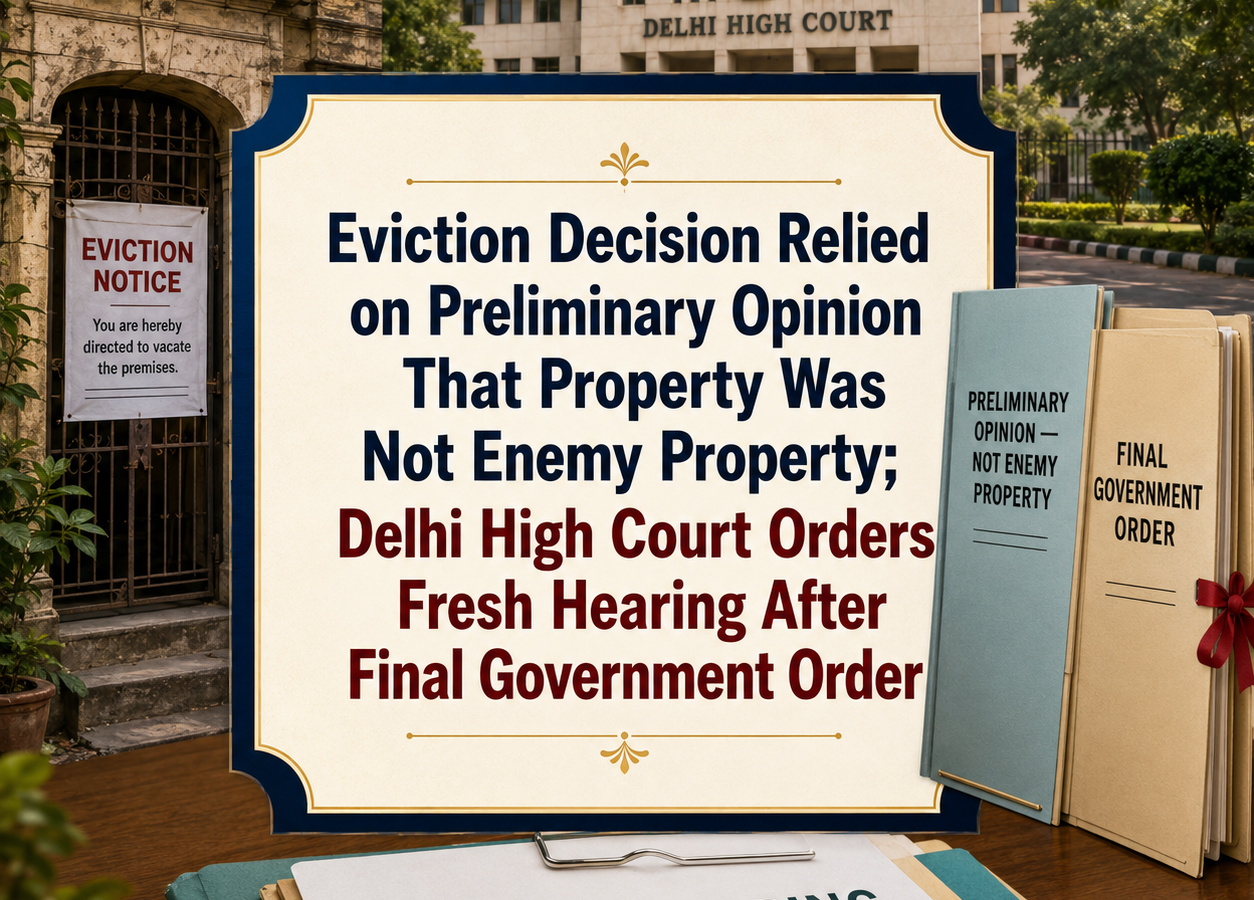
Rent Court Decided Eviction Using 2016 Enemy Property Opinion, but Final Order Came in 2024; Delhi High Court Directs Reconsideration
Facts
The dispute concerned a tenanted portion on the ground floor of Property No. 2012, Gali Haji Ismail, Mohalla Qabristan, Turkman Gate, Delhi.
The premises consisted of:
- One room measuring approximately 15 feet by 8 feet;
- A verandah measuring approximately 15 feet by 8 feet; and
- An open courtyard measuring approximately 15.3 feet by 16 feet.
Mohd Farid instituted an eviction petition against Mukhtar Ahmed and another occupant under Section 14(1)(e) of the Delhi Rent Control Act, 1958.
The dispute involved the question of whether the property belonged to Indian nationals or was liable to be classified as enemy property.
In 1969, the tenants’ predecessor allegedly informed the Custodian of Enemy Property that the property was owned by Hamid Hussain, Qadir Hussain and Rabia Begum, who were stated to be Pakistani nationals residing in Pakistan since 1947.
Rent was thereafter allegedly deposited with or collected by the Custodian of Enemy Property.
Mohd Farid submitted a representation dated 10 February 2016 to the Ministry of Home Affairs concerning the status of the property.
On 21 April 2016, the office of the Custodian of Enemy Property issued a communication expressing the view that the properties were not enemy properties and belonged to an Indian national.
On 14 March 2019, the Additional Rent Controller decided the eviction petition. While doing so, the Rent Controller placed considerable reliance upon the 2016 communication.
Mukhtar Ahmed and the other tenant challenged that judgment before the Delhi High Court under Section 25B of the Delhi Rent Control Act.
During the pendency of the revision petition, the Ministry of Home Affairs passed a final order dated 11 November 2024 on the representation concerning whether the premises could be classified as enemy property.
The 2024 order did not exist when the Rent Controller delivered the judgment in 2019.
The tenants argued that the 2016 communication was only a preliminary opinion and that the eviction judgment could not survive without consideration of the Ministry’s final order.
The 2024 order had itself been challenged in separate proceedings before the Delhi High Court.
Issues
- Whether the Rent Controller’s judgment could be sustained when it relied substantially upon a 2016 communication that was allegedly only a preliminary opinion.
- Whether the Ministry of Home Affairs’ final order dated 11 November 2024 constituted a material subsequent development.
- Whether a revisional court may consider developments arising after the original judgment.
- Whether the Delhi High Court should itself determine the legal effect of the 2024 order.
- Whether the matter should instead be remanded to the Rent Controller for fresh consideration.
- What was the proper scope of the High Court’s revisional jurisdiction under Section 25B(8) of the Delhi Rent Control Act.
Petitioner’s Arguments
The tenants argued that the 2019 judgment was founded upon the communication dated 21 April 2016 issued by the Custodian of Enemy Property.
That communication did not amount to a final adjudication of whether the premises were enemy property. It merely conveyed the authority’s opinion at an interlocutory stage.
The final determination was made only through the Ministry of Home Affairs’ order dated 11 November 2024.
Since the principal basis of the Rent Controller’s decision was a non-final opinion, the tenants argued that the judgment could not be sustained.
They submitted that the 2019 decision should be set aside and the dispute reconsidered after taking the final government order into account.
Respondent’s Arguments
Mohd Farid argued that the 2016 communication was sufficient for the Rent Controller to decide the eviction petition based on the material available at that time.
The final 2024 order had already been challenged by the tenants in separate proceedings before the Delhi High Court.
Therefore, the landlord contended that there was no need to interfere with the Rent Controller’s judgment in the present revision petition.
He sought maintenance of the existing judgment and opposed remand.
Analysis of the Law
Scope of Revision Under Section 25B(8)
The High Court’s jurisdiction under the proviso to Section 25B(8) of the Delhi Rent Control Act is supervisory and revisional.
It is narrower than appellate jurisdiction.
The High Court does not ordinarily:
- Reappreciate the entire evidence;
- Substitute its own factual findings;
- Conduct a roving inquiry; or
- Interfere merely because another view is possible.
Interference is generally confined to examining:
- Legality;
- Procedural compliance;
- Propriety of the decision-making process;
- Jurisdictional errors; and
- Errors apparent on the face of the record.
Effect of Subsequent Developments
Courts may take notice of facts or legal developments occurring after the original proceedings when they have a fundamental effect on the relief claimed.
Procedure exists to facilitate justice and should not compel courts to ignore updated realities that directly affect the controversy.
A subsequent event may be considered where:
- It is directly connected with the dispute;
- It materially affects the right to relief;
- It could not have been considered by the original court;
- Both parties receive a fair opportunity to address it; and
- Its consideration is necessary to avoid an ineffective or unjust result.
Need for Remand
The 2024 order was not merely an unrelated event. It was the final decision on the same representation that led to the 2016 communication relied upon by the Rent Controller.
Its legal and evidentiary effect required examination.
However, the High Court considered it inappropriate to undertake this factual and legal exercise for the first time in a limited revision petition.
The Rent Controller was the proper forum to examine:
- The contents of the 2024 order;
- Its effect on the parties’ claims;
- The pending challenge against it;
- Additional pleadings and documents; and
- The resulting impact on the eviction petition.
Precedent Analysis
Sarla Ahuja v. United India Insurance Co. Ltd.
The Supreme Court explained that revision under Section 25B(8) is narrower than a regular appeal.
The High Court must exercise restraint and should interfere only where the Rent Controller’s decision suffers from a material legal or jurisdictional defect.
Hindustan Petroleum Corporation Ltd. v. Dilbahar Singh
The Supreme Court reiterated that revisional jurisdiction does not permit a complete rehearing or reassessment of evidence as if the High Court were deciding a first appeal.
The High Court’s role is supervisory rather than substitutive.
Abid-Ul-Islam v. Inder Sain Dua
The Supreme Court held that the omission of an appellate remedy under Section 25B was deliberate.
The High Court’s revisional power is intended to supervise the decision-making process and ensure legality and procedural propriety. It cannot be converted into ordinary appellate jurisdiction.
Pankaj Pahwa v. Prem Wati
The Delhi High Court applied the restricted scope of revision under Section 25B and emphasised that the Court should not substitute its conclusions merely because another possible view exists.
Sanjeev Hiranandani v. Sunny Grover
This decision similarly reiterated the limited and supervisory character of the High Court’s rent-control revision jurisdiction.
Pasupuleti Venkateswarlu v. Motor & General Traders
The Supreme Court held that courts may—and in appropriate cases must—take cautious notice of subsequent events that fundamentally affect the right to relief.
Procedure is the handmaid of justice. Courts should not ignore updated facts that could make the original remedy ineffective or inconsistent with current realities.
The principle applies even at the appellate or revisional stage, provided fairness to both parties is maintained.
Court’s Reasoning
The Delhi High Court found that the Rent Controller had placed considerable reliance upon the Custodian’s 2016 communication while deciding the eviction petition.
The final Ministry of Home Affairs order was issued only in November 2024, more than five years after the Rent Controller’s judgment.
The Rent Controller therefore had no opportunity to examine its contents or legal consequences.
The Court held that the 2024 order was not an ordinary subsequent event. It directly concerned the same representation and the same enemy-property question forming the basis of the original judgment.
Whether the final order ultimately supported the landlord or the tenants was not decided by the High Court.
The Court also declined to determine the validity or correctness of the 2024 order because:
- It was under challenge in separate proceedings;
- Its effect had not been examined by the Rent Controller;
- The parties might need to file additional pleadings and documents; and
- Such an inquiry for the first time in revision would exceed the limited scope of Section 25B(8).
The interests of justice therefore required the 2019 judgment to be set aside and the matter remanded for fresh consideration.
Conclusion
The Delhi High Court set aside the Additional Rent Controller’s judgment dated 14 March 2019.
It remanded the eviction petition for fresh consideration in light of:
- The Ministry of Home Affairs’ final order dated 11 November 2024;
- Any additional pleadings or documents produced by the parties; and
- The legal and evidentiary effect of the subsequent development.
The Court did not decide:
- Whether the property was enemy property;
- Whether the 2024 order was valid;
- Whether the final order supported the landlord or tenants; or
- Whether the eviction petition should ultimately be allowed.
The parties were directed to appear before the Additional Rent Controller on 27 July 2026.
Case Details
Case: Mukhtar Ahmed & Another v. Mohd Farid
Court: High Court of Delhi at New Delhi
Case Number: Rent Control Revision No. 528 of 2019 with Civil Miscellaneous Application Nos. 40136 of 2019, 26316 of 2025 and 37644 of 2025
Judge: Justice Harish Vaidyanathan Shankar
Date: 17 July 2026
Result: Revision petition disposed of. The eviction judgment dated 14 March 2019 was set aside, and the matter was remanded to the Additional Rent Controller for fresh consideration of the Ministry of Home Affairs’ final 2024 order and any consequential material