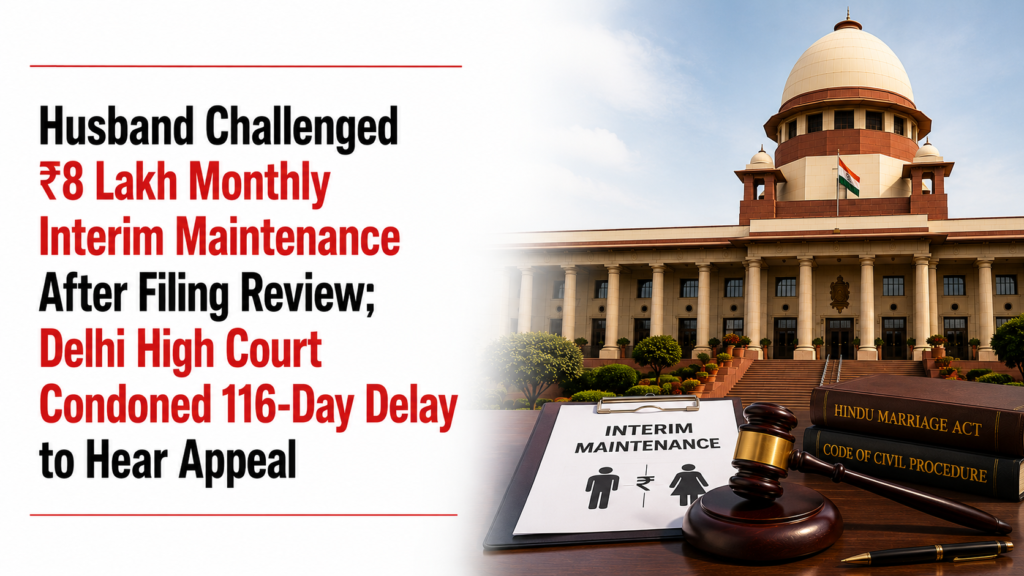
Husband Challenged ₹8 Lakh Monthly Interim Maintenance After Filing Review; Delhi High Court Condoned 116-Day Delay to Hear Appeal

Bona Fide Pursuit of Review Petition Can Justify Delay in Filing Appeal: Delhi High Court
Facts
The appellant-husband challenged two orders passed by the Family Court in matrimonial proceedings between the parties. By order dated 17 October 2025, the Family Court partly allowed the wife’s application under Section 24 of the Hindu Marriage Act, 1955, directing the husband to pay ₹8,00,000 per month as interim maintenance. Subsequently, on 19 February 2026, the Family Court dismissed the husband’s review petition under Order XLVII Rule 1 read with Section 114 of the Code of Civil Procedure, 1908, and imposed costs of ₹25,000.
The husband thereafter filed the present appeal challenging both orders along with an application under Section 5 of the Limitation Act, 1963, seeking condonation of a 116-day delay in filing the appeal.
The husband contended that the delay occurred because he had first pursued the statutory remedy of review before the Family Court in good faith. According to him, once the review petition was dismissed on merits, he immediately approached the High Court.
The wife opposed the application, arguing that filing a review petition could not extend limitation for filing an appeal and that the review itself had been filed belatedly merely to prolong the maintenance proceedings.
Issues
- Whether the appellant had established “sufficient cause” under Section 5 of the Limitation Act for condonation of the 116-day delay.
- Whether bona fide prosecution of a review petition could constitute a relevant circumstance while considering delay condonation.
- Whether the alleged delay in filing the review petition disentitled the appellant from seeking condonation of delay in the subsequent appeal.
Appellant’s Arguments
The husband submitted that the delay related only to the challenge against the original order dated 17 October 2025 because he had first invoked the review jurisdiction of the Family Court.
He argued that the review petition had been pursued bona fide, believing that the Family Court itself would reconsider its order. Immediately after dismissal of the review petition on 19 February 2026, he filed the present appeal within the prescribed limitation period.
Reliance was placed upon State of Manipur v. All Manipur Regular Post Vacancies S.T.A. and Shivom Minerals Ltd. v. Bajrang Metalics Ltd., contending that bona fide pursuit of an available legal remedy constituted sufficient cause for condonation of delay.
Respondent’s Arguments
The wife argued that limitation for filing an appeal could not be enlarged merely because the husband chose to file a review petition.
According to her, instead of pursuing an appeal within limitation, the husband deliberately adopted the review route only to delay payment of interim maintenance.
It was further submitted that the review petition itself had been filed belatedly before the Family Court, and therefore the husband could not rely upon those proceedings to seek equitable relief under Section 5 of the Limitation Act.
Analysis of the Law
The Court reiterated that the expression “sufficient cause” under Section 5 of the Limitation Act is elastic and must receive a liberal, pragmatic and justice-oriented interpretation. However, delay cannot be condoned mechanically; the explanation must be bona fide and free from negligence or deliberate inaction.
The Court held that although filing a review petition does not automatically suspend or extend the period of limitation for filing an appeal, bona fide prosecution of such a remedy remains a relevant consideration while deciding an application for condonation of delay.
A significant circumstance in the present case was that the Family Court entertained the review petition and decided it on merits. It neither dismissed the review as barred by limitation nor rejected it as not maintainable. Consequently, the appellant could not subsequently be faulted for having pursued a statutory remedy which the Family Court itself considered on merits.
The Court also rejected the respondent’s contention regarding delay in filing the review petition. Since the Family Court had chosen to adjudicate the review on merits rather than reject it on limitation, the appellant’s pursuit of that remedy could not be treated as lacking bona fides while considering the subsequent application under Section 5.
The Court found no material suggesting that the appellant had deliberately delayed the appeal or acted with any ulterior motive. It further observed that the respondent failed to demonstrate any irreversible prejudice that would result if the delay were condoned.
Precedent Analysis
B. Madhuri Goud v. B. Damodar Reddy (2012) 12 SCC 693
The Supreme Court held that “sufficient cause” under Section 5 of the Limitation Act should receive a liberal interpretation to advance substantial justice and prevent genuine claims from being defeated on technical grounds. The High Court relied upon this principle while adopting a justice-oriented approach toward condonation of delay.
Inder Singh v. State of Madhya Pradesh (2025 SCC OnLine SC 600)
The Supreme Court condoned delay in filing a second appeal despite the earlier review petition having itself been dismissed on limitation. The High Court observed that the present case stood on an even stronger footing because the Family Court had actually entertained and decided the review petition on merits.
State of Manipur v. All Manipur Regular Post Vacancies S.T.A. (1997) 10 SCC 385
The appellant relied upon this decision to contend that bona fide pursuit of an available statutory remedy is a relevant circumstance while considering delay condonation.
Shivom Minerals Ltd. v. Bajrang Metalics Ltd. (2023 SCC OnLine Ori 7108)
This decision was relied upon by the appellant in support of the proposition that a litigant who diligently pursues an available legal remedy should not ordinarily be denied adjudication on merits merely because of delay.
Court’s Reasoning
The Court held that the appellant had genuinely pursued the review remedy before the Family Court. Importantly, the review petition was neither rejected at the threshold nor dismissed as not maintainable. Instead, it was fully heard and decided on merits.
The Court observed that mere dismissal of the review petition did not retrospectively render the decision to pursue that remedy mala fide or frivolous.
Although the Court reiterated that filing a review does not automatically extend limitation for filing an appeal, it emphasised that such bona fide litigation is a relevant factor while exercising discretion under Section 5 of the Limitation Act.
The Court also noted the absence of any evidence showing deliberate delay, negligence or abuse of process. Since denying condonation would elevate procedural technicalities over substantial justice, the explanation furnished by the appellant was accepted as constituting sufficient cause.
Accordingly, the Court condoned the 116-day delay and directed that the appeal be listed for hearing on merits.
Conclusion
The Delhi High Court allowed the application under Section 5 of the Limitation Act and condoned the 116-day delay in filing the appeal. It held that the appellant had bona fide pursued the statutory remedy of review before the Family Court and had promptly approached the High Court after the review was dismissed. Consequently, the appeal challenging the interim maintenance order and dismissal of the review petition was directed to proceed on merits.
Case Details
Case: Ishaan Bhatia v. Gehana Bhatia
Court: High Court of Delhi
Case No.: MAT.APP. (F.C.) 102/2026
Bench: Justice Vivek Chaudhary and Justice Renu Bhatnagar
Reserved On: 10 July 2026
Pronounced On: 24 July 2026
Relevant Provisions: Section 5, Limitation Act, 1963; Section 24, Hindu Marriage Act, 1955; Order XLVII Rule 1 read with Section 114, Code of Civil Procedure, 1908
Result: Delay of 116 days condoned; appeal directed to proceed on merits.