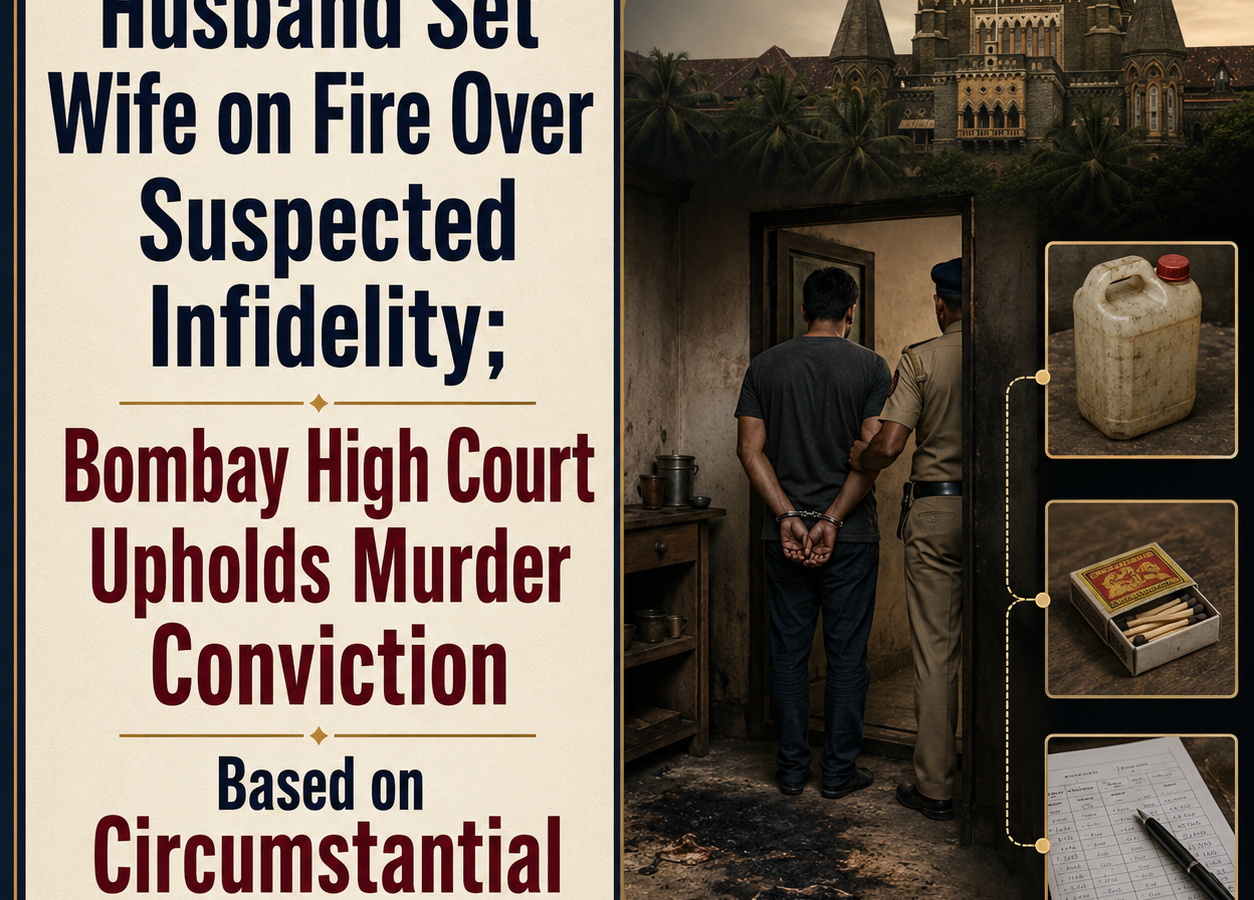
Husband Set Wife on Fire Over Suspected Infidelity; Bombay High Court Upholds Murder Conviction Based on Circumstantial Evidence

No Eyewitness to Wife’s Burning Death, but Complete Chain of Evidence Proved Husband’s Guilt: Bombay High Court
Facts
Samsher Abulesh Devang worked as a watchman at a construction site in Nashik. He resided with his wife, Ayesha Khatun Samsher Shah, in a tin shed erected at the site.
According to the prosecution, the couple had a strained marital relationship. Samsher allegedly consumed alcohol, suspected his wife’s fidelity and frequently quarrelled with and assaulted her.
During the night of 12 June 2018, Ayesha suffered 100% burn injuries inside the tin shed and died.
After receiving information about a fire, police officers reached the scene and found Ayesha’s charred body inside the room. The fire was extinguished with the help of police personnel and nearby residents.
Samsher was not present when the police initially arrived. According to the prosecution witnesses, he returned approximately half an hour later with burn injuries on his palms, face, eyebrow, abdomen and other parts of his body.
When questioned about the incident, he allegedly gave evasive answers. He was taken to the hospital and treated for approximately 40% burn injuries.
A water-filled drum and borewell were situated close to the tin shed. However, the available water had not been used to extinguish the fire or save Ayesha.
The investigating agency recovered, among other articles, a plastic can, matchbox and stove from the scene. The post-mortem examination established that Ayesha died from shock caused by ante-mortem burn injuries that were sufficient in the ordinary course to cause death.
Samsher claimed that the fire originated from the stove while Ayesha was cooking. He stated that he entered the room to save her, sustained burns, went outside to seek help, became unconscious and was later taken to the hospital.
The Sessions Court at Nashik rejected his defence. By its judgment dated 20 March 2021, it convicted him of murder under Section 302 of the Indian Penal Code and sentenced him to life imprisonment with a fine of ₹1,000.
Samsher challenged his conviction before the Bombay High Court.
Issues
- Whether Samsher’s conviction for murder could be sustained when the prosecution’s case was based principally on circumstantial evidence.
- Whether the prosecution established a complete and unbroken chain of circumstances pointing exclusively to the appellant’s guilt.
- Whether the prosecution proved a motive arising from Samsher’s suspicion concerning his wife’s fidelity and their history of quarrels and abuse.
- Whether Samsher’s failure to explain how his wife suffered fatal burns inside their shared home attracted Section 106 of the Indian Evidence Act, 1872.
- Whether his claim that the fire originated from a stove was credible.
- Whether his conduct after the incident, burn injuries, evasive answers and contradictory statements could be considered incriminating circumstances.
- Whether the alleged extra-judicial confession was voluntary, reliable and sufficiently corroborated to form an additional link in the prosecution’s case.
Petitioner’s Arguments
Samsher argued that the prosecution evidence was weak, inconsistent and insufficient to prove murder beyond reasonable doubt.
The entire case rested upon circumstantial evidence, and there was no eyewitness who saw him pour kerosene on Ayesha or set her on fire.
He contended that the prosecution failed to establish:
- His presence at the time of the alleged offence;
- A reliable motive;
- A complete chain of circumstances;
- That he fled the scene; and
- That the fire was intentionally caused.
He questioned the reliability of the prosecution witnesses and pointed to alleged inconsistencies concerning his presence during the spot panchanama and the timing of his hospital admission.
He maintained that he had sustained burn injuries while attempting to save his wife and had gone outside to seek help.
According to him, he sufficiently explained the incident. Therefore, the prosecution could not invoke Section 106 of the Evidence Act or draw an adverse inference against him.
He also argued that the investigation was defective and that the prosecution’s theory concerning his suspicion of Ayesha’s character had not been independently established.
On these grounds, he sought acquittal and setting aside of the life sentence.
Respondent’s Arguments
The State argued that the prosecution had established a complete chain of circumstances proving that Samsher murdered his wife by pouring kerosene over her and setting her on fire.
Ayesha suffered 100% burns inside the tin shed where she and the appellant lived together. The incident took place in the privacy of their shared dwelling, and Samsher was required to explain how she sustained the fatal injuries.
Instead of saving his wife or raising an alarm, Samsher allegedly left the scene and returned approximately half an hour later.
Despite the presence of a water-filled drum and borewell nearby, he made no attempt to use the water to extinguish the fire.
The State relied upon:
- The couple’s strained relationship;
- Samsher’s suspicion concerning Ayesha’s fidelity;
- His alleged history of physical abuse;
- His absence when the police arrived;
- His burn injuries;
- His evasive answers;
- The kerosene can and matchbox recovered from the scene;
- His contradictory explanations;
- The undamaged condition of the stove;
- Medical evidence; and
- His alleged extra-judicial confession.
The prosecution argued that Section 106 placed a corresponding burden upon Samsher to explain facts that were especially within his knowledge.
Minor discrepancies in witness testimony did not affect the central prosecution case.
Analysis of the Law
Conviction Based on Circumstantial Evidence
A conviction can be based entirely upon circumstantial evidence if every circumstance is firmly established.
The circumstances must:
- Be consistent only with the accused’s guilt;
- Be incompatible with innocence;
- Exclude every reasonable alternative explanation; and
- Form a complete and unbroken chain pointing to the accused.
Minor inconsistencies that do not affect the core prosecution case are not sufficient to destroy an otherwise complete chain.
Section 106 of the Indian Evidence Act
Section 106 provides that when a fact is especially within a person’s knowledge, the burden of proving that fact lies upon that person.
This provision does not relieve the prosecution of its initial burden to establish the foundational circumstances of the offence.
However, where a murder takes place secretly inside a home occupied only by the accused and the deceased, the accused must offer a cogent explanation about how the death occurred.
Failure to provide a credible explanation can become an additional link in an already established chain of circumstantial evidence.
Section 106 cannot independently prove guilt, but it can strengthen a prosecution case supported by other reliable circumstances.
Statement Under Section 313 of the Code of Criminal Procedure
The examination of an accused under Section 313 gives the accused an opportunity to personally explain incriminating circumstances appearing in the evidence.
A conviction cannot be based solely upon a Section 313 statement.
However, false, inconsistent or contradictory answers may be considered as an additional circumstance where the prosecution has otherwise established the relevant foundational facts.
Extra-Judicial Confession
An extra-judicial confession is generally treated as a weak form of evidence and must be assessed with considerable caution.
It may be relied upon where it:
- Was made voluntarily;
- Is truthful;
- Inspires confidence;
- Does not suffer from material discrepancies;
- Is proved in accordance with law; and
- Is corroborated by other reliable evidence.
A properly established extra-judicial confession, supported by a complete chain of circumstances, may form an additional basis for conviction.
Effect of Absence of Strong Motive
Proof of motive assumes importance in a case based on circumstantial evidence.
However, failure to prove a strong motive is not necessarily fatal when the remaining circumstances form a complete chain that points exclusively to the accused.
Precedent Analysis
Premchand v. State of Maharashtra
The Supreme Court explained the purpose of examining an accused under Section 313 of the Code of Criminal Procedure.
The provision is a valuable safeguard intended to establish direct dialogue between the court and the accused. Every incriminating circumstance must be put to the accused fairly and specifically.
While an accused’s statement cannot be the sole basis for conviction, false or inconsistent answers can provide an additional link where the prosecution has otherwise proved its case.
Nandu Singh v. State of Madhya Pradesh
The Supreme Court set aside a conviction where the prosecution failed to establish a complete chain of circumstances and motive was also not proved.
The Bombay High Court distinguished that case. It held that, in Samsher’s case, the cumulative circumstances formed a complete chain pointing exclusively towards him. Therefore, even the absence of a particularly strong motive would not weaken the prosecution case.
Trimukh Maroti Kirkan v. State of Maharashtra
The Supreme Court held that where murder is committed secretly inside a house, the prosecution’s initial burden remains, but the nature of evidence required may be comparatively lighter.
Once foundational circumstances are established, the inmates of the house must offer a cogent explanation of how the offence occurred.
The Bombay High Court applied this principle because Samsher and Ayesha lived together in the tin shed, and he failed to provide a credible explanation for her fatal burns.
Sahadevan v. State of Tamil Nadu
The Supreme Court identified the conditions under which an extra-judicial confession may be relied upon.
It must be voluntary, truthful, confidence-inspiring and corroborated by other cogent circumstances.
The Bombay High Court held that the alleged confession in the present case was supported by medical and circumstantial evidence and constituted an additional link against Samsher.
Court’s Reasoning
The Bombay High Court held that the prosecution successfully established a complete chain of circumstances proving Samsher’s guilt.
The following circumstances were found significant:
- Samsher and Ayesha were husband and wife and lived together in the tin shed where the incident occurred.
- The evidence indicated a strained relationship involving frequent quarrels, physical abuse and suspicion regarding Ayesha’s fidelity.
- Ayesha suffered 100% fatal burn injuries inside their shared dwelling.
- Samsher was absent when the police arrived and returned approximately half an hour later with burn injuries.
- He gave evasive answers when questioned about the incident.
- A water-filled drum and borewell were located nearby, but he did not use them to extinguish the fire or save his wife.
- His claim that the fire originated from a stove was contradicted by photographs showing that the stove was not damaged.
- The plastic can and matchbox recovered from the scene supported the prosecution’s kerosene-burning theory.
- The medical evidence established that his burn injuries could have been caused if a burning person embraced him.
- His explanations under Section 313 and in his written statement contained contradictions and were found false.
- He failed to explain how Ayesha sustained fatal burns inside their shared dwelling.
- His alleged extra-judicial confession was corroborated by the surrounding circumstances.
The Court rejected the defence that Samsher was burned while trying to rescue Ayesha. His failure to raise an alarm, seek immediate assistance or use the readily available water was inconsistent with that claim.
Since the death occurred inside the couple’s dwelling and the relevant facts were especially within Samsher’s knowledge, his failure to offer a credible explanation attracted Section 106 of the Evidence Act.
The Court clarified that Section 106 was not used as a substitute for proof by the prosecution. It operated as an additional link after the prosecution had established the foundational circumstances.
The cumulative evidence excluded any reasonable possibility that the death was accidental or caused by another person.
Conclusion
The Bombay High Court dismissed Samsher Abulesh Devang’s criminal appeal.
It held that the circumstantial evidence formed a complete and unbroken chain pointing exclusively towards Samsher as the person who murdered his wife by pouring kerosene on her and setting her on fire.
His stove-fire explanation was contradicted by the physical evidence, and his failure to explain the fatal incident inside the shared dwelling became an additional circumstance under Section 106 of the Evidence Act.
The Court confirmed:
- His conviction for murder under Section 302 of the Indian Penal Code;
- His sentence of life imprisonment;
- The fine of ₹1,000; and
- The default sentence of three months’ rigorous imprisonment.
The connected interim application was also disposed of.
Case Details
Case: Samsher Abulesh Devang v. State of Maharashtra
Court: High Court of Judicature at Bombay, Criminal Appellate Jurisdiction
Case Number: Criminal Appeal No. 97 of 2022; CNR No. HCBM010044802022
Judge: Justice G.S. Kulkarni and Justice Aarti Sathe
Reserved On: 21 April 2026
Date: 15 July 2026
Result: Criminal appeal dismissed. The conviction under Section 302 of the Indian Penal Code and sentence of life imprisonment imposed by the Sessions Court, Nashik, were confirmed.