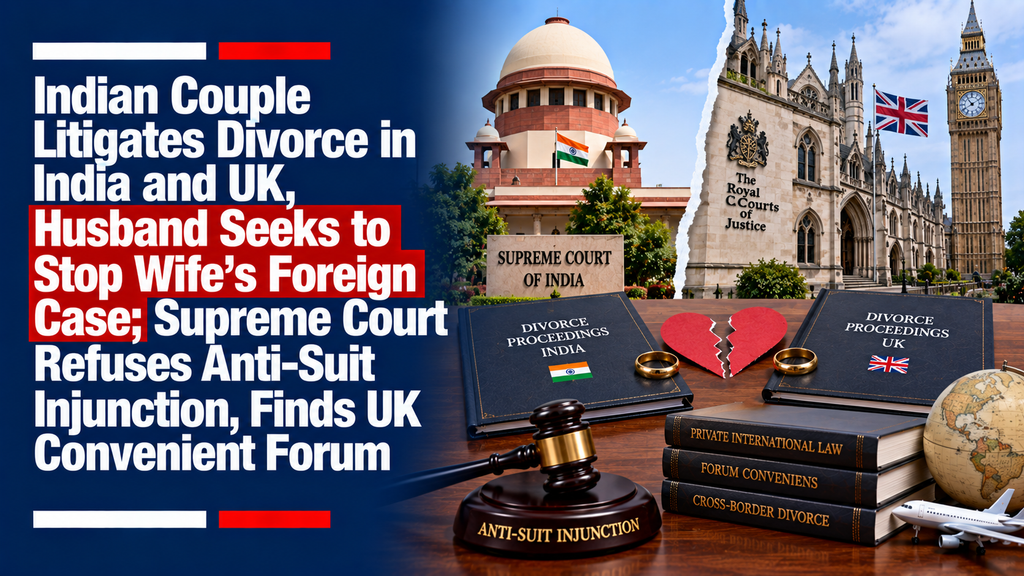
Indian Couple Litigates Divorce in India and UK, Husband Seeks to Stop Wife’s Foreign Case; Supreme Court Refuses Anti-Suit Injunction, Finds UK Convenient Forum

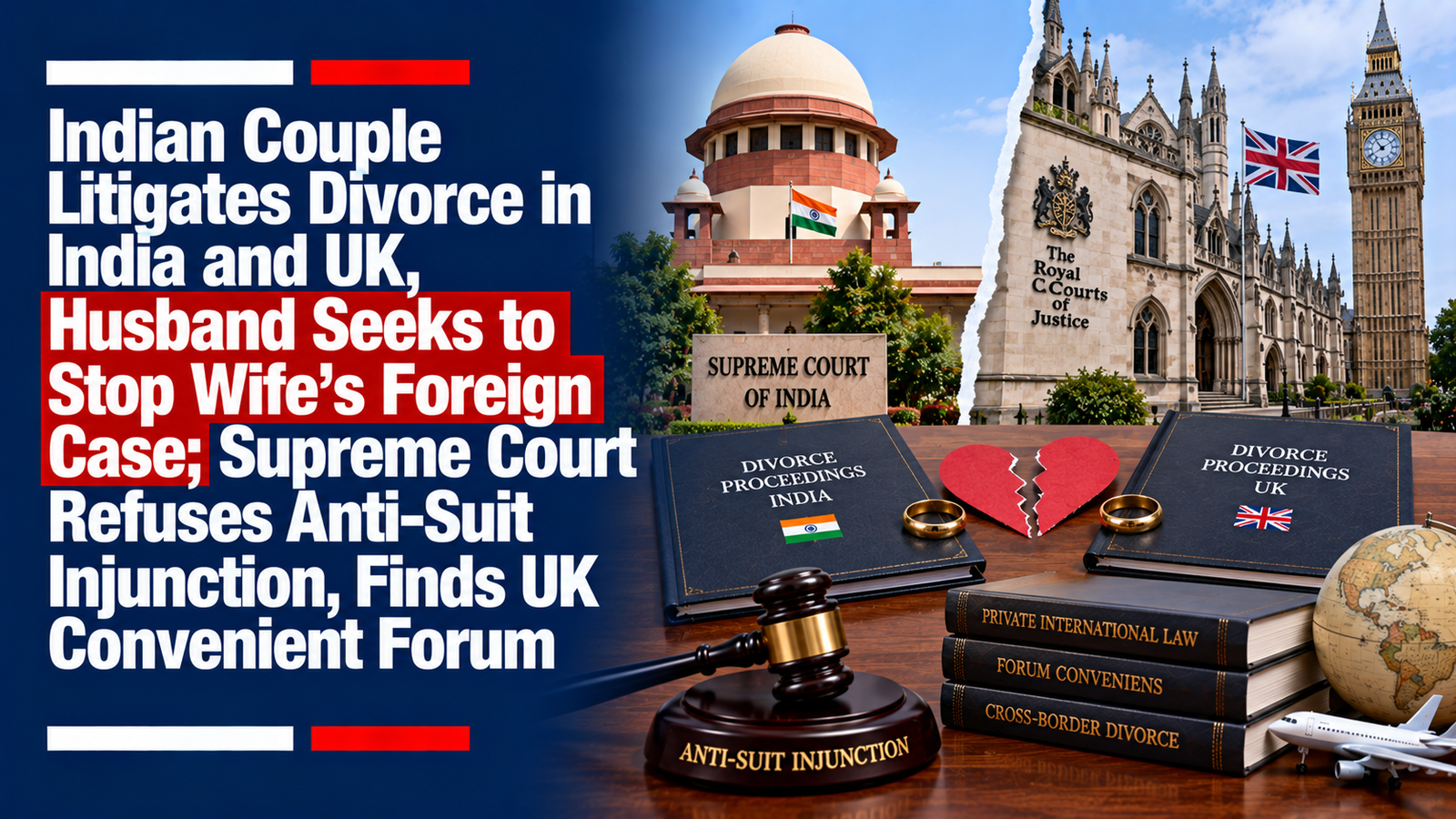
Foreign Divorce May Not Ultimately Be Recognised in India, Husband Argues; Supreme Court Says Future Non-Recognition Cannot Prematurely Stop UK Proceedings
Facts
The appeal was filed by Mihir Prakash Bajoria against his wife Vidushi Jain Bajoria, challenging a Calcutta High Court judgment dated 15 December 2025. The High Court had set aside an interim anti-suit injunction granted by the Alipore Civil Court restraining the wife from pursuing matrimonial proceedings in the United Kingdom.
The parties’ relationship had substantial connections with London. The wife moved to the UK for higher studies around 2014–15, where she cohabited with the husband. They married in Kolkata on 15 December 2018 according to Hindu customs and lived together in London between 2018 and 2020.
After further periods in India and the UK, their relationship deteriorated. On 4 September 2024, the husband instituted divorce proceedings before the Alipore court under Section 13 of the Hindu Marriage Act, 1955, alleging that the marriage had irretrievably broken down.
On 10 October 2024, the wife instituted divorce proceedings before the UK Family Court, also relying on irretrievable breakdown of marriage. She simultaneously initiated proceedings seeking interim maintenance and related financial relief.
The UK Family Court subsequently ordered interim maintenance and costs and began considering its jurisdiction as a preliminary issue.
The husband then instituted a civil suit at Alipore seeking a declaration that the UK proceedings were vexatious and without jurisdiction. He also claimed ₹2.40 crore with 18% interest, including ₹85 lakh towards legal expenses allegedly incurred in defending the UK litigation.
On 1 November 2025, the Alipore Trial Court granted an ex parte anti-suit injunction, restraining the wife from continuing her UK divorce and financial proceedings. The Calcutta High Court subsequently vacated that injunction.
The husband approached the Supreme Court.
Issues
The principal questions were whether an Indian court should restrain the wife from prosecuting matrimonial proceedings before the UK Family Court; whether a foreign divorce proceeding based on irretrievable breakdown of marriage, a ground not available in the ordinary statutory scheme under the Hindu Marriage Act, justified an anti-suit injunction; whether possible future non-recognition of a UK divorce decree under Section 13 CPC could justify stopping the proceedings at the threshold; and whether India or the UK was the more appropriate and convenient forum for the matrimonial dispute.
Appellant-Husband’s Arguments
The husband argued that the UK proceedings were oppressive and created parallel and potentially inconsistent adjudicatory processes.
He emphasised that both parties were Indian citizens and had married according to Hindu law. According to him, the wife’s foreign divorce proceedings rested upon a ground not recognised under the Hindu Marriage Act and any resulting foreign decree would therefore face difficulties under Section 13 CPC.
He relied upon Y. Narasimha Rao v. Y. Venkata Lakshmi and Kishorekumar Mohan Kale v. Kashmira Kale, arguing that the grounds on which a foreign matrimonial decree is granted must conform to the matrimonial law governing the parties.
He further stressed that his Indian divorce proceeding was instituted earlier and alleged that the subsequent UK proceedings subjected him to oppressive parallel litigation.
Respondent-Wife’s Arguments
The wife argued that the question whether a future UK decree would ultimately be recognised in India was premature.
Recognition of a foreign decree under Section 13 CPC depends upon factors such as jurisdiction, natural justice and the circumstances in which the foreign judgment is eventually rendered. It could not be determined merely by looking at the nomenclature of the ground for divorce before the foreign court.
She further argued that the parties had established their matrimonial home in the UK and that the English court was therefore an appropriate forum.
According to her, the husband himself had lived in the UK since he was approximately 14–15 years old, and there were substantial factual connections between the marriage and England.
Analysis of the Law
The Supreme Court explained that an anti-suit injunction does not technically stay a foreign court’s proceedings. An Indian court has no appellate or supervisory authority over a foreign sovereign court.
Instead, the injunction operates in personam: it restrains a party who is subject to the Indian court’s jurisdiction from instituting or continuing proceedings abroad.
Relying on Modi Entertainment Network v. W.S.G. Cricket, the Court reiterated three important considerations:
- the person sought to be restrained must be amenable to the Indian court’s jurisdiction;
- refusal of the injunction must result in injustice or defeat the ends of justice; and
- the court must respect comity of courts.
Where multiple forums are available, considerations such as whether foreign proceedings are oppressive, vexatious or instituted in a forum non conveniens become relevant.
However, the Court emphasised that anti-suit injunctions are not routine remedies.
The two particularly important considerations are the oppressive or vexatious character of the foreign proceeding and the likelihood of irreparable harm.
Precedent Analysis
Modi Entertainment Network
The Supreme Court reiterated the established principles governing anti-suit injunctions, including personal jurisdiction, ends of justice, forum convenience and international judicial comity.
Dinesh Singh Thakur v. Sonal Thakur
The Court considered this precedent particularly comparable.
There too, the parties had married under Hindu rites, the husband instituted proceedings under the Hindu Marriage Act in India, and the wife pursued divorce proceedings abroad based on irretrievable breakdown.
The Supreme Court had declined to restrain the foreign proceedings merely because the ground invoked abroad was unavailable under the Hindu Marriage Act.
Importantly, a foreign court cannot simply be presumed to be exercising jurisdiction wrongly merely because the parties may continue to be governed by Hindu matrimonial law in India.
Arif Azim Company Ltd. v. Micromax Informatics FZE
The Court reiterated that forum non conveniens permits a court otherwise possessing jurisdiction to decline to exercise it when another available forum is more appropriate and fair in the circumstances of a cross-border dispute.
Court’s Reasoning
1. Future Non-Recognition of UK Divorce Was Speculative
The husband’s central argument was that irretrievable breakdown was not a recognised statutory ground under the Hindu Marriage Act and therefore a future UK divorce decree might not be enforceable in India.
The Supreme Court held that this was a premature and speculative basis for an anti-suit injunction.
The UK proceedings were still pending; jurisdictional questions remained open; and the wife still had to establish her case through evidence.
An Indian court could not proceed on the assumption that the UK court would ultimately grant divorce and then use the possible future enforceability problem to stop the proceedings beforehand.
2. UK Had Substantial Connection With the Marriage
The Supreme Court agreed with the High Court that, on the facts before it, the UK was the forum conveniens.
The husband had resided in the UK for several years from approximately age 14–15. The wife had also resided there and was treated as habitually resident there.
Although the marriage ceremony took place in Kolkata, the couple had spent much of their pre- and post-marriage life in London.
The Court identified substantial connecting factors with England:
their prolonged matrimonial life, their matrimonial home, London as their habitual centre of interests, and their financial arrangements in the UK.
3. Foreign Proceedings Should Not Be Stopped While Still Inchoate
Another important consideration was that the UK proceedings had not reached final adjudication when the Alipore Trial Court granted the injunction.
The Supreme Court held that ordinarily there would be no legitimate basis to restrain foreign proceedings that remained “at an inchoate stage” and had not culminated in a final decision.
The Alipore court therefore committed a “patent error” by issuing the anti-suit injunction at that stage.
4. Anti-Suit Injunctions Must Be Exceptional
The Court strongly cautioned that anti-suit injunctions cannot become a routine response whenever parallel foreign proceedings exist.
Frequent or unmindful use of such orders can undermine comity of courts, intrude into another sovereign jurisdiction and actually create the jurisdictional conflict and multiplicity of proceedings that the injunction supposedly seeks to prevent.
5. Subsequent UK Conditional Divorce Order
During the Supreme Court proceedings, an English District Judge passed a conditional divorce decree on 17 June 2026.
The Supreme Court had on 30 July 2026 temporarily restrained the wife from proceeding pursuant to that conditional order.
However, the Court expressly clarified that the present appeal concerned only the legality of the original anti-suit injunction dated 1 November 2025.
It therefore expressed no opinion on the subsequent UK conditional divorce order. Either party remained free to challenge any further or final UK order before the competent forum in accordance with law.
Conclusion
The Supreme Court upheld the Calcutta High Court’s decision vacating the anti-suit injunction.
It held that the Alipore Trial Court should not have restrained the wife from pursuing the UK matrimonial proceedings merely because she sought divorce on irretrievable breakdown or because a future foreign decree might potentially face objections to recognition in India.
The Court found substantial connecting factors with the UK and agreed that, on the facts, the UK was the convenient forum.
The husband’s appeal was therefore dismissed.
Case Details
Case: Mihir Prakash Bajoria v. Vidushi Jain Bajoria
Court: Supreme Court of India
Citation: 2026 INSC 1034
Case: Civil Appeal arising out of SLP(C) No. 15849 of 2026
Bench: Justice S.V.N. Bhatti & Justice N.V. Anjaria
Judgment by: Justice N.V. Anjaria
Date: 22 September 2026
Result: Appeal dismissed; Calcutta High Court judgment vacating the anti-suit injunction upheld.