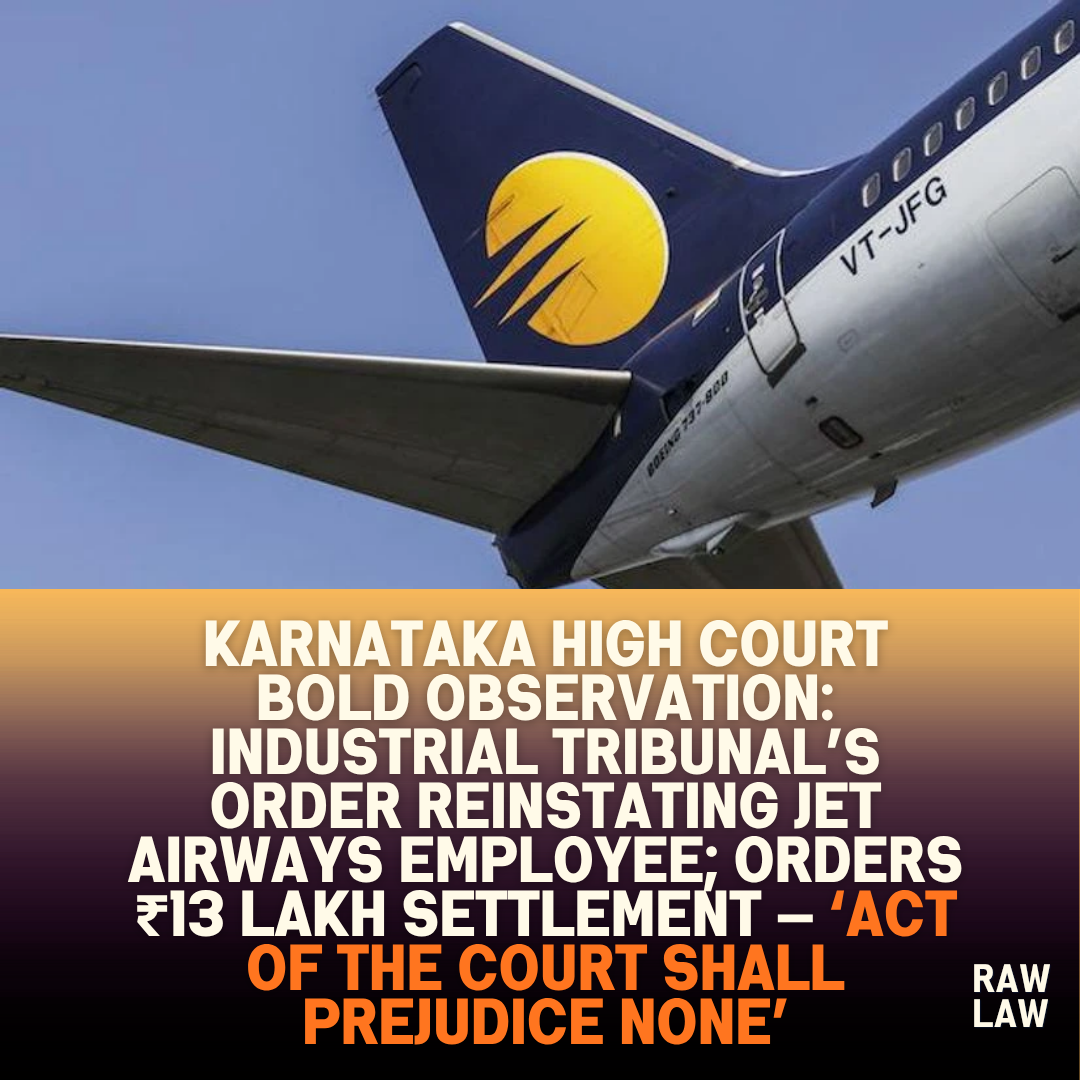
Karnataka High Court bold observation: Industrial Tribunal’s Order Reinstating Jet Airways Employee; Orders ₹13 Lakh Settlement — ‘Act of the Court Shall Prejudice None’

Court’s Decision
The Karnataka High Court (Bengaluru Bench), comprising Justice D.K. Singh and Justice Venkatesh Naik T, dismissed a writ petition filed by Jet Airways (India) Pvt. Ltd. (in liquidation) challenging an Industrial Tribunal award that had directed reinstatement of a dismissed employee with 50% back wages and continuity of service.
While upholding the Tribunal’s findings, the Court held that since Jet Airways was under liquidation, reinstatement was not possible, but the employee’s right to 50% back wages crystallized when the Tribunal passed its award in 2017. The amount of ₹13,00,000, deposited pursuant to an interim order, was therefore directed to be released to the employee along with accrued interest.
Justice D.K. Singh, writing for the Bench, invoked the equitable maxim actus curiae neminem gravabit — meaning that “an act of the Court shall prejudice none” — and held:
“The pendency of the writ petition cannot act to the prejudice of the respondent. The rights got crystallized on the date of the award, and but for the interim order, he would have received his dues.”
Facts
The respondent, employed as a Customer Service Assistant with Jet Airways since 1999, was dismissed on 30 August 2008 following disciplinary proceedings. The dismissal order was challenged before the Central Government Industrial Tribunal-cum-Labour Court in C.R. No. 35/2009.
On 13 January 2017, the Tribunal held that the disciplinary inquiry violated the principles of natural justice, that the charges were unproved, and that the punishment was disproportionate. The Tribunal directed reinstatement with 50% back wages and continuity of service.
Jet Airways filed the present writ petition challenging this award. The Single Judge initially stayed the award on 20 April 2017, subject to depositing ₹13,00,000. The company complied, and the amount was held in fixed deposit.
Meanwhile, in 2025, the Supreme Court ordered Jet Airways’ liquidation in State Bank of India & Ors. v. Consortium of Murari Lal Jalan & Florian Fritsch (2025) 4 SCC 354. With the company under liquidation, the issue of reinstatement became untenable, and only the question of back wages remained.
Issues
- Whether the Industrial Tribunal’s award reinstating the workman and granting 50% back wages was justified.
- Whether the employee was entitled to receive ₹13,00,000 with interest despite the liquidation of Jet Airways.
- Whether the deposit made during interim proceedings formed part of the liquidation estate under the Insolvency and Bankruptcy Code, 2016 (IBC).
Petitioner’s Arguments
Jet Airways, through its counsel, argued that once the company entered liquidation, the Industrial Tribunal’s award could not be implemented as the airline had ceased operations. The management contended that the ₹13,00,000 deposited under interim orders formed part of the liquidation estate under Section 36 of the IBC, and that the employee should have filed his claim before the liquidator.
Relying on the Bombay High Court judgment in Siti Networks Ltd. v. Rajiv Suri (2024 SCC OnLine Bom 3550), the petitioner asserted that once a moratorium under Section 14(1) of the IBC is imposed, any decree or award becomes unenforceable and can only be addressed under the resolution plan or liquidation process.
It was further submitted that the respondent’s earlier claim of ₹63,441, partially admitted by the resolution professional, was the only amount he could recover under liquidation, and hence the deposit of ₹13,00,000 could not be released to him directly.
Respondent’s Arguments
The employee, appearing in person, argued that the Tribunal had rightly found the dismissal order illegal and unjustified, and that his back wages were withheld solely due to the interim order. He emphasized that his rights crystallized on 13 January 2017, the date of the Tribunal’s award, long before Jet Airways entered liquidation.
He further expressed readiness to accept ₹13,00,000 with accrued interest in full and final settlement, acknowledging that reinstatement was no longer possible. The respondent contended that withholding the amount would amount to injustice, as he had already been deprived of his livelihood for years despite a favourable award.
Analysis of the Law
The Court analyzed the limited scope of judicial review under Article 226 of the Constitution, emphasizing that it cannot re-appreciate evidence or substitute its own findings for those of the Tribunal unless they are perverse or unsupported by the record.
Upon reviewing the record, the Bench found that the Tribunal had correctly concluded that the disciplinary inquiry violated natural justice and that the employer failed to prove misconduct. Hence, no interference was warranted.
The Bench then turned to the question of the ₹13 lakh deposit. Applying equitable principles and constitutional jurisdiction under Article 226, the Court held that the interim order of stay merged with the final order, and therefore the employee’s rights under the award must be restored.
The maxim actus curiae neminem gravabit — “an act of the Court shall prejudice none” — was applied to ensure the respondent was not deprived of his dues merely because of the writ petition’s pendency.
Precedent Analysis
- Amarjeet Singh & Ors. v. Devi Ratan & Ors. (2010) 1 SCC 417 — The Supreme Court held that interim orders merge with final decisions and that a litigant cannot derive benefit from pendency of proceedings. The Court cited this to hold that Jet Airways could not use the interim stay to deny payment after dismissal of the writ.
- South Eastern Coalfields Ltd. v. State of Madhya Pradesh (2003) 8 SCC 648 — Reaffirmed that “no one shall suffer by an act of the Court.” The Karnataka High Court applied this principle to ensure restitution of the employee’s rights and directed the release of the deposited amount.
- Mahadeo Savlaram Shelke v. Pune Municipal Corporation (1995) 3 SCC 33 — Recognized the Court’s inherent jurisdiction to award compensation or undo harm caused by its interim orders.
- Siti Networks Ltd. v. Rajiv Suri (2024 SCC OnLine Bom 3550) — Cited by the petitioner to argue that post-liquidation claims fall under the IBC process. However, the Court distinguished this case, holding that the employee’s right predated the liquidation and hence the precedent was inapplicable.
Court’s Reasoning
The Bench reasoned that since the employee’s claim crystallized before the initiation of liquidation, the IBC framework could not nullify vested rights. The Court observed that the writ petition’s pendency — and the interim stay granted in 2017 — had only deferred payment, not extinguished entitlement.
It was also noted that the ₹13,00,000 deposit was made pursuant to a judicial order, not as part of the company’s operational assets, and thus could not be treated as liquidation property. The Court therefore directed its release to the respondent.
Justice Singh wrote:
“The parties should be placed at the same position in which they would have been had the Court not intervened by its interim order. When at the end of the proceedings, the final verdict matches the Tribunal’s findings, the injury caused by the act of the Court must be undone.”
Conclusion
The Court dismissed the writ petition and upheld the Tribunal’s 2017 award reinstating the employee with 50% back wages. It held that reinstatement was infeasible due to Jet Airways’ liquidation but that the respondent’s monetary rights subsisted.
Accordingly, the Registry was directed to release ₹13,00,000 with accrued interest to the respondent after due identification.
Implications
This judgment serves as a significant precedent in labour law and insolvency overlap, affirming that:
- Vested employee rights pre-dating liquidation are protected from being extinguished under the IBC.
- Interim orders cannot prejudice successful litigants when the main petition fails.
- The principle of restitution and equity remains central to constitutional jurisdiction under Article 226.
The decision underscores judicial commitment to restorative justice and ensures that technical insolvency processes do not override legitimate employee entitlements.